189 TOEFL Writing Transition Words, With Examples (Free PDF)
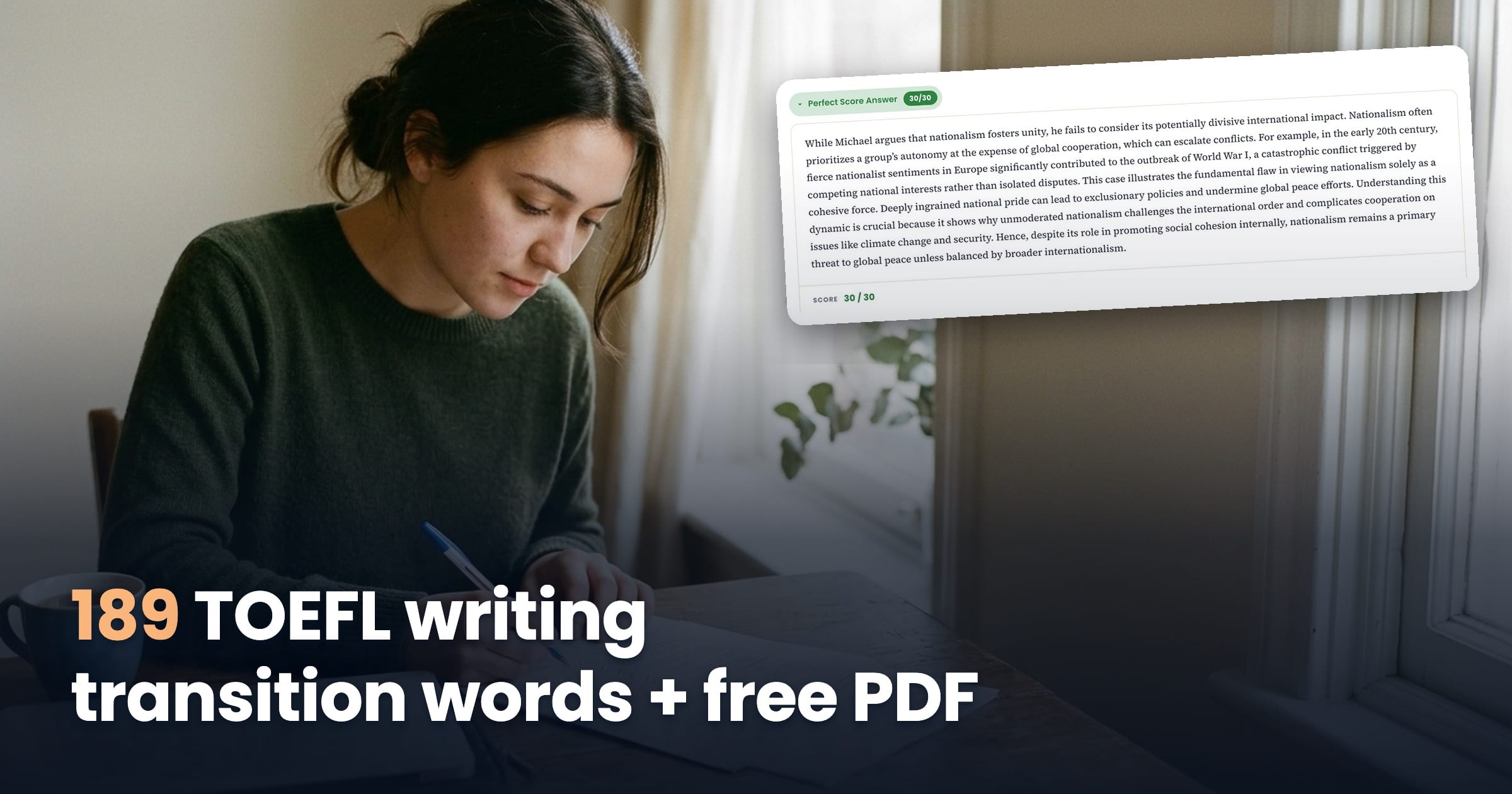
Transition words are the first thing most students memorize for TOEFL Writing. Moreover, Furthermore, In conclusion. So I counted them in 114 of our own model answers. In conclusion did not show up once.
This page collects 189 transition words and phrases you can use right away in the 2026 TOEFL Write an Email and Write for an Academic Discussion tasks, grouped into 14 sets. Each one comes with a note on how to use it and a test-style example, and the full list is also a printable PDF. Below the tables, you will also find what we counted in 114 of our model answers.
Get all 189 as a PDF
The same tables, laid out for A4 printing. Free, no sign-up.
189 transition words in 14 sets
Each set notes where it fits (Email, Academic Discussion, or both), and the examples use topics you could see on test day. Tap a set below to jump to it.
- Stating your position (14)
- Giving reasons (15)
- Explaining in more detail (14)
- Giving examples (14)
- Adding a point (14)
- Contrasting and conceding (16)
- Responding to classmates (14)
- Showing results (14)
- Comparing (10)
- Conditions and what-ifs (10)
- Adding emphasis (10)
- Ordering your points (12)
- Wrapping up (12)
- Email-only phrases (20)
Stating your position
Use in: Academic Discussion · 14 phrases
| Phrase | How to use it | Example |
|---|---|---|
| In my view, | Opens your main claim; more formal than I think | In my view, first-year students should be required to live on campus. |
| From my perspective, | Signals a personal angle on the issue | From my perspective, online classes work best for students who already have strong study habits. |
| I firmly believe that | Strong, clear position; good first sentence | I firmly believe that schools should teach basic financial skills. |
| I strongly agree that | Agreeing with the professor's statement | I strongly agree that cities should invest more in public transportation. |
| I am inclined to think that | Softer position when the issue is two-sided | I am inclined to think that a shorter school week would hurt younger students. |
| As far as I am concerned, | Personal stance, slightly formal | As far as I am concerned, the benefits of social media outweigh the risks. |
| It seems to me that | Cautious opinion | It seems to me that most students choose a major too early. |
| My position is that | Direct, academic statement of your side | My position is that homework should be optional in elementary school. |
| I would argue that | Makes a claim you will defend | I would argue that public libraries are more important now than ever. |
| I am convinced that | Confident claim | I am convinced that group projects prepare students for real jobs. |
| When it comes to | Narrows the topic before your opinion | When it comes to learning a language, daily practice matters more than talent. |
| Personally, | Short personal signal; use once | Personally, I prefer studying in a quiet library to studying at home. |
| I tend to agree with the idea that | Moderate agreement | I tend to agree with the idea that uniforms reduce peer pressure. |
| There is no doubt that | Introduces a point everyone accepts | There is no doubt that smartphones have changed how teenagers communicate. |
Giving reasons
Use in: Email · Academic Discussion · 15 phrases
| Phrase | How to use it | Example |
|---|---|---|
| This is mainly because | Explains the cause of the sentence before | Many students skip breakfast. This is mainly because their first class starts too early. |
| The main reason is that | Introduces your strongest reason | The main reason is that students learn faster when they teach each other. |
| The primary reason for this is | Formal version of the main reason | The primary reason for this is the high cost of living near campus. |
| One reason is that | First of several reasons | One reason is that remote work saves employees hours of commuting. |
| Another reason is that | Second reason, clean and safe | Another reason is that small classes allow more questions. |
| This is because | Basic cause signal | Some companies ban phones in meetings. This is because people stop listening. |
| due to | Followed by a noun phrase, not a clause | The event was canceled due to heavy rain. |
| owing to | Formal; followed by a noun | Owing to budget cuts, the library now closes at 6 p.m. |
| since | Reason the reader already accepts | Since most students work part-time, evening classes are very popular. |
| given that | Uses a known fact as a reason | Given that tuition keeps rising, students need more scholarship options. |
| in light of | Formal; reason based on new information | In light of the new research, the school changed its start time. |
| That is why | Links a reason back to your claim | Exercise improves focus. That is why I think schools need longer breaks. |
| for the simple reason that | Stresses that the reason is obvious | I support the policy for the simple reason that it saves time. |
| What makes this important is that | Raises the stakes of your reason | What makes this important is that habits formed in college often last for life. |
| I say this because | Natural bridge to a personal example | I say this because I saw the same problem in my own high school. |
Explaining in more detail
Use in: Academic Discussion · 14 phrases
| Phrase | How to use it | Example |
|---|---|---|
| In detail, | Opens a closer description of the point | In detail, the program pairs each new student with an older mentor for one semester. |
| To be more specific, | Moves from general to specific | To be more specific, students spend about two hours a day on social media. |
| In other words, | Restates the idea more simply | In other words, the rule protects students who cannot afford new devices. |
| That is to say, | Formal restatement | Teachers should be facilitators. That is to say, they should guide rather than lecture. |
| To put it another way, | Second angle on the same point | To put it another way, cheap food is not really cheap if it makes us sick. |
| What I mean is that | Clarifies your own sentence | What I mean is that students need time to rest, not just more classes. |
| More specifically, | Adds precise detail | More specifically, the app reminds users to review words they missed. |
| To elaborate, | Expands on the previous claim | To elaborate, part-time jobs teach time management in a way classes cannot. |
| Put simply, | Summarizes a complex idea in plain words | Put simply, the policy costs more than it saves. |
| This means that | Spells out the consequence of a fact | This means that students would lose their only chance to practice speaking. |
| In particular, | Focuses on one group or case | In particular, first-generation students benefit from extra advising. |
| Specifically, | Introduces a concrete fact | Specifically, the survey found that most users quit within a week. |
| Namely, | Names the exact items you meant | Two groups would benefit most, namely commuters and working parents. |
| The point is that | Brings the reader back to your core idea | The point is that technology should support teachers, not replace them. |
Giving examples
Use in: Email · Academic Discussion · 14 phrases
| Phrase | How to use it | Example |
|---|---|---|
| For example, | The default example signal | For example, my cousin learned to code entirely through free online courses. |
| For instance, | Same as for example; use to avoid repetition | For instance, many museums now offer free virtual tours. |
| To illustrate, | Introduces a longer example or scenario | To illustrate, a student who reads 20 minutes a day finishes about 15 books a year. |
| such as | Lists examples inside the sentence | Outdoor activities such as hiking and cycling reduce stress. |
| A good example of this is | Introduces one strong case | A good example of this is Finland, where students have very little homework. |
| Take ... as an example. | Puts a specific case in front | Take my high school as an example. It banned phones, and grades went up. |
| In my experience, | Personal evidence; strong in discussion posts | In my experience, study groups work only when someone sets clear goals. |
| When I was in high school, | Opens a short personal story | When I was in high school, our teacher let us choose our own project topics. |
| like | Informal such as; fine in short examples | Small changes, like turning off notifications, can improve focus. |
| including | Lists some members of a larger group | The club offers many activities, including weekend hikes and film nights. |
| Consider | Invites the reader to picture a case | Consider how much time students spend commuting to campus each week. |
| Imagine | Hypothetical example | Imagine a student who has to work 30 hours a week while studying full-time. |
| to name a few | Ends a short list | Cafes, libraries, and parks, to name a few, all offer free Wi-Fi now. |
| As an illustration, | Formal example signal | As an illustration, the city's bike-sharing program cut car trips by a noticeable amount. |
Adding a point
Use in: Email · Academic Discussion · 14 phrases
| Phrase | How to use it | Example |
|---|---|---|
| In addition, | Adds a new point of equal weight | In addition, living on campus makes it easier to join clubs. |
| Moreover, | Adds a stronger point | Moreover, the new schedule gives teachers more time to plan. |
| Furthermore, | Formal addition | Furthermore, online courses let students review lectures as often as they need. |
| Also, | Simple addition; fine in emails | Also, public transportation is better for the environment. |
| On top of that, | Conversational addition; good in emails | On top of that, the program is completely free for students. |
| Besides, | Informal; adds a supporting point | Besides, most students already own a laptop. |
| What is more, | Adds a surprising extra point | What is more, the library stays open until midnight during exams. |
| Not only ... but also | Two benefits in one sentence (note the inversion) | Not only does exercise improve health, but it also boosts concentration. |
| Along with | Adds a noun-phrase point | Along with lower costs, remote work offers more flexibility. |
| As well as | Joins two nouns or verbs | Tutors help with writing as well as with test preparation. |
| Another point to consider is | Introduces a new angle | Another point to consider is the cost of maintaining the new buildings. |
| Equally important, | Second point with the same weight | Equally important, students need someone to talk to when they struggle. |
| Additionally, | Formal; common in emails | Additionally, I would like to ask whether the deadline can be extended. |
| Not to mention | Adds an obvious extra point | The commute is long, not to mention expensive. |
Contrasting and conceding
Use in: Academic Discussion · 16 phrases
| Phrase | How to use it | Example |
|---|---|---|
| However, | Main contrast signal; start of a sentence | Some people think homework is useless. However, it builds discipline. |
| On the other hand, | Shows the other side of the same issue | Living alone is expensive. On the other hand, it teaches responsibility. |
| Although | Concession inside one sentence | Although online classes are flexible, many students feel isolated. |
| Even though | Stronger although | Even though the plan costs more, it will save money in the long run. |
| While | Concession at the start of a sentence | While technology helps, it cannot replace a good teacher. |
| Nevertheless, | Your point stands despite the problem | The rule is unpopular. Nevertheless, it keeps students safe. |
| Despite | Followed by a noun phrase | Despite the high cost, many families choose private tutoring. |
| In contrast, | Compares two different things | City schools have large classes. In contrast, rural schools are often very small. |
| Instead, | Offers an alternative | Schools should not ban phones. Instead, they should teach students to use them wisely. |
| Admittedly, | Concedes a weakness before defending | Admittedly, the policy will be difficult to enforce at first. |
| It is true that ..., but | Classic concession pattern | It is true that dorms are expensive, but they save students time and travel costs. |
| That being said, | Natural turn after a concession | Online learning is convenient. That being said, it requires strong self-control. |
| Even so, | Short concession | The new library is far from the dorms. Even so, students use it every day. |
| Rather than | Compares two choices and picks one | Rather than banning junk food, schools should offer healthier options. |
| Whereas | Contrasts two groups in one sentence | Some students like group work, whereas others prefer to study alone. |
| Conversely, | Formal reversal | Strict rules can reduce cheating. Conversely, they can also reduce trust. |
Responding to classmates
Use in: Academic Discussion · 14 phrases
| Phrase | How to use it | Example |
|---|---|---|
| I agree with ... that | Names the classmate and the exact idea | I agree with Kelly that living on campus helps students make friends. |
| I understand ...'s point about ..., but | Polite disagreement; very common opener | I understand Andrew's point about cost, but the benefits are worth it. |
| While ... makes a good point, | Respectful concession before your view | While Maria makes a good point about safety, I think the rule goes too far. |
| Building on ...'s idea, | Adds to a classmate instead of repeating | Building on Daniel's idea, schools could also offer weekend workshops. |
| ... raises an interesting point, but | Acknowledges, then pivots | Emily raises an interesting point, but she overlooks the cost to taxpayers. |
| I see where ... is coming from, but | Natural, friendly disagreement | I see where Jason is coming from, but not every student can afford a laptop. |
| Unlike ..., I believe that | Clear opposite position | Unlike Sarah, I believe that exams are still the fairest way to measure learning. |
| I partly agree with ..., but | Middle position | I partly agree with Tom, but I think the rule should apply only to younger students. |
| Like ..., I think | Short agreement, then add your own reason | Like Kevin, I think teachers should give fewer but better assignments. |
| ... overlooks the fact that | Points out a gap in the argument | Andrew overlooks the fact that many dorms offer financial aid. |
| What ... does not mention is | Adds what the classmate missed | What Lisa does not mention is how long the training would take. |
| To add to ...'s argument, | Supports and extends | To add to Chris's argument, smaller classes also reduce noise and stress. |
| I would go further than ... and say | Takes the classmate's idea further | I would go further than Anna and say that the policy should be national. |
| Both ... and ... make valid points, but | Acknowledges both posts at once | Both Kelly and Andrew make valid points, but I lean toward Kelly's side. |
Showing results
Use in: Email · Academic Discussion · 14 phrases
| Phrase | How to use it | Example |
|---|---|---|
| As a result, | Most common result signal | The cafeteria added healthy options. As a result, fewer students eat off campus. |
| Therefore, | Logical conclusion | The bus is often late. Therefore, students should be allowed some flexibility. |
| Consequently, | Formal result | Prices rose sharply. Consequently, many students moved back home. |
| Thus, | Formal, compact | The test is shorter. Thus, students have less time to recover from mistakes. |
| As a consequence, | Often a negative result | As a consequence, the city had to close two libraries. |
| This leads to | Cause to effect inside one sentence | Less sleep leads to lower grades and more stress. |
| This results in | Formal cause and effect | Skipping practice results in slower progress. |
| Because of this, | Plain result signal | Because of this, many students never ask for help. |
| For this reason, | Turns your reason into a conclusion | For this reason, I think the school should keep the program. |
| so | Simple; joins two clauses | The library was full, so we studied in a cafe. |
| Hence, | Very formal; use sparingly | The data is incomplete. Hence, the conclusion may be wrong. |
| which means that | Adds a result to the same sentence | The deadline moved up, which means that we have only two days left. |
| In turn, | Chain of effects | Better sleep improves focus, and focus, in turn, improves grades. |
| As a result of | Followed by a noun | As a result of the new policy, attendance went up. |
Comparing
Use in: Academic Discussion · 10 phrases
| Phrase | How to use it | Example |
|---|---|---|
| Similarly, | Shows two things work the same way | Libraries offer quiet space. Similarly, study cafes give students a place to focus. |
| Likewise, | Formal similarly | Teachers need feedback. Likewise, students need clear goals. |
| In the same way, | Parallel example | In the same way, companies benefit when workers rest. |
| Compared to | Compares with a reference point | Compared to ten years ago, students today read far fewer printed books. |
| Just as ..., so | Elegant comparison | Just as athletes need rest, so do students before exams. |
| Unlike | Contrast between two things | Unlike traditional classes, online courses can be taken at any time. |
| much more ... than | Strong comparison | Group study is much more effective than studying alone for some subjects. |
| By comparison, | Puts a second item next to the first | Bikes are cheap to maintain. By comparison, cars cost thousands each year. |
| the same is true of | Extends a claim to another case | Exercise improves mood, and the same is true of spending time outdoors. |
| is far better than | Clear preference | Learning by doing is far better than memorizing rules. |
Conditions and what-ifs
Use in: Academic Discussion · 10 phrases
| Phrase | How to use it | Example |
|---|---|---|
| If ..., then | Clear condition and result | If schools start later, then students will sleep more. |
| Unless | Negative condition | Unless the city adds more buses, traffic will keep getting worse. |
| As long as | Condition for something to be allowed | Phones are fine in class as long as students use them for research. |
| Provided that | Formal as long as | Remote work can succeed, provided that teams meet regularly. |
| Otherwise, | Shows the bad result if not done | Students need breaks. Otherwise, they lose focus quickly. |
| In that case, | Follows up a situation | Some students cannot attend in person. In that case, recorded lectures help. |
| Without | Shows what is needed | Without clear rules, group projects become unfair. |
| If this happens, | Predicts a consequence | Funding may be cut. If this happens, the program will close. |
| Even if | Result stays true in any case | Even if the course is optional, most students would take it. |
| Suppose that | Sets up a hypothetical | Suppose that every student had a personal tutor. Grades would rise quickly. |
Adding emphasis
Use in: Academic Discussion · 10 phrases
| Phrase | How to use it | Example |
|---|---|---|
| Indeed, | Confirms and strengthens the last point | Sleep matters. Indeed, it may matter more than extra study hours. |
| In fact, | Adds a surprising true fact | Many people think cycling is slow. In fact, it is often faster in city traffic. |
| Above all, | Marks your most important point | Above all, students need teachers who believe in them. |
| Most importantly, | Strongest point in a list | Most importantly, the policy protects students' mental health. |
| Clearly, | Signals an obvious conclusion | Clearly, the old system is not working. |
| Obviously, | Use with care; can sound dismissive | Obviously, no single rule will solve the problem. |
| It is worth noting that | Highlights a useful fact | It is worth noting that the program is already used in several countries. |
| Especially | Narrows emphasis to a group | Especially for younger students, routine is very important. |
| Undoubtedly, | Confident statement | Undoubtedly, the internet has made research easier. |
| The key point is that | Focuses the reader on one idea | The key point is that students learn best when they are curious. |
Ordering your points
Use in: Email · Academic Discussion · 12 phrases
| Phrase | How to use it | Example |
|---|---|---|
| First of all, | Opens the first point | First of all, I want to thank you for your quick reply. |
| To begin with, | Starts a list of reasons | To begin with, uniforms save families money. |
| Firstly, / Secondly, | Numbered reasons | Firstly, the plan is cheap. Secondly, it is easy to start. |
| Next, | Moves to the next item; emails | Next, I would like to ask about the meeting time. |
| Then, | Time order | We could meet at the library. Then, we could go to the lab together. |
| After that, | Time order in plans | After that, I will send you the final draft. |
| Finally, | Last item in a list | Finally, I would appreciate it if you could confirm the date. |
| Lastly, | Last point; same as finally | Lastly, the program builds confidence. |
| To start with, | Casual first point | To start with, the room is too small for our group. |
| At the same time, | Two things true together | At the same time, we should listen to students' concerns. |
| Meanwhile, | Parallel actions | I will finish the slides. Meanwhile, could you check the data? |
| Before that, | Earlier step | Before that, I need to finish my lab report. |
Wrapping up
Use in: Academic Discussion · 12 phrases
| Phrase | How to use it | Example |
|---|---|---|
| Overall, | Short wrap-up that fits a 100-word post | Overall, the benefits of the program clearly outweigh the costs. |
| For these reasons, | Ties your reasons to your position | For these reasons, I support Kelly's view. |
| That is why I believe | Restates your claim after the reason | That is why I believe schools should start later. |
| All things considered, | Balanced final judgment | All things considered, online learning is a good option for adults. |
| In the end, | Final takeaway | In the end, the choice should belong to the students. |
| Ultimately, | Deepest or final point | Ultimately, a good teacher matters more than any technology. |
| To sum up, | Summary of points; use only if space allows | To sum up, uniforms save money and reduce pressure. |
| In short, | Quick one-line summary | In short, the plan is cheap, fast, and fair. |
| In conclusion, | Classic, but heavy for a 100-word post | In conclusion, I believe the city should invest in bike lanes. |
| This is why | Conversational wrap-up | This is why I would choose the second option. |
| On balance, | Weighs both sides before deciding | On balance, the rule does more good than harm. |
| Taking everything into account, | Formal final judgment | Taking everything into account, I would support the proposal. |
Email-only phrases
Use in: Email · 20 phrases
| Phrase | How to use it | Example |
|---|---|---|
| I am writing to | States the purpose in the first line | I am writing to ask about the summer research program. |
| I am writing about | Names the topic right away | I am writing about a used textbook I bought last week. |
| I hope this message finds you well. | Polite opener; optional, costs words | Dear Professor Kim, I hope this message finds you well. |
| I would like to | Polite request or intention | I would like to request a short extension on my essay. |
| Could you please | Standard polite request | Could you please tell me when the office opens? |
| Would it be possible to | Very polite request | Would it be possible to move our meeting to Friday? |
| I would appreciate it if you could | Formal request | I would appreciate it if you could send me the reading list. |
| Unfortunately, | Introduces a problem politely | Unfortunately, I will not be able to attend the meeting on Monday. |
| The problem is that | Names the issue clearly | The problem is that the heater in my room stopped working. |
| As you may know, | Shared background | As you may know, the project is due next Friday. |
| I was wondering if | Soft question | I was wondering if there are any spots left in the workshop. |
| In addition to this, | Adds a second request | In addition to this, I would like to know the total cost. |
| As a result of this, | Explains the impact of a problem | As a result of this, I missed the first two classes. |
| I would be happy to | Offers help | I would be happy to help with the event setup. |
| Please let me know if | Standard closing line | Please let me know if you need any more information. |
| Thank you for | Thanks for something specific | Thank you for your help with my application. |
| I look forward to | Closing line; followed by -ing | I look forward to hearing from you. |
| Thank you in advance for | Closing before a request is answered | Thank you in advance for your time. |
| If it is not too much trouble, | Softens a request | If it is not too much trouble, could you check my registration? |
| I apologize for | Apology in emails | I apologize for the short notice. |
All in one answer
Here is a response to a discussion question on requiring first-year students to live on campus, using five phrases from the tables. The transitions have a blue wavy underline. I packed in more than usual to show them; on test day, keeping three of these would be plenty.
Academic Discussion sample response
I understand Andrew’s point about cost, but I agree with Kelly that first-year students should live on campus. The main reason is that the first year is when students build their study habits. In detail, a student in a dorm can join a late study group or ask a classmate for help within five minutes, while a student who commutes for an hour usually goes straight home. While dorms are expensive, many universities offer housing aid to students who need it, so cost alone should not decide the rule. For these reasons, I believe requiring one year on campus helps students more than it hurts them.
No In conclusion, and the counterargument is handled with a single While inside the sentence. The opening line, which names a classmate, comes from the ‘Responding to classmates’ set.
What 114 model answers actually use
We pulled every Email and Academic Discussion model answer from the testpracticelab writing practice sets and full tests: 55 written to a top-score standard and 59 strong answers one level below, 12,783 words in total. Then we counted how often each of the 189 phrases below appears.
These are answers we wrote ourselves, not ETS-scored essays. Still, they show how writing a teacher marks as "full score" connects ideas differently from writing marked "good, but one step down."
Source: 114 Email and Academic Discussion model answers from 20 testpracticelab writing sample sets and 12 full tests (duplicates removed). Words like so, like and also were left out of the count because they are used more often in other senses.
How to use this list
- Three to five per answer is enough. Top answers average about two per 100 words, so a 150-word discussion post lands around three. A transition on every sentence reads as mechanical.
- Learn the in-sentence ones first. While, Although, Rather than and which means that join two ideas in one sentence. This is where top and strong answers differed most.
- Do not end a discussion post with In conclusion. A post of about 150 words has no room for a separate conclusion. One sentence that starts with Overall or For these reasons does the job.
- The email set can be used as is. Polite requests are supposed to sound familiar. Just keep greetings like I hope this message finds you well to one, since they cost words.
Get all 189 as a PDF
The same tables, laid out for A4 printing. Free, no sign-up.
Pick two today
You do not need all 189. Pick two from one set and use them on a real question today. Work through an Email or Discussion task in our free TOEFL writing practice sets, then put the model answer next to yours and compare the transitions. The difference shows up fast.
For how each task works, see the Academic Discussion guide and the Write an Email guide. If you want a frame to memorize, the Academic Discussion templates article covers that.