TOEFL Academic Discussion: Where a 5 and a 3 Split

In ETS's scoring guide, a 5 is a response with well-elaborated explanations, examples, and details, and a 3 is one where part of an explanation, example, or detail is missing, unclear, or irrelevant. The dividing line isn't grammar. It's how far you develop your thinking. This article reads Write for an Academic Discussion through the official guide, adds a comparison of 30 of testpracticelab's model answers, and adds what I've seen in 12 years of teaching, so you know what to prepare and how.
What the official sources say
- Time: 10 minutes.
- Length: no maximum, and a good response is usually at least 100 words.
- Score: 0 to 5 per task.
- Three criteria: relevant and clearly developed ideas, variety in language use, and correct language. Minor errors typical of timed writing are acceptable.
(Sources: ETS's official Write for an Academic Discussion description and Writing Scoring Guide)
Below is the real screen: one professor's question and two students' posts, then you write yours. In the worked examples under each tip, a wavy underline marks the better version and a strikethrough marks what to avoid.
1. The real screen and the scoring guide
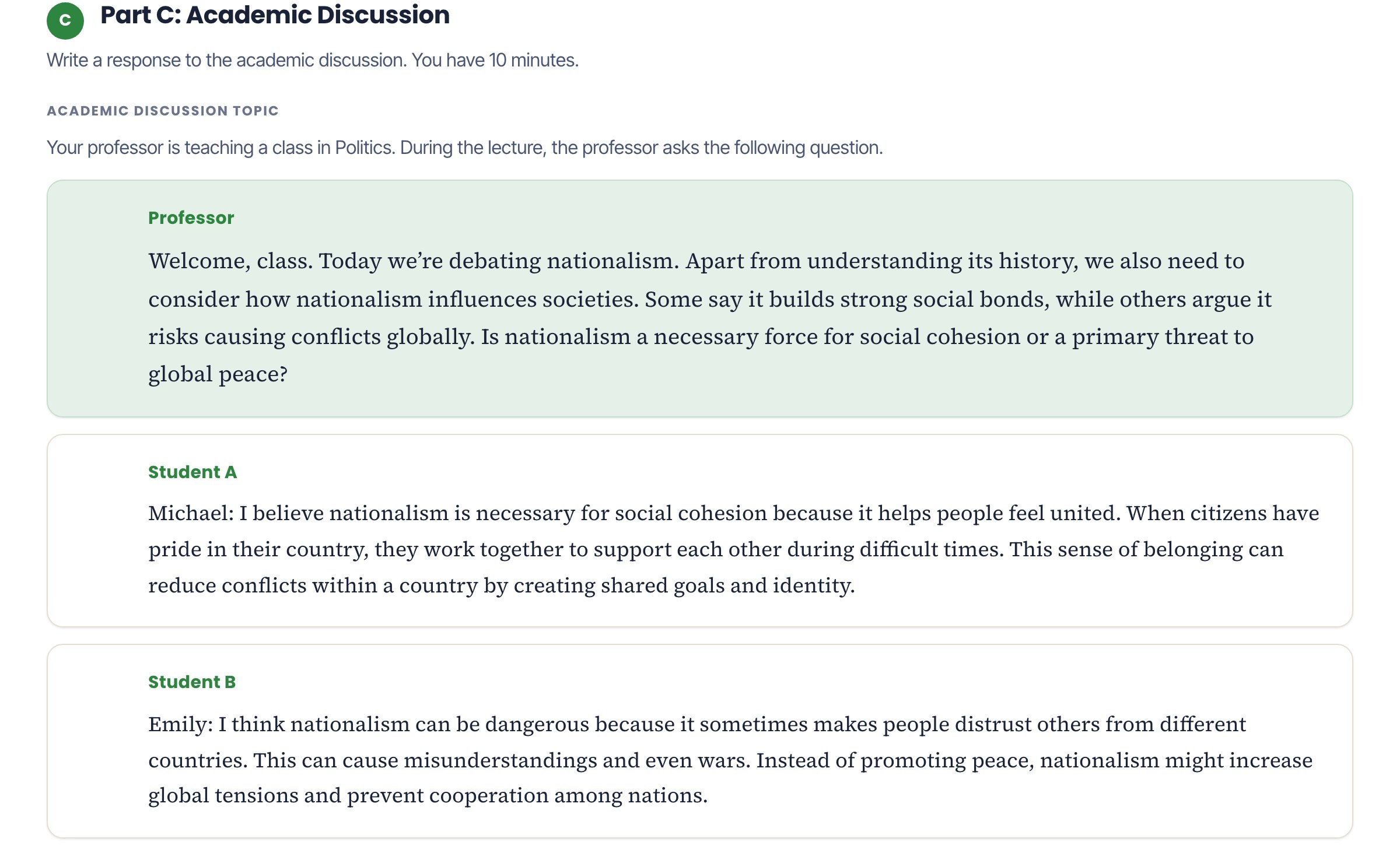
- 5: a relevant contribution with well-elaborated explanations, examples, and details, a variety of sentence structures, and precise word choice.
- 4: a relevant contribution with adequately elaborated explanations, examples, and details.
- 3: mostly relevant and understandable, but part of an explanation, example, or detail is missing, unclear, or irrelevant.
- The description of a 1 includes coherent language that is mostly borrowed from the stimulus. Copying the students' posts earns no credit.
- Even a 5 allows the kind of typos a competent writer makes under time pressure. The requirement isn't perfect grammar. It's an idea developed all the way through.
2. What 30 of our model answers show
- testpracticelab's 15 writing sample sets each have one top answer and one lower answer for the same question, 30 in total. I counted them myself. This compares our model answers and is not an official scoring result. Our model answers are labeled out of 30, while ETS's raw score per task is 0 to 5.
| Top answers (Perfect) | Lower answers (High) | |
|---|---|---|
| Length (median) | 120 words | 79 words |
| Sentences (median) | 6 | 6 |
| First sentence only names a student ("I agree with Lily.") | 0 / 15 | 5 / 15 |
| Evidence citing a real event, country, or company | 7 / 15 | 0 / 15 |
| Example introduced with "For example" or "For instance" | 5 / 15 | 10 / 15 |
| First sentence follows the "While X argues..., he fails to..." formula | 10 / 15 | 0 / 15 |
The sentence count is the same but the word count isn't. Top answers use longer sentences and pack the reason and the consequence into one sentence. Lower answers used "For example" more often (10 of 15), but what followed was usually a generic situation, like a national holiday celebration or "students can...". What separates them is how specific the example is, not how many there are.
3. One question, two answers, taken apart
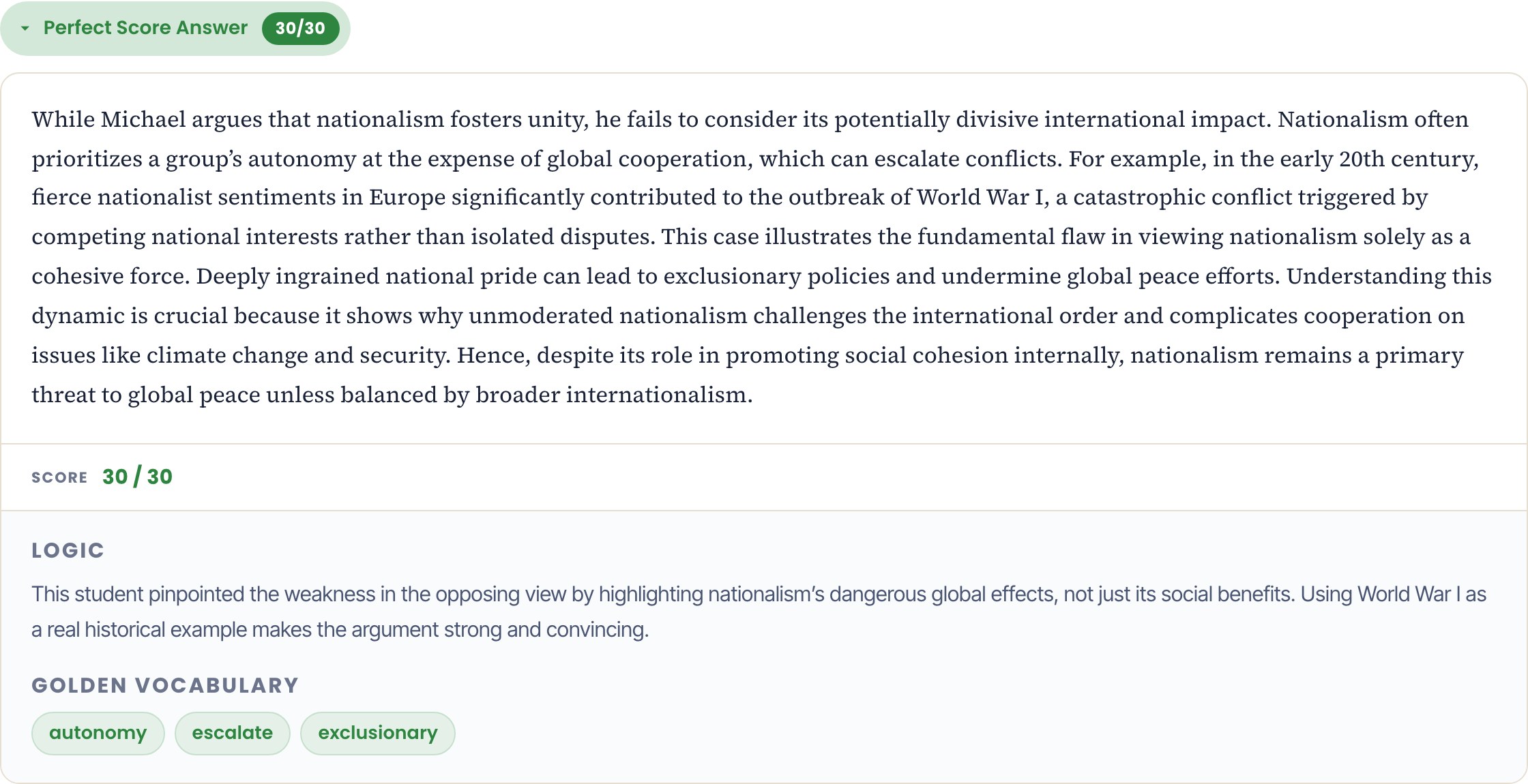
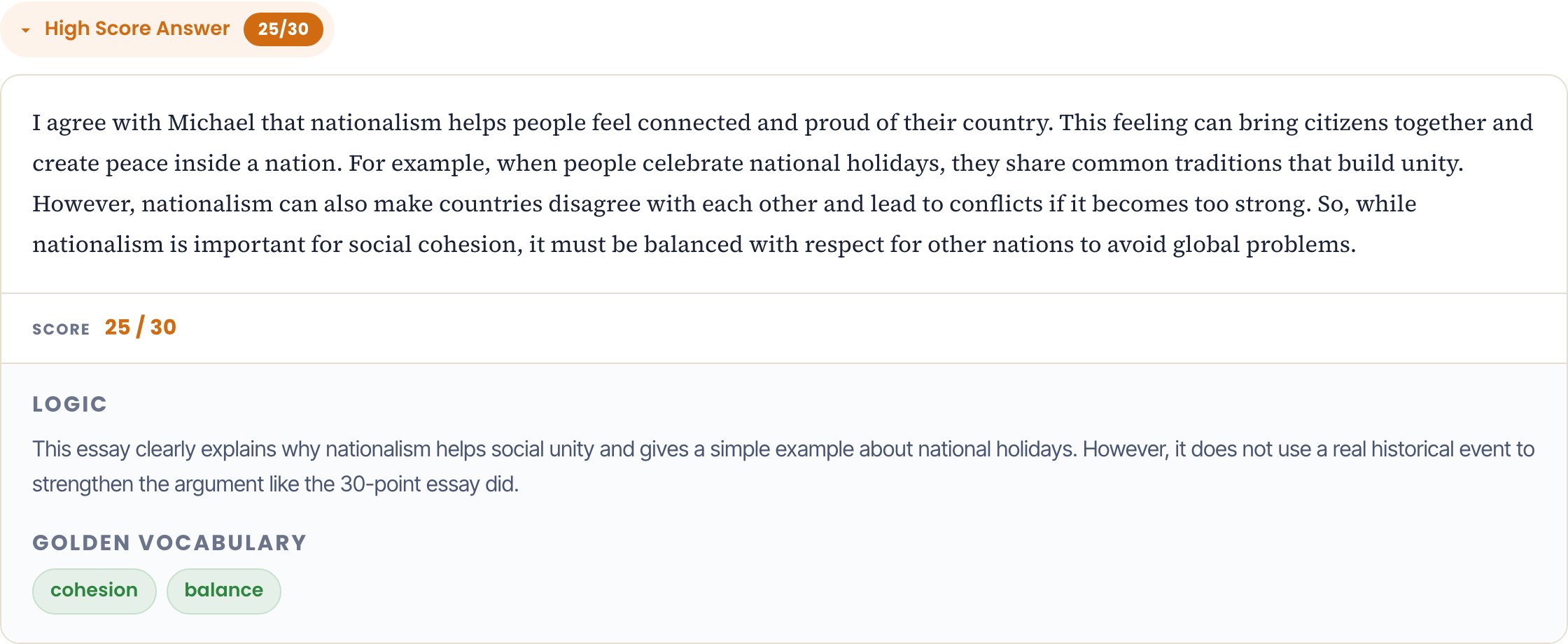
- The question was whether nationalism is a necessary force for social cohesion or a primary threat to global peace. The student Michael said it is necessary and Emily said it is dangerous.
- The lower answer (about 80 words) opens with "I agree with Michael...", gives national holiday celebrations as an example, and ends with "it must be balanced." No sentence is wrong, but the example doesn't hold the claim up.
- The top answer (about 140 words) restates Michael's claim in one sentence, points to where it falls short, builds its evidence on a real event, World War I, and then develops what the problem is.
State your position and your reason in the first sentence
Don't stop at "I agree with Lily." Attach the reason in the same sentence. In our data, a first sentence that only names a student appeared only in the lower answers.
I agree with Lily.
It only names a student. There's no reason.
I agree with Lily that schools should require uniforms, mainly because they reduce pressure on students.
It gives the position and the reason in the same sentence.
Write it in three beats: reason, evidence, so what
For every claim, write one unit of "why it holds, what shows it, and what changes because of it." That unit is what the scoring guide calls elaboration.
Support your point with a named event or a specific case
Instead of a hypothetical like "students can...", a case you can check, such as an event, a country, or a study, makes that sentence hold up the claim. If nothing comes to mind, picture the most specific situation you can and write that.
For example, when people celebrate national holidays, they share common traditions.
The example doesn't hold the claim up.
fierce nationalist sentiments in Europe significantly contributed to the outbreak of World War I
A named, real event carries the evidence.
Don't copy the students' posts; restate them in one sentence of your own
The scoring guide's description of a 1 is language borrowed from the stimulus. Don't copy a student's sentence. Summarize it in one sentence in your own words, then respond.
Michael says that nationalism helps people feel united.
Nearly identical to the student's sentence.
Michael treats national pride as a glue for cooperation.
One sentence in your own words.
4. The real reason after 12 years of teaching: it's reasoning, not vocabulary
- Most students think good vocabulary earns the score. But the low scores I've seen are rarely about words. You have to think about how to aim what you mean and what you intend to say as precisely as you can, and the good words follow.
- In practice, many students' reasoning is stuck at an elementary school level. They leave claims that are easy to rebut as they are and try to swap in different words, and the writing gets awkward. Reasoning needs to reach high school and university level.
Fix what can be rebutted before you change words
After you write a claim, first ask who could argue against this sentence. If something rebuttable remains, fancier words won't stop the writing from feeling awkward. Make the reasoning one step more concrete first.
Public schools are bad because students feel bored.
Elementary-level reasoning. Easy to rebut.
Public schools are detrimental because students experience tedium.
Only the words changed. The reasoning is the same, so it reads awkwardly.
A fixed curriculum cannot adjust to each student's pace, so fast learners stall and slow learners fall behind.
The reason is specific, so the words follow naturally.
5. Are templates worth it? Only right before the test
- Among the students I've taught, those who memorized templates scored roughly 2 to 3 points higher than those who didn't. So I do recommend memorizing a template right before the test.
- In our model answers, 10 of the 15 top answers also opened with the "While X argues..., he fails to consider..." formula. It's a safe frame, that much is true.
- But while you're studying, it's better not to memorize templates. A template is just where the first sentence starts. It raises your floor, but reasoning sets your ceiling. (The official criteria include variety in language use, but there's no official basis for saying templates are penalized.)
Sort out templates one or two weeks before the test
While you're studying, spend your time on reasoning practice, and one or two weeks before the test, settle on two or three first-sentence frames. On the day, use a frame only as a starting point and put your effort into the three sentences that follow.
6. How to build reasoning
- For all-around English learning, the first thing is to research without a time limit and without AI, and develop your own writing as you go.
Research on your own, without a time limit and without AI
Pick a topic, look things up on Google, and watch YouTube to see how other people think about it. If you copy down an answer an AI organized for you, your own thinking doesn't grow. Developing your writing while looking at different opinions yourself is the best training.
Split one topic into individual, company, and government views
Even a single topic looks different from an individual's view, a company's view, and a government's view. Weaker or younger students don't grasp the difference and can't work it into their writing. Learn the views first and the kinds of evidence you can use multiply.
Individual: personal time, health, freedom of choice
Company: productivity, cost, keeping talent
Government: labor policy, tax revenue, public services
Sample topic: a four-day work week. A different viewpoint means a different kind of evidence.
Train with our Academic Discussion practice sets
To turn the views you researched into writing right away, practice in the real question format. Work an Academic Discussion question on testpracticelab and compare a top answer with your own on length, first sentence, and how specific the evidence is.
Time management
Go past 100 words and split the 10 minutes into three parts
ETS says a good response is usually at least 100 words. The median of our top answers was 120. The time split is our suggestion: the first 2 minutes to read and pick a position, 6 to write, and the last 2 to strengthen evidence and check typos.
Start practicing today
What splits the scores isn't fancy words but how precisely you can lay out your thinking so that it can't easily be rebutted. Bring a template right before the test, and until then, build your reasoning.
The screens in this article come from testpracticelab's free TOEFL Writing sample sets. Set a 10-minute timer, write one, and compare your writing with the top answer using the items in the table above. The frames worth memorizing right before the test are in the next article.