TOEFL Academic Discussion Templates: Memorize the Frame, Leave the Content Blank

In the previous article (Where a 5 and a 3 Split), I said to memorize a template only right before the test. This article answers the next question: what should you memorize? Most template articles list generic sentences like "In my opinion, I agree with...". This one is different. I read the top 15 of testpracticelab's model answers one by one and worked out which frames they were actually written in. Two frames came out. Below: which frame to use for which question, how to handle the other student's post, and what to memorize right before the test.
First: these frames are not official templates
- ETS has not set any template. The official criteria are relevant and clearly developed ideas, variety in language use, and correct language.
- The frames below were pulled from our top 15 model answers. They are patterns in our answers, not official scoring results.
- A template raises your floor, but the content sets your ceiling. So memorize the frame (the blanks), not the sentences, and fill in new content every time.
(Sources: ETS's official Write for an Academic Discussion description and Writing Scoring Guide; a full check of the top model answers in testpracticelab's 15 writing sample sets)
Below is the real screen: one professor's question and two students' posts, then you write yours. In the worked examples under each item, a wavy underline marks the better version and a strikethrough marks what to avoid.
1. The top 15 answers split into two frames
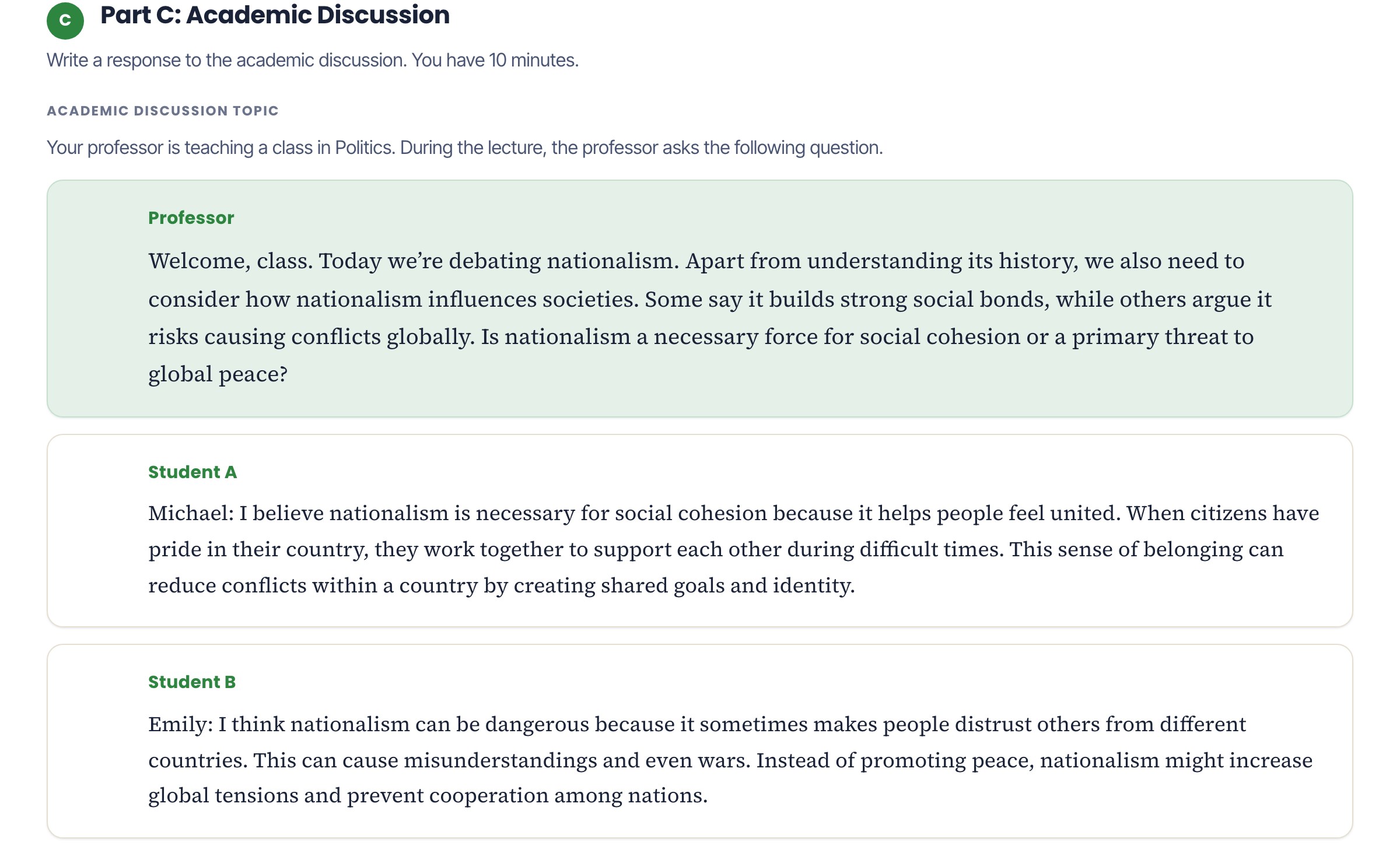
- This is an observation from our sets, not the distribution of questions on the real test.
- The 3 short answers in Frame B are shorter than ETS's "a good response is usually at least 100 words", so I didn't use them as models.
| Frame A: experience | Frame B: principle and case | |
|---|---|---|
| Answers | 5 | 10 |
| Questions they appeared in | Everyday and preference topics: uniforms, part-time jobs, friends, allowance, school food | Policy and social topics: nationalism, tariffs, wealth tax, world government, AI liability, remote work, four-day week |
| First sentence | "I agree with X that ..., because ..." | "While X argues ..., he fails to consider ..." |
| Evidence | One piece of my own experience | A principle, then a named real case (7 of 10) |
| The other student | Acknowledged, then rebutted with However | Named in the first sentence as the target |
| Length | 118 to 124 words | 128 to 140 words (5 answers), 46 to 61 words (3 answers) |
2. Frame A: experience
- It appeared in questions about everyday life and preferences (should students wear uniforms, should teenagers have part-time jobs). It has five blanks.
The five slots of Frame A
Position and reason, one piece of my experience, what the experience shows, acknowledge the other student and rebut, and a closing line. Fill each blank with content for your own topic.
I agree with Lily that schools should require uniforms, mainly because they reduce pressure on students.
Slot 1: position and reason in one sentence.
When I was in middle school, we could wear our own clothes, and many of my classmates worried about having the newest sneakers or brand-name jackets.
Slot 2: one piece of experience.
Marcus makes a fair point that clothes help young people show their personality. However, students still have many other ways to express themselves, such as their hairstyle, their backpack, or the clubs they join.
Slot 4: acknowledge, then rebut with a specific alternative.
3. Frame B: principle and case
- It appeared in questions about policy and social issues (tariffs, wealth taxes, remote work). It has five blanks.
- In our top Frame B answers, expressions like fundamental, mechanism, facilitate, and paradigm shift repeated across several answers. If you memorize the wording too, you could lose out on the variety criterion, so memorize the frame only and choose the words as you go.
The five slots of Frame B
Name the other student and the gap, explain the principle, give a named case, say what the case shows, and conclude. Choose a case you could check, such as an event, a country, or a study.
While Michael argues that nationalism fosters unity, he fails to consider its potentially divisive international impact.
Slot 1: name the other student and point out what's missing.
For example, in the early 20th century, fierce nationalist sentiments in Europe significantly contributed to the outbreak of World War I
Slot 3: a named real event.
This case illustrates the fundamental flaw in viewing nationalism solely as a cohesive force.
Slot 4: tie the case to the claim.
4. Which frame for which question
- If your own experience can back up the answer (school rules, friends, allowance, part-time jobs), use Frame A. One piece of experience is the most specific evidence you can give.
- If the question is about social systems or policy (taxes, trade, regulation, ways of working), use Frame B. Your own experience is weak evidence there, and a named case holds the claim up.
- If either could work, start with Frame A and swap the evidence for a case. Don't force the "While X argues..." opener of Frame B.
Read the question and pick a frame within 2 minutes
During the reading time, first ask whether your own experience can back up your answer. If it can, use A. If not, see whether a social case comes to mind and use B.
5. How to treat the other student's post
- One of the clearest differences between the lower and top answers was here. On the 5 everyday-topic questions, all 5 lower answers dismissed the other student in a single clause. All 5 top answers acknowledged the other student's point and then rebutted it with a specific alternative. (An observation from 5 pairs in our sets.)
Acknowledge the other student's strongest point first, then rebut
Don't dismiss the other student in one clause. Acknowledge their strongest point first, then rebut it with a specific alternative. Acknowledging makes your rebuttal more believable.
Marcus says clothes show personality, but I think school is a place for studying, not for fashion.
Dismisses the other claim in one clause. No reason.
Marcus makes a fair point that clothes help young people show their personality. However, students still have many other ways to express themselves.
Acknowledges, then rebuts with a specific alternative.
6. When to memorize, when to let go
- Among the students I've taught, those who memorized templates scored roughly 2 to 3 points higher than those who didn't. But if you lean on a frame throughout your studies, your reasoning doesn't grow.
Split what you memorize by stage
While studying, write without a frame. One or two weeks before the test, settle the slot order. The day before, fill the slots with one practice question. On test day, pick a frame during the reading time, jot a short note in slot order, then write.
Start practicing today
A template is a frame, not sentences. The slot order stays the same when the question changes, and you fill the slots with new content every time. That content comes from reasoning in the end.
You can see both frames in testpracticelab's free TOEFL Writing sample sets. Pick a set, start a 10-minute timer, read the question, decide whether Frame A or B fits, and write by filling the slots. The scoring criteria and the data analysis are in the previous article.