TOEFL Write an Email: You Covered All Three Bullets. Why Only a 4?
I once scored a practice email to calibrate our grading. It was 112 words long, it covered all three bullets, and the grammar was nearly clean. I gave it a 4. My note said: "Structure and length are fine, but the story doesn't hook. Vocabulary is too safe."
A 41-word answer to the same situation got a 1.5. Explaining the gap between those two is easy. Explaining the gap between a 4 and a 5 is much harder, and that's what this article is about.
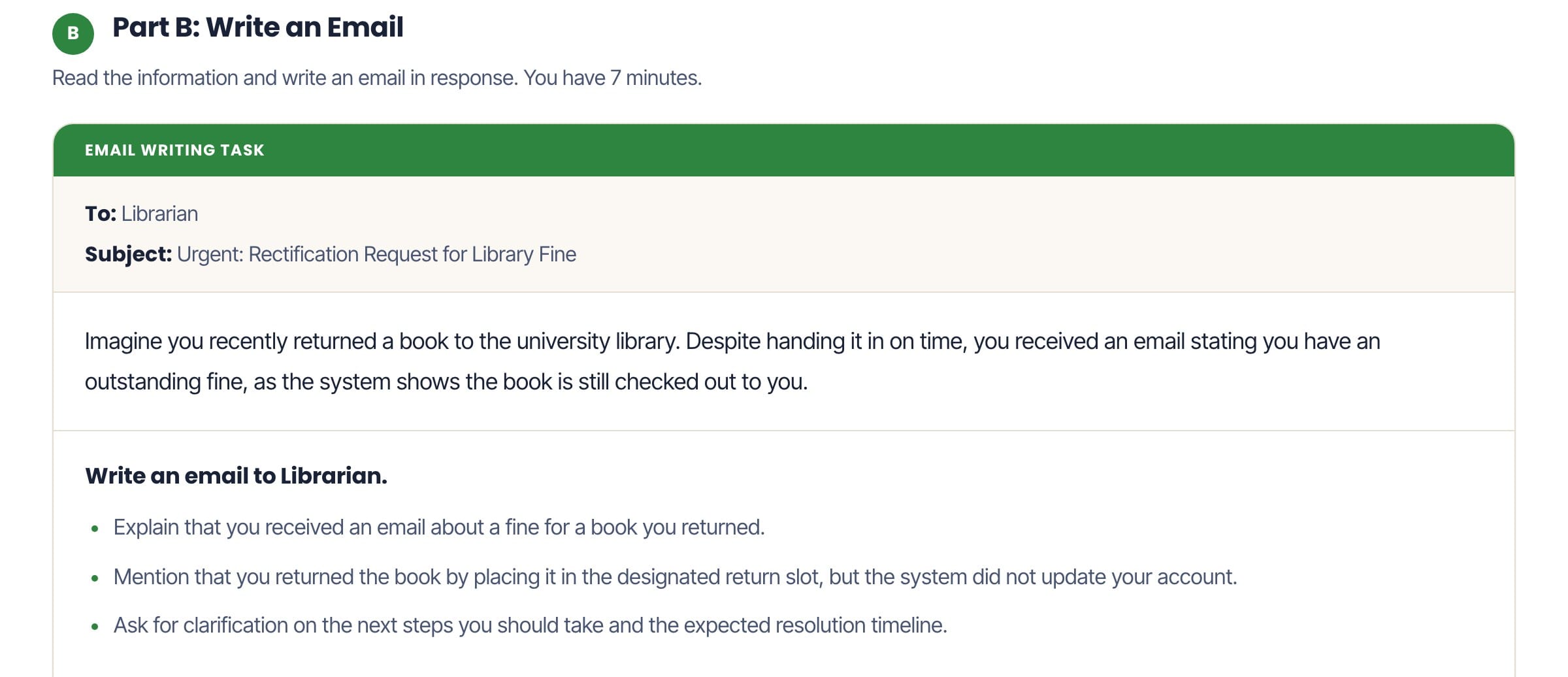
What the task looks like
- Time: 7 minutes
- Screen: a recipient, a subject line, one paragraph describing the situation, and three bullet points telling you what to include
- Score: 0 to 5
The ETS Writing Scoring Guide describes a 5 in three parts: elaboration that effectively supports the purpose of the email, syntactic variety with precise, idiomatic word choice, and consistent social conventions such as politeness, register, and the way you make requests or refusals. A 4 has the same items at an "adequate" level. Following the bullets is only the starting line. The 4 and the 5 split on how specific you get and how you sound.
The three bullets come in a fixed order
We pulled the 25 email tasks on testpracticelab (13 from the writing sample tests, 12 from our full tests) and looked only at the bullet points.
| Item | Count across 25 tasks |
|---|---|
| First bullet | Mostly describes the situation (Explain / Describe / Thank) |
| Last bullet asks for a request, suggestion, or next step | 24 |
| Also asks what you'll do if it doesn't work out | 5 (all higher-level tasks) |
| Recipient is a friend | 2 (the rest are professors, librarians, office staff, and so on) |
(Source: 25 testpracticelab email tasks, duplicates removed)
The order is almost always what happened → the details → what you want them to do. The last bullet is the reason the email exists. The first two are the material that makes the request convincing. Since most recipients are senior to you or represent an office, the default tone is a polite work email.
Add one thing to every bullet
Here is what our 30/30 answer and our 25/30 answer wrote for each bullet of the same prompt (a library fine charged by mistake).
| Bullet | 25/30 answer | 30/30 answer |
|---|---|---|
| 1. You got an email about a fine | a library fine for a book I actually returned | an incorrect library fine applied to my account |
| 2. You used the return slot, but the system didn't update | the return slot last Monday | March 10th, “Modern Economics”, the return slot at the entrance, on the due date |
| 3. Ask about next steps and the timeline | what I should do ... when I can expect it to be resolved | the procedures for resolving this issue and the anticipated timeline for clearing the fine |
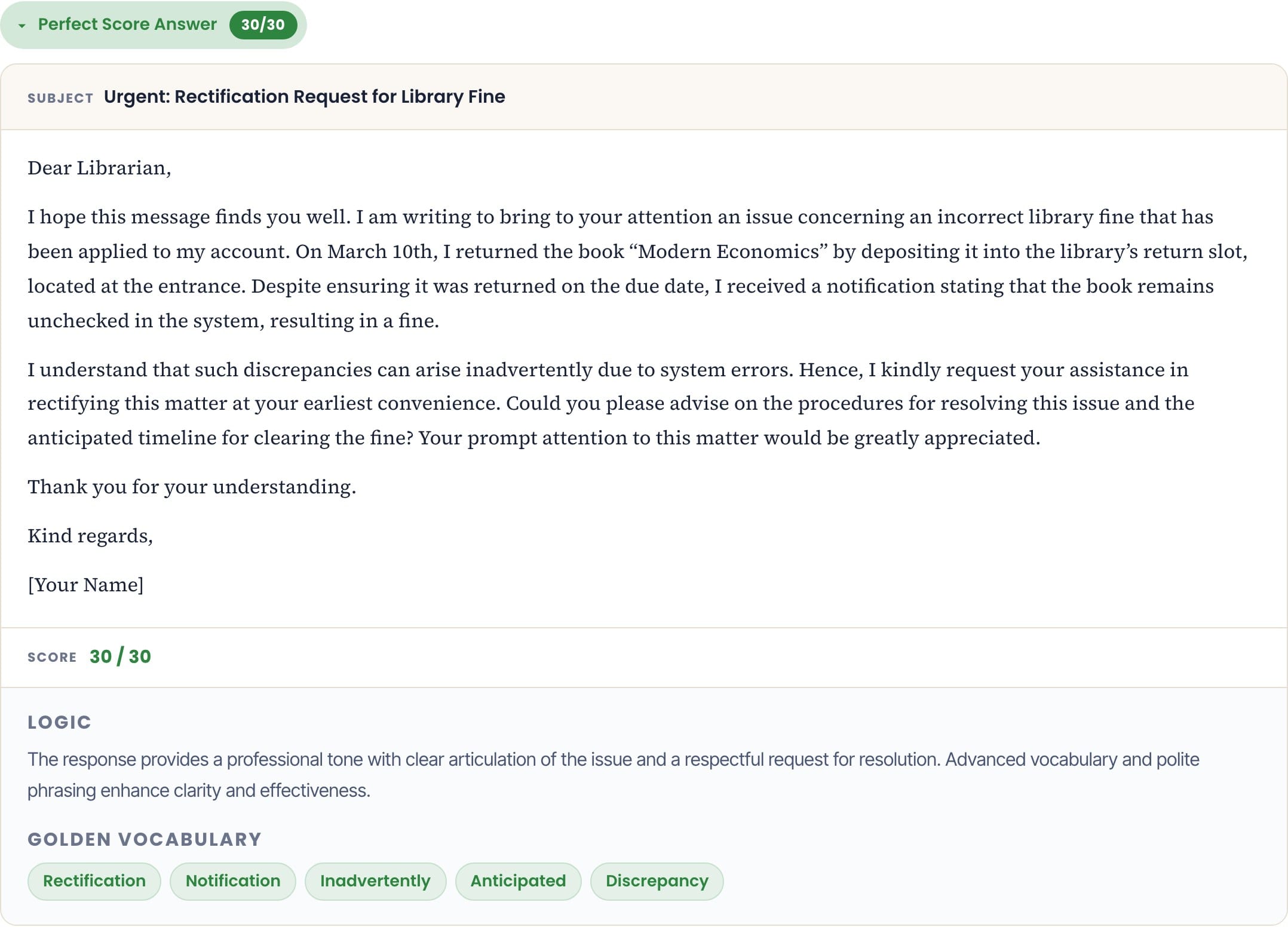
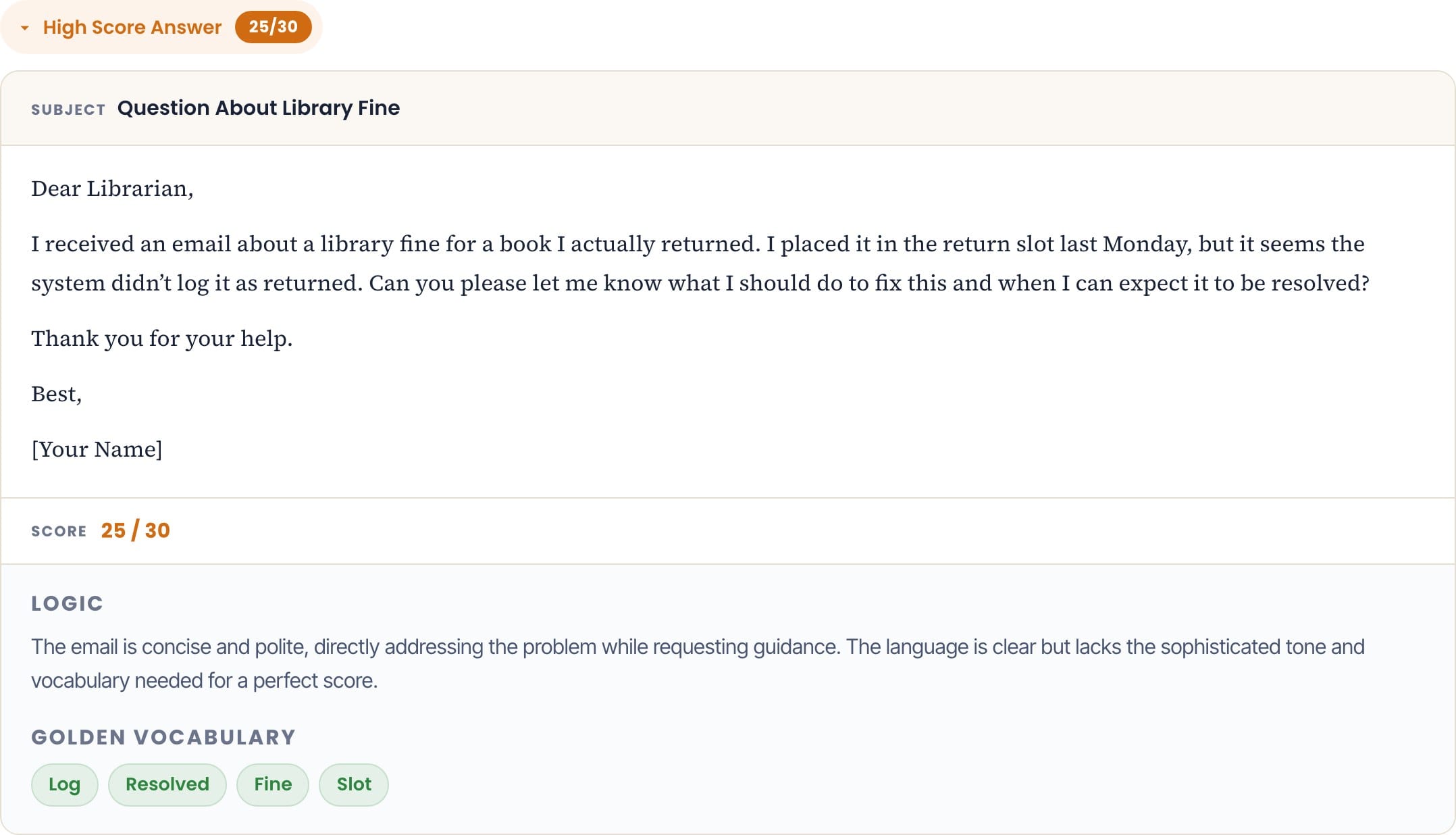
Most of the difference sits in the second bullet: a date, a book title, where the return slot is, and the fact that it was returned on time. All of it is something the librarian can check. Across all 25 tasks, the top answer held more dates, days, and numbers in 18 pairs, the two were even in 7, and the lower answer never had more.
One caveat. The two sentences below appear in the 30/30 answer, but they are not why it scored higher.
“I hope this message finds you well” · “Your prompt attention to this matter would be greatly appreciated”
These fit any email, so they carry no information.
Our grading also doesn't count memorized lines that fit any prompt as doing the task. Politeness matters a lot, but it belongs in the request itself, not in the greeting (more on that below). What made the difference was information that lets the librarian find the record.
So when you read a bullet, first decide one specific detail to attach to it: a date, a name, an amount, a place, or a deadline.
From 4 to 5: make up your own story
Some answers stop at a 4 even with every detail in place. The 112-word email above did. It named the textbook, the quiz date, and the return deadline, and my note still said "doesn't hook."
What I tell students is simple. An email needs a narrative. Imagine a personal situation the prompt doesn't give you, and put it in. The prompt only gives facts: you returned the book, the system didn't record it, you got a fine. Stop there, and to the librarian you are one of ten emails that day. But what if your account is blocked because of the fine, and you need to borrow more sources for a thesis due next week? The same facts become something they should deal with today.
I received an email about a library fine.
Follows the bullet. Nothing wrong, but no reason to hurry.
Because of this fine, my account is currently blocked, and I need to borrow two more sources for my thesis, which is due next Friday.
Adds a personal situation. The reader knows why it needs attention now.
The test doesn't ask for a true story. If it's believable and fits the situation, an invented detail helps your score. Just don't let it bury the three bullets. Keep the story to one or two sentences and attach it to the first or second bullet.
How many words?
Search around and you'll find advice ranging from 80 to 150 words, 100 to 120, or 150 to 200. In our 25 tasks, the top model answers averaged 158 words and the lower ones 80. The top answers are twice as long.
That still doesn't make length the goal. The 112-word email got a 4. Its length was fine. What it lacked was the personal situation, the reason a reader would think "I should handle this soon." Our own grader uses 100 words as the reference length and treats length as one factor among several. Once you're around 100 words, check that each bullet has a detail attached before you add more words.
End the last bullet with a question
The ETS description of a 5 specifically mentions how you formulate requests. The last bullet is almost always a request, so this is where scores split. Three things to check:
- Write a real question. Instead of stating what you want, ask something the reader can answer.
- Offer options. The 5-point answer in our first full test (a used textbook with missing pages) asks for an exchange first and adds that a refund is fine if no copies are left.
- Say what you can do. The same answer mentions the receipt and says the writer can bring the book in any afternoon that week. The reader can settle it with one reply.
I want to know the next steps.
States a wish. It isn't a request.
Could you tell me what I should do next?
A question the reader can answer right away.
Higher-level tasks also ask what you will do if nothing changes. Even then, don't sound like a threat. State the next step calmly. This is the "social conventions" part of the official rubric.
On tone, here's what I push students on: be formal, be as polite as possible, and say what you mean indirectly. The recipient is usually a professor or an office. Even if the system is clearly wrong, write it so it doesn't sound like you're blaming them.
You didn't update the system. → It seems the return may not have been recorded in the system.
Remove the fine. → I would be grateful if the fine could be reviewed.
Answer me quickly. → I would appreciate it if you could let me know at your earliest convenience.
If not, I'll complain. → If this cannot be resolved, I may need to contact the student services office for further guidance.
On the left is what you want to say. On the right is what goes in the email. The message gets through, and nobody is blamed.
Start practicing today
Write an Email starts with covering all three bullets, and the score goes up when every bullet carries a detail the reader can check. Add a sentence or two of your own situation, and end with a request phrased as a polite, indirect question.
Practice it like the real test, starting today. The library fine prompt from this article is Part B of our TOEFL writing sample test, so you can set a 7-minute timer and write it yourself. More prompts are on our TOEFL writing practice page. For the discussion task in the same section, see how to answer Academic Discussion and how to use templates. For the first task, sentence building, see our Build a Sentence trap analysis.