TOEFL Build a Sentence: We Sorted 120 Trap Tiles
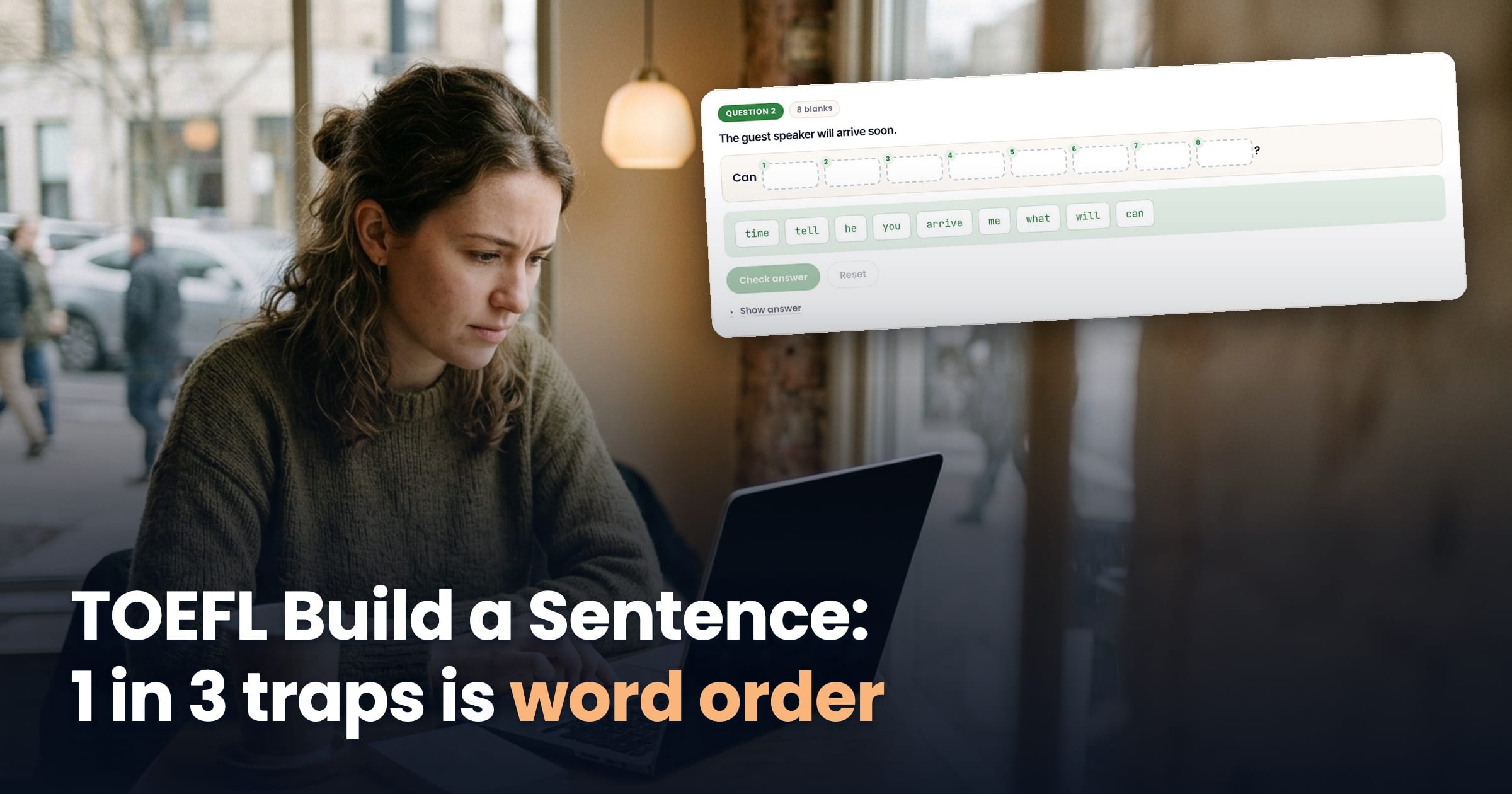
Build a Sentence usually slips in one tile you don't use. It's a trap that doesn't belong in the answer, and that one chunk turns an otherwise perfect sentence into zero. From the question writer's side, the trap tile is the whole point of the item. So we went back through the 120 trap tiles in testpracticelab's 120 full-test items and sorted them by type.
At a glance (official sources)
- Format: Read one line from another speaker, then arrange words and phrases into a response sentence or question. The first word or two may already be filled in.
- Items: 10.
- Scoring: Up to 1 point per item. If even one chunk is in the wrong place, that item is unlikely to earn the point.
- Time: The ETS specifications give the Writing section 12 items in 23 minutes. Take away 7 minutes for the Email and 10 for the Academic Discussion, and Build a Sentence gets about 6 minutes, or roughly 36 seconds an item. Some guides cite 6 minutes 50 seconds or 7 minutes. Either way, practice at under 40 seconds an item.
(Sources: ETS TOEFL iBT 2026 Test Blueprint and Specifications, ETS Writing Section page)
What 120 traps look like
| Trap type | Count | Example (trap → answer) |
|---|---|---|
| Word order (indirect questions, inversion, inverted conditionals) | 36 | was it → it was / If the sample was → Were the sample |
| Verb form (base, -ing, to, past participle) | 33 | finding → find / taking → take |
| Agreement and tense | 19 | were → was / will close → closes |
| Relative pronouns and clause linkers | 14 | who → whose / which → that |
| Comparisons | 10 | more → much / the less → the fewer |
| Similar word, wrong choice | 8 | lend → borrow / say → tell |
(Count: the 120 trap tiles in testpracticelab's TOEFL full tests, 12 sets × 10 items, each sorted by hand)
Three things stand out. A third of the traps are about word order, and almost as many are about verb form. Only 8 traps test whether you know a word. Build a Sentence is a grammar structure test, not a vocabulary test.
Trap 1. Inside an indirect question, drop question order
After Do you know..., Can you tell me..., or I wonder..., anything that follows a question word is in statement order. Of our items whose answer contains an indirect question, 8 out of 10 used a question-order chunk as the trap (does, was it, can we, is it, do they, did he go, and so on).
Do you know when does the sale ends?
The trap does turns it back into question order.
Do you know when the sale ends?
After when: subject + verb.
Can you tell me which room is it in?
is it is direct-question order.
Can you tell me which room it is in?
Inside an indirect question: it is.
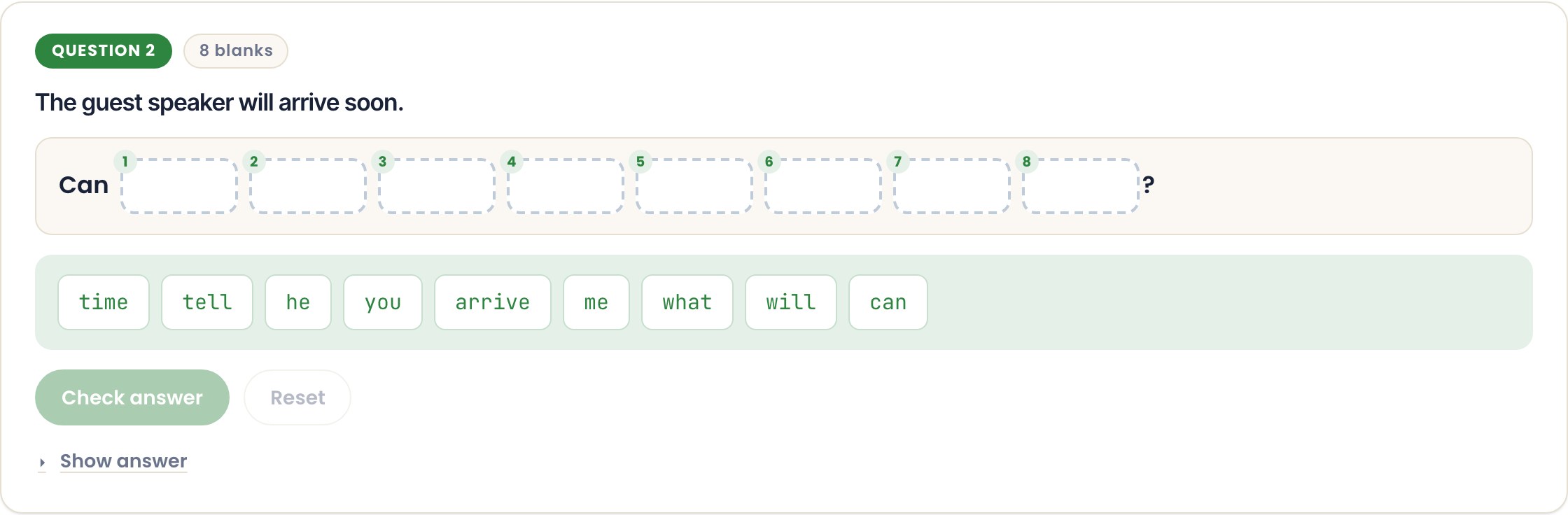
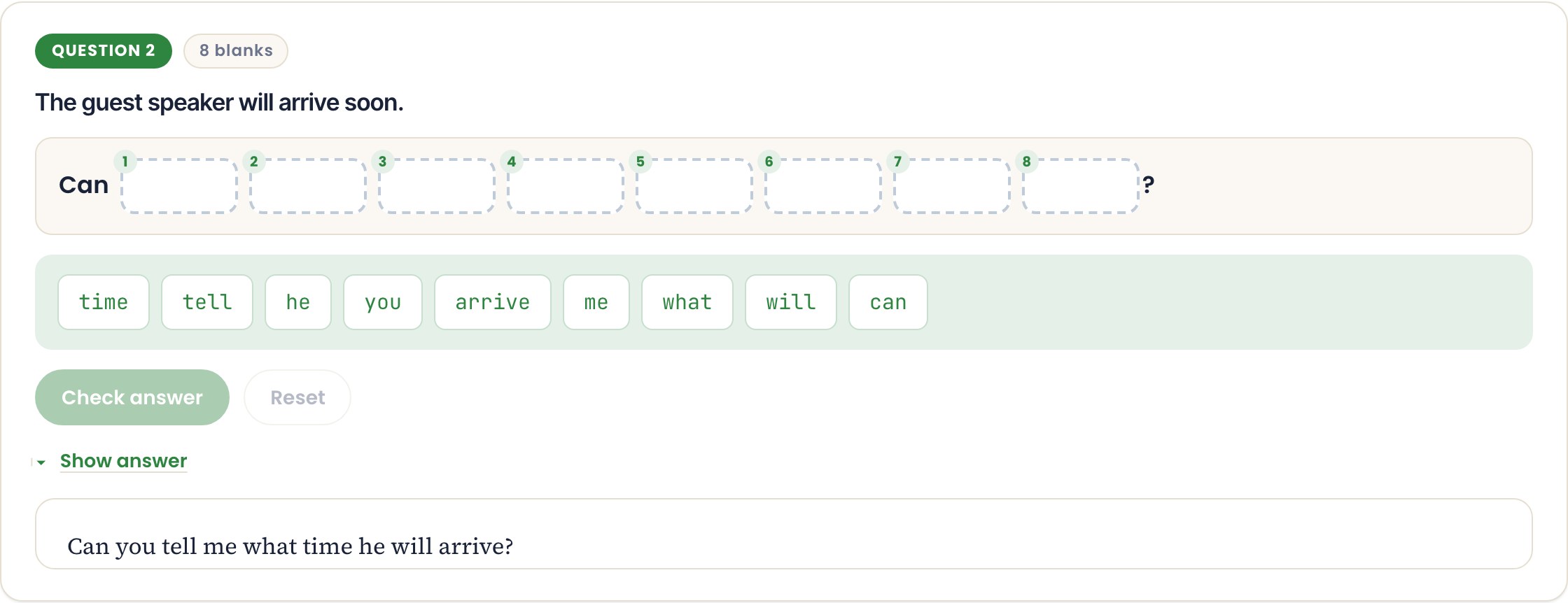
Can you tell me what time will he arrive?
It's tempting to put will before the subject.
Can you tell me what time he will arrive?
After what time, still statement order.
Question 2 on the screen above works the same way. Can you tell me is followed by what time, so the rest is he will arrive in statement order, not will he arrive. It's easy to put will first just because the item looks like a question.
Trap 2. The word before the verb decides its form
Most of the 33 verb-form traps are settled by the word right before the verb.
- After Did / Do / Does / can / should: base form. Did you find (not finding)
- After to: base form. need to review (not reviewing)
- After suggest that + subject: base form. She suggested that I take (not taking)
- After have / has / had: past participle. Have you checked (not check)
- After Why don't you: base form. Why don't you ask (not asking)
Before you place the verb tile, look at what comes in front of it. That alone filters out nearly every verb-form trap.
Trap 3. Find the subject, then match the verb
The 19 agreement and tense traps show up when the subject and verb are far apart. In The garden behind the art building is, the subject is garden, not the nearby building. When a what clause is the subject, as in What interested me most was, the verb is singular. After time and condition linkers (before, until, provided that), future events still take the present tense (before the library closes).
Three drills I recommend as an English teacher
For this task, learning by hand how traps are built works faster than rereading a grammar book from the start. These are the three drills I recommend.
1. Be the question writer. Take one English sentence you read today, cut it into chunks, and slip in one wrong chunk on purpose. For She suggested that I take statistics, you'd add taking. Once you've built traps yourself, you see why the leftover tile is there before you even start. Rotate through the six types in the table, one sentence a day.
2. Ten sentences a day: turn questions into indirect questions. Rewrite Where is the library? as Do you know where the library is?, and When does it start? as Can you tell me when it starts?. Word order is the most common trap, and it's a habit of the hand more than a matter of understanding, so repetition is the fix.
3. Say the finished sentence out loud. Most Build a Sentence answers are things people say in real conversation. An order you've said aloud comes to mind first the next time you see the tiles, and a wrong sentence said once sounds off to your ear. In the test room, just read it in your head.
Two things to check first on screen
- End punctuation: Check whether the frame ends in ? or a period. 45 of the 100 practice items on our site were questions. A question mark means a question, a period means a statement.
- The prefilled first word: Starting with an auxiliary like Can, Would, or Do means a question. But if it continues as Can you tell me or Do you know, everything from the question word on goes back to statement order. The first word tells you the frame of the whole sentence.
A 36-second routine
- Use the other speaker's line and the end punctuation to decide what kind of sentence it is (question, answer, suggestion).
- Place the subject and verb pair first.
- If it's an indirect question, put everything after the question word in statement order.
- Place the rest, and if one tile is left over, confirm that it's the trap.
Start practicing today
Build a Sentence tests structure more than words. A third of the traps are word order and nearly another third are verb form. Two rules get you past most of them: statement order inside indirect questions, and let the word before the verb decide its form. Building traps yourself sharpens that sense fastest.
Practice it like the real test, starting today. You can try Question 2 from this article in Part A of our TOEFL writing sample test. More sets are on our TOEFL writing practice page. For the email task in the same section, see how to handle Write an Email.