TOEFL Listen to a Conversation: 6 Tips
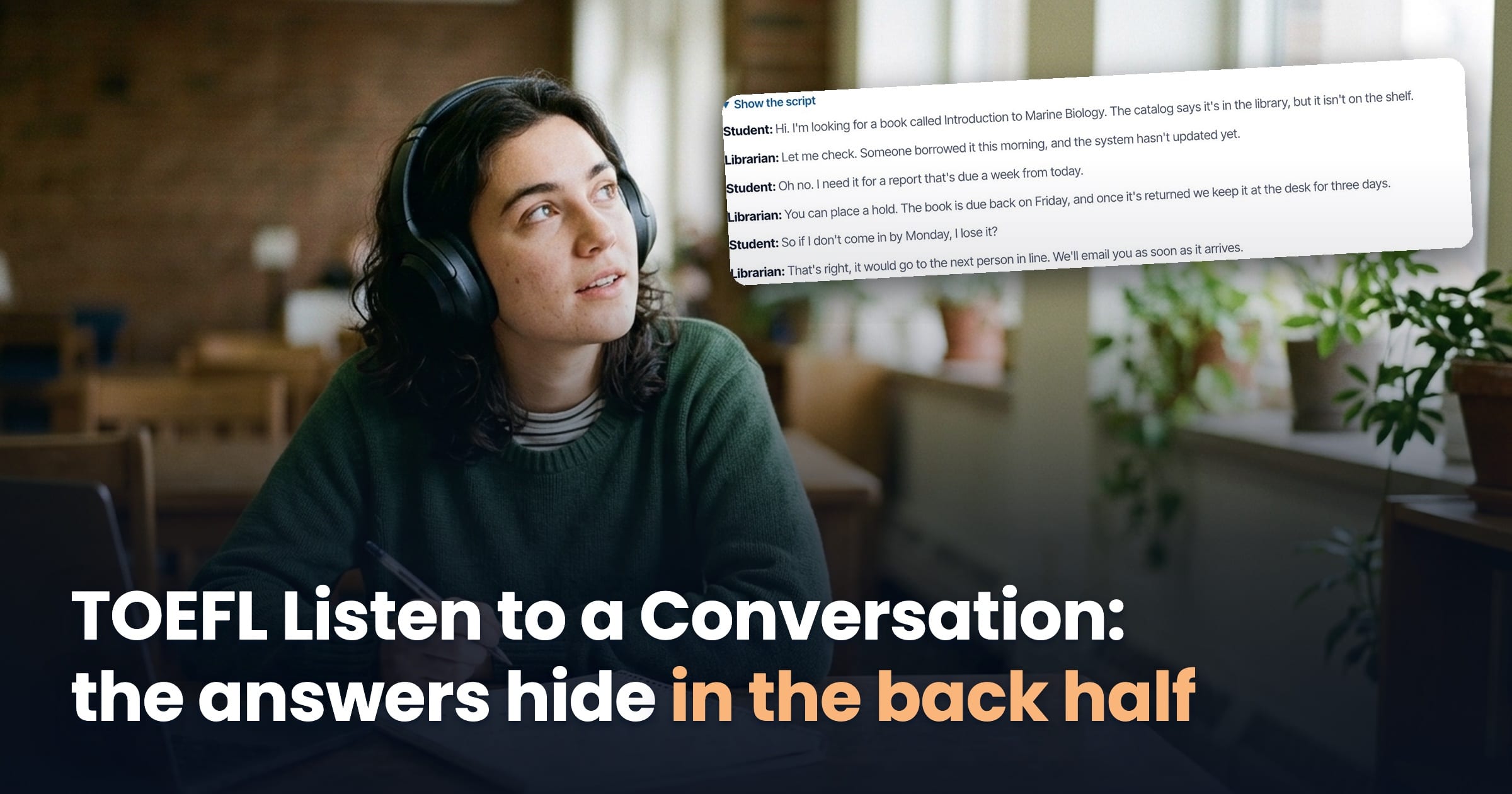
The conversation task is simple on paper: a conversation of about a minute, then two questions. Honestly, it isn't one of the harder Listening tasks. Most students follow the general picture. They know who came in, why, and what the situation is.
They still lose points, and in my classes the misses land in two places. One is the speaker-intent question, the one that asks why someone said something. The other is the back half of the conversation. Students who follow the start well and then lose the end are the most common group I see. This post explains both, using numbers from 120 of our own questions broken down line by line. Let's look at one conversation first.
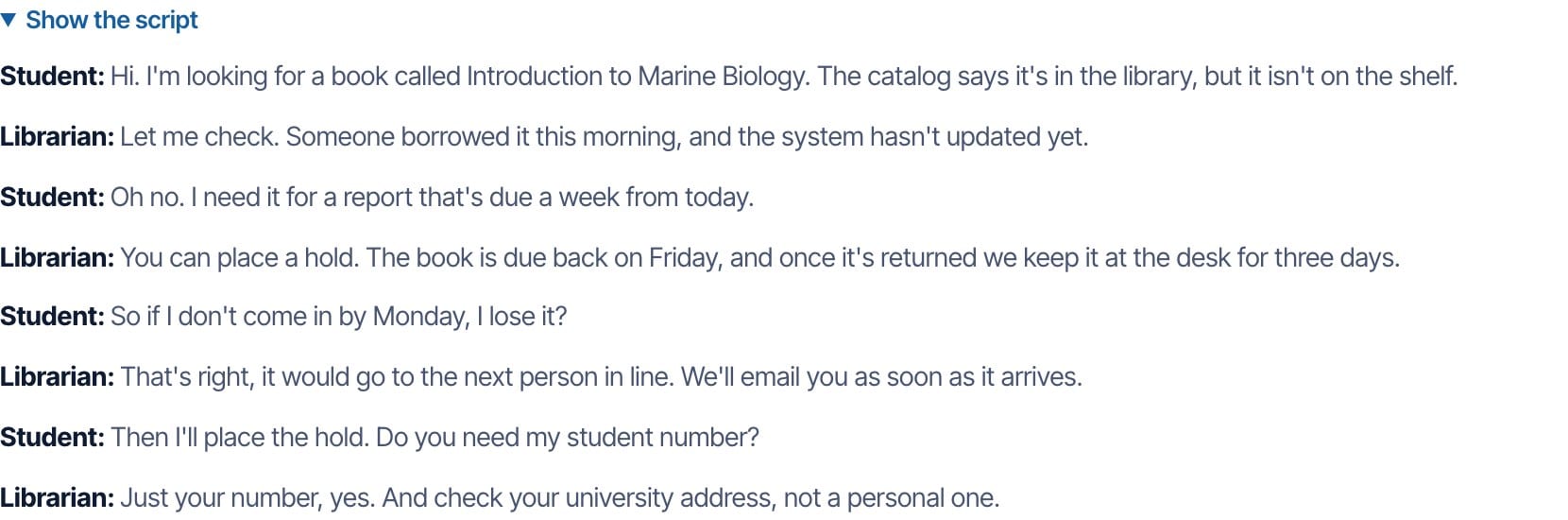
A student comes to the library desk. The catalog says a book is in, but it isn't on the shelf. The librarian says someone borrowed it this morning, and the student says she needs it for a report due in a week. The librarian suggests placing a hold and adds a condition: the book is due back Friday, and once it's returned the desk keeps it for three days. The student checks, "So if I don't come in by Monday, I lose it?" and wraps up with "Then I'll place the hold."
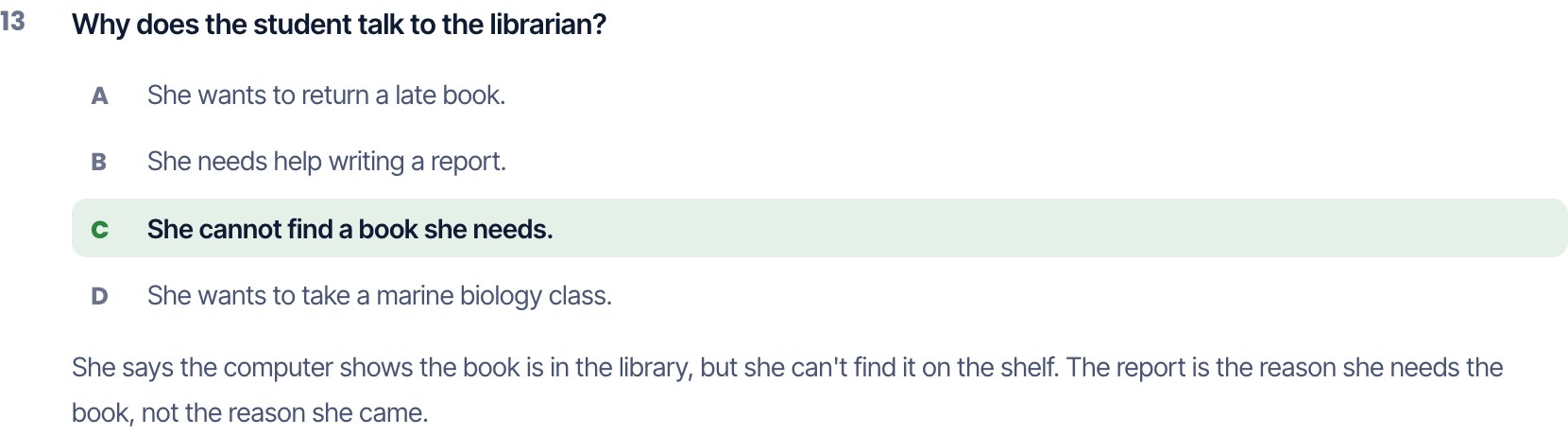
The two questions are: why does the student talk to the librarian, and by when does she have to collect the book? The evidence for the first is in line one. The evidence for the second is in lines four and five. The line about the report due in a week isn't the answer to either question. Instead, two wrong options ("She needs help writing a report" and "Only on the day her report is due") were built from it.
What the task looks like
- You hear: one conversation between two people. In our sets, 6 to 10 turns and 90 to 214 words. The script isn't shown; you only see photos of the two speakers.
- You answer: two multiple-choice questions per conversation (per ETS's Listening lesson plan). Questions and four options appear as text.
- Chances: the audio plays once. You can't go back to earlier questions in Listening.
- Position: after Choose a Response. Our full tests put three conversations in Module 1 and two in Module 2. The test is adaptive, so the number you get may differ slightly.
- Time: there's no per-conversation limit. It shares the module time (in our tests, 18 minutes for Module 1 and 11 for Module 2) with the other tasks.
(Source: ETS TOEFL iBT Lesson Plan, Listening)
What 120 of our questions show
We sorted the 60 conversations and 120 questions in our 12 TOEFL full practice tests by question type.
| Question type | Count | Example |
|---|---|---|
| Detail | 59 | What does the professor tell the student to bring? |
| Inference | 41 | What will the student probably do? |
| Purpose | 7 | Why does the student come to the office? |
| Next action | 7 | What will the student probably do first? |
| Main idea | 6 | What are the students mainly discussing? |
The shape changes a lot by level. All 14 purpose and next-action questions are in the easy and intermediate sets. In upper and advanced, 57 of 60 questions are detail or inference. Conversations also double in length, from an average of 103 words at easy to 205 at advanced. At higher levels the test stops asking "Why did they come?" and starts asking "So what happens?"
Speaker-intent questions, the "Why does the professor mention..." and "What does she mean when she says..." kind, made up 10 of the 120. Our sets lean toward content questions, so tip 6 covers this type separately.
We also counted the first word of each question: What 68, Why 44 (37%). Questions about advice, suggestions or offers (suggest, advise, recommend, offer and so on) numbered 34 (28%). As for who talks, 16 conversations are between a student and a professor, 11 between two students, and the other 33 are with campus staff such as librarians, advisers, housing staff and parking officers.
Tip 1. The first two lines are the problem, the last two are the decision
Campus conversations nearly all follow the same frame. A student brings a problem, the other person offers a way forward, and at the end they settle on what to do.
For five of the seven purpose questions, the evidence was in the first third of the conversation. For all seven next-action questions, it was in the back two-thirds. And in 18 of the 60 conversations, one of the last two lines started with Then or So: "Then the waiting list is your best option," "Then fill out the online application today."
So the places to listen hardest are the first two lines and the last two. In the first two, pin down in a few words what isn't working for this person. When you hear Then or So near the end, catch the decision. The middle is how they get from one to the other.
Tip 2. Inference answers sit in the back half
For 38 of the 41 inference questions, the evidence was in the middle or final third of the conversation. Only 3 had it in the first third. Detail questions went the other way: 28 of 59 had their evidence near the start, more than any other position.
The reason is simple. Inference questions ask "So what will happen?", and that answer only exists once the conditions and reactions are all out. Take the parking ticket conversation. A student got a ticket, parked in the wrong lot, and explains the other lot was full. In the final line the officer says that for a first ticket, an online appeal within seven days is usually approved. The question asks what will probably happen if he submits the appeal form, and the answer is that the ticket will likely be canceled. You could hear the opening perfectly and still not answer this one.
Once the first few lines give you the picture, it's easy to relax. But nearly half the questions come from what follows. Students who follow the start and lose the end are the biggest group I teach, and at bottom that's a focus problem. The surest fix is to keep writing notes from the first line to the last. While your hand is moving, your ears don't take a break. As you practice, notice where your attention drops and work out your own way to hold on.
Tip 3. Dates and conditions come back as math
Ten of the 120 questions used words like if, by when, earliest or when will to ask what happens once a condition is applied.
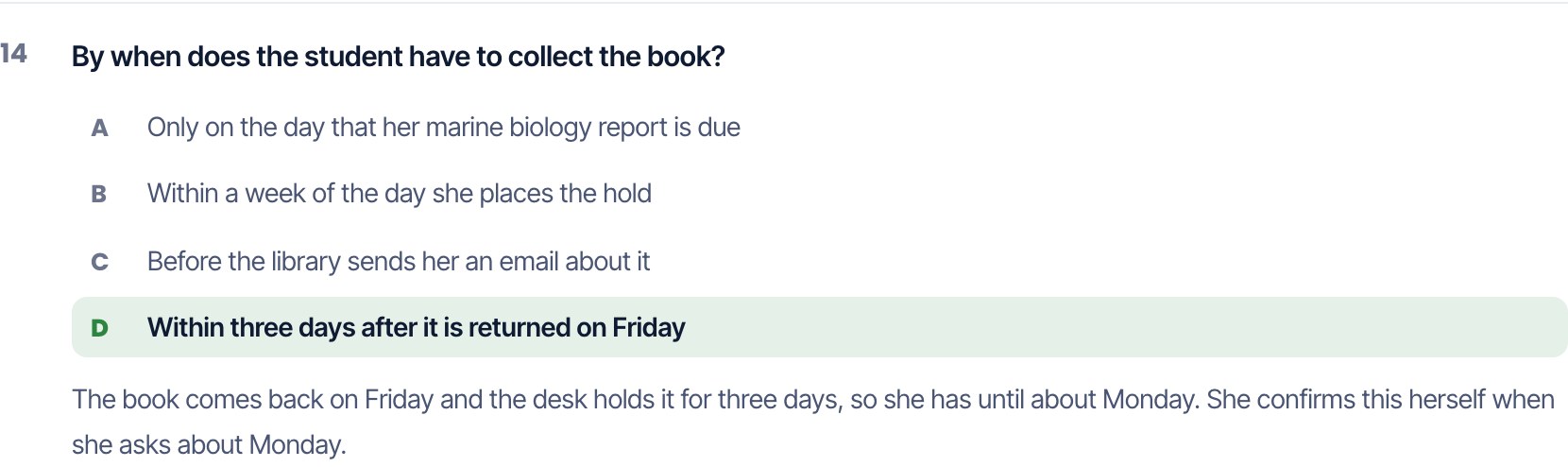
The second library question is this kind. "Monday" comes up in the conversation, but the student is the one who says it, checking her understanding. What the librarian actually gives is "back on Friday, held three days," and the correct option says "within three days after it is returned on Friday." Each wrong option uses another time from the conversation: "within a week" (the report deadline), "before the library sends an email" (how she'll be contacted), "only on the day the report is due" (her own situation).
When two or more dates, days or numbers come up, don't write the numbers alone. Tag each one with what it's the number of, even with a single word: "Fri return / 3 days hold / report 1 wk." Most numbers in the conversation show up again in the options, just attached to the wrong thing.
Tip 4. Why starts about one question in three, and advice comes with a reason
37% of the questions started with Why, and at advanced it was 15 of 30, half. In conversations, reasons usually travel with advice. When someone says "do this," the "because" follows right after.
Take the part-time job conversation. The adviser says the dining hall and the library are both hiring, and that the library pays a little more but requires at least one weekend shift. The student says he goes home most weekends. The question asks why he's unlikely to choose the library job, and the answer is that it requires weekend work. One wrong option says it pays less than the dining hall, the exact opposite of what was said.
When advice comes up, catch the "why" with it. If you keep advice and reason together on one line of your notes, the Why questions and the suggest questions both get easier.
Tip 5. In conversations, heard words won't filter out wrong options
In the Choose a Response post, I said to be suspicious of an option that repeats a word you just heard. That rule doesn't carry over here. In our 120 questions, on average 60% of the content words in correct options appeared in the script, against 49% for wrong options. Correct answers actually reuse script words a bit more.
Wrong options in conversations don't swap the words. They take a real fact from the script and attach it to the wrong thing. The course registration conversation is a good example. The class the student wants is full, and the adviser suggests a Wednesday evening section. The student works at the bookstore then, and his manager sets the schedule a month ahead, so it can't change this term. The question asks why he decides against the evening section. The answer: he can't change his work shift this term. But the wrong option "He is eleventh on the waiting list" is also straight from the script. It's just about the waiting list, not the evening section.
So filter options by "Who said this, and about what?", not by "Was this said?" If it was said but belongs to a different topic, it's wrong.
Tip 6. Speaker-intent questions turn on spoken expressions
The questions students miss most in this task are the ones asking "Why does the speaker say this?" or "What does she mean?" They know the situation and miss what one line really means.
The cause is the direction of their practice. Prep that leans on academic passages and lectures makes students strong at written English and weak at the small spoken expressions people use every day. If you don't know that "I wouldn't count on it" means "don't expect it" and "That's a stretch" means "that's going too far," you can follow the whole conversation and still miss the question. It isn't a vocabulary gap. It's not knowing the nuance an expression carries.
In our sets, this type looks like this. "Why does the professor mention the department chair's travel?" The answer: the student should get the form signed early. The question isn't about the trip; it's about why the professor brought it up. Another asks what the professor means by saying the student has a subject, not a question. The answer: the topic is broad, and he hasn't yet said what puzzles him about it.
That's why spoken expressions need to be memorized separately from written English. I've put 100 common ones, with their real meanings, in 100 Spoken English Expressions for TOEFL Listening Conversations.
Write down almost everything, but write it as structure
You should take notes in the conversation task too. Think of it as writing down nearly everything. But students split into two kinds here. Some write whatever they hear, word for word. Others process what they heard for a moment and write it down as structure. The second group scores higher.
When one sentence runs long, you can't possibly write all of it. Catching the core of that sentence in the moment and writing it so you can recall it later is the most important skill in conversation notes. That takes your own abbreviations and flow marks, and it means deciding what to write and what to leave out. Here is the library conversation from the top, noted two ways.
| Word-for-word notes | Structured notes |
|---|---|
| looking for a book Introduction to Marine Biology catalog says in library but isn't on the shelf | S: book X not on shelf (catalog ✓) |
| someone borrowed it this morning system hasn't updated | L: borrowed a.m. → hold OK |
| due back on Friday keep it at the desk for three days | Fri return → 3 days hold (= Mon) |
| report due a week from today | (S's reason: report 1 wk) |
| Then I'll place the hold student number university address | decision: hold ✓ / ID no., school email |
The left column misses line two while writing line one. The right column shows "problem → option → condition → decision" with just arrows and brackets, and the answers to both questions (why she came, by when) are in it. Information that won't be an answer, like the student's own reason, is pushed down into brackets.
Three ways I'd practice
- Keep your hand moving from start to finish. Listen to one conversation and take notes like the right column above. Afterward, look only at your notes and fill in three slots out loud: problem, option, decision. An empty slot shows where your focus dropped.
- Number the evidence line for every miss. On the answer key page, open "Show the script" and find which line holds the evidence. If your misses keep pointing to the back half, tip 2 is your weak spot. If they're speaker-intent questions, it's tip 6.
- Memorize spoken expressions separately. Underline any expression in the script whose meaning you get but whose nuance feels fuzzy, check its real meaning in the 100 spoken expressions table, and learn it with its example.
Start practicing like it's test day
TOEFL Full Practice Test 001 has five conversations in the Listening section, in real test order. The audio plays once and the script never appears. When you're done, open the scripts on the answer key page and find the evidence lines yourself. The short-response task that comes before conversations is covered in TOEFL Listen and Choose a Response: 5 Tips, and more conversations and lectures are in TOEFL listening practice. If your notes keep falling apart, start with common TOEFL listening note-taking mistakes.