TOEFL Listen and Choose a Response: 5 Tips
Let's start with a question instead of an explanation. There's nothing written on the screen. Someone says one sentence.
"Do you want to walk or take the bus to the concert?"
You get four options.
- A. Let's walk. It's a nice evening.
- B. Yes, I do.
- C. The concert was great, especially the last song.
- D. A bus ticket is two dollars.
The answer is A. But the option worth studying is B. "Yes, I do." is grammatical, and it fits neatly onto "Do you want." That's why it pulls you in. Still, if someone asks whether you'd rather walk or take the bus, "Yes, I do" isn't a reply. Almost every wrong option in this task works the same way. It matches something your ear caught, and it never answers what the person said.
Most points lost here aren't lost because students didn't hear the sentence. They're lost because students followed a word they heard. The sentence is short, so it feels like you caught all of it, and then you pick the option that contains a word from it instead of the option that answers it. So this article is less about listening better and more about how the wrong answers are built.
What the task looks like
- What you hear: one short sentence from one speaker. Sometimes it's a question, sometimes it's just a remark. It never appears on screen. You only hear it.
- What you choose: the most natural reply. The four options appear as text.
- How many chances: the audio plays once. In the Listening section you can't go back to an earlier question.
- Where it sits: at the very start of the Listening section. Our full practice tests follow the ETS layout with 12 of these in Module 1 and 7 in Module 2. The test is adaptive, so the real count can vary a little, and third-party guides put it at 15 to 19.
- Timing: there's no per-question limit. You share the module clock (18 minutes for Module 1 and 11 for Module 2 in our tests) with the conversations, announcements and talks.
(Sources: ETS TOEFL iBT Lesson Plan, Listening / ETS Teacher Resources Practice Test 2)
What 228 of our questions look like
I took the 228 Choose a Response questions in the 12 testpracticelab TOEFL full tests and sorted them by what kind of sentence the speaker says.
| Type of sentence | Questions | Share |
|---|---|---|
| Not a question (complaint, news, worry, thanks, etc.) | 90 | 39% |
| Yes/no question (including negative and tag questions) | 71 | 31% |
| Wh- question (how, why, which, what, who, when, where) | 48 | 21% |
| Either/or question (A or B) | 19 | 8% |
By level, the share of non-questions climbs from 12 of 57 in easy (21%) to 23 in intermediate (40%) and 35 in upper (61%). From easy to upper, the task shifts from "hear a question, pick the answer" to "hear a remark, keep the conversation going." Advanced drops back to 20 (35%), but its questions lean on indirect phrasing and questions asked back.
I also counted how often words from the prompt show up again in the options. I ignored function words like articles and pronouns and checked whether any content word from the prompt appears in the option.
| Options that reuse a content word from the prompt | |
|---|---|
| 684 wrong options | 486 (71%) |
| 228 correct options | 59 (26%) |
To be honest, this number exists because we wrote the wrong options that way. We did it on purpose. Real test distractors follow the same idea, and most guides to this task name "following the word you heard" as the first trap. The five tips below come straight out of these tables.
Tip 1. The first word decides what kind of answer you need
Trap option: "How long does it take to walk to the stadium?" → "The game starts at seven."
It's about the stadium and it's about time, so it sounds right. But "how long" asks for a duration, and this option gives a start time. The answer is "About fifteen minutes from here."
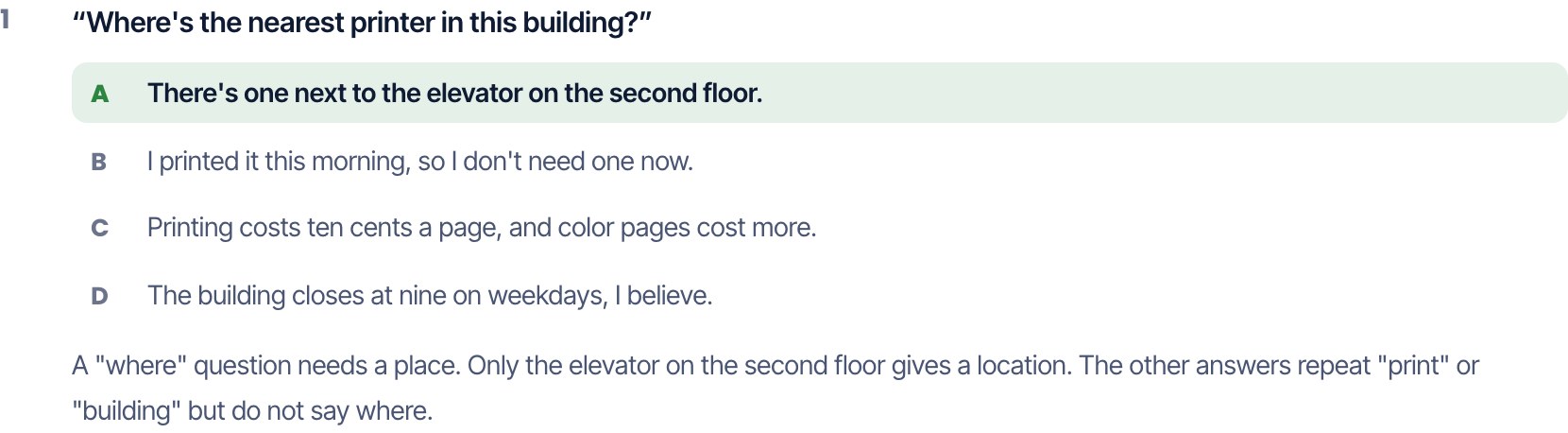
Rule: with a wh- question, the slot for the answer is set the moment you hear the first word. Where wants a place, when a time, why a reason, who a person, how long a duration. Picture that slot before you read the options, and cross out anything that doesn't fit it.
| First word | What fills the slot | Trap in our questions |
|---|---|---|
| Why | a reason | a time or place ("It opens at eight.") |
| Who | a person or office | a place ("It is in the student center.") |
| Which | one of several | general facts about the thing ("I usually take the bus when it's raining.") |
| How long | a duration | a start time ("The game starts at seven.") |
The slot isn't always filled with a name or a number, though. For "Who's in charge of booking rooms?" the answer wasn't a name. It was "You'll need to ask someone at the student center." Telling someone where to ask is a perfectly natural reply.
Tip 2. Don't wait for "yes" or "no" on a yes/no question
Trap option: "Did you finish the reading for tomorrow's class?" → "Tomorrow is Friday, so the whole weekend is still free."
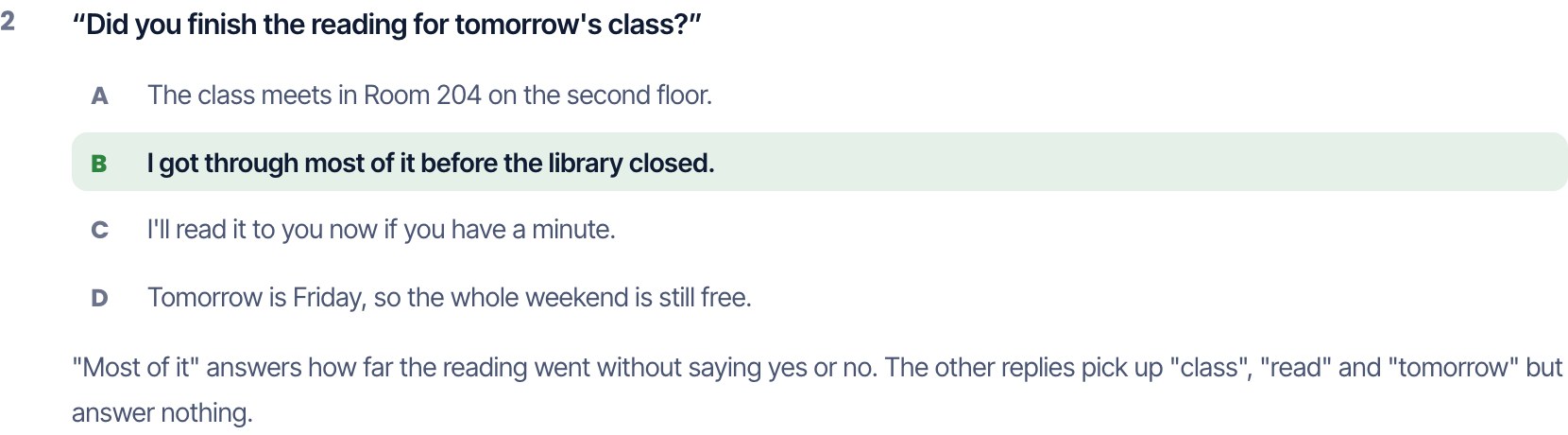
The answer is "I got through most of it before the library closed." No yes, no no.
Of our 228 questions, 71 were yes/no questions. Only 12 of their correct answers (17%) started with yes, no, sure or not at all. The other 59 skipped straight to the content: "most of it," "I think Friday is appointments only," "they pushed the decision to the end of the month."
Real conversation works this way. Ask a friend "Did you finish the homework?" and you'll hear "almost" or "not yet, tonight" more often than a plain "yes." When you hear a yes/no question, don't hunt for yes or no. Ask what the speaker actually wants to know. "Do you know when the results will be announced?" isn't asking whether you know. It's asking when. So "Yes, I know several people who applied." is wrong, and "They said sometime before spring break." is right.
Tip 3. When it's not a question, answer the "so what?"
Trap option: "I lost my student ID card." → "My card is blue, and it has my photo on it."
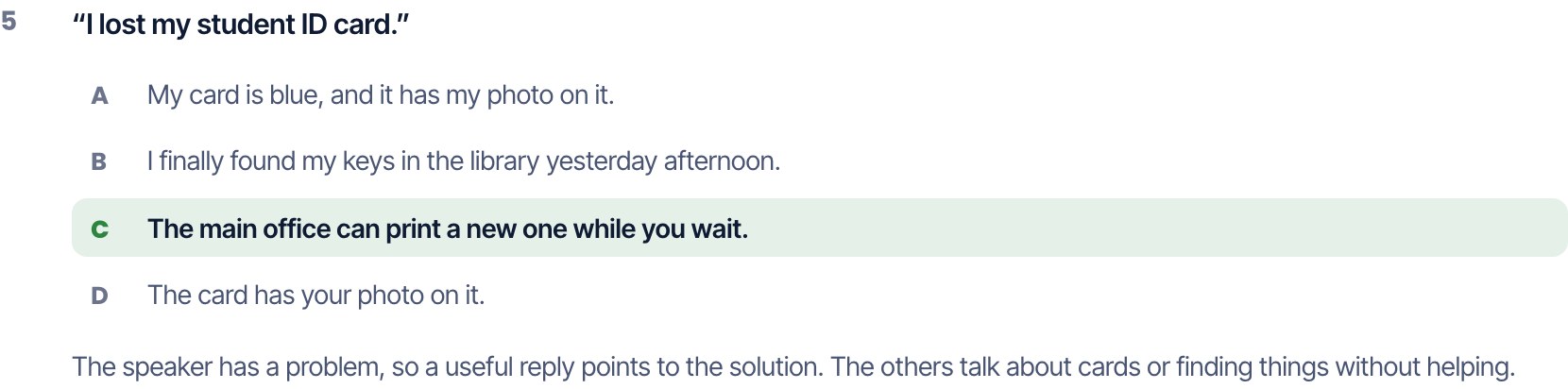
Without a question mark, it's hard to see what there is to answer. But people say things like this for a reason, and that reason points to the answer.
| What they said | What they mean | Shape of the right answer (our questions) |
|---|---|---|
| A problem ("The printer is out of paper again.") | What do I do? | A fix ("There's a box of it in the cabinet.") |
| A worry ("I'm so nervous about my presentation.") | I'm anxious | Reassurance ("You've practiced it so many times.") |
| News ("Office hours have been moved to Thursday.") | Did you know? | How it affects me ("That's a problem. I have a lab all day Thursday.") |
| Thanks ("Thanks for covering my shift.") | Thank you | Accepting it ("Any time.") |
| A surprise ("I'm surprised how few people signed up.") | Why is that? | A reason ("It clashes with the exam workshop.") |
The correct reply to the ID card prompt was "The main office can print a new one while you wait." The "so what?" behind "I lost my card" is "how do I get it back?"
This type nearly triples from easy (21%) to upper (61%). If you're aiming for intermediate or higher, this tip covers more questions than any other.
Tip 4. If a word you heard shows up in an option, be suspicious
Trap option: "Thanks for covering my shift on Saturday." → "The cover of that book is really striking."
"Cover" is right there. On a test where you hear everything once, seeing a word you just heard feels like relief. That relief is exactly what this option is counting on.
In our questions, 71% of wrong options reused a word from the prompt, against 26% of correct ones. So push any option that repeats the prompt's words to the bottom of your list. These are the shapes we used most:
- Same word, different meaning: covering my shift → the cover of that book / split a taxi → split my time / jammed (the printer) → jam and toast
- Same word, unrelated event: "Why don't we review our notes?" → "I reviewed that movie online."
- Me too: "Someone left a laptop charger in the lecture hall." → "I left my umbrella there last week too."
The third one stacks a word trap on top of a sympathy trap. "Me too" sounds friendly, but when the other person needs a fix or a fact, it doesn't answer anything.
Tip 5. Either/or questions don't take "yes"
Trap option: "Should we meet in the library or in my room to study?" → "Yes, let's study together before the exam."
19 of our 228 questions were either/or questions. None of their correct answers started with yes or no. Meanwhile, 8 of the 19 had a wrong option that did. The "Yes, I do." at the top of this article is one of them.
The right answer picks one side and adds a reason ("Your room. The library closes early tonight.") or adds a condition ("It depends on whether you work mornings…"). When you hear "or," cross out the options that start with yes or no first. On a lot of questions, that single rule gets you down to three options.
Three ways I'd practice
Each question takes a few seconds, so how you work through one question matters more than how many you do.
- Cover the options and answer first. After the audio, before you look, say in a word what you'd reply. It doesn't have to be in English. "A place," "a fix," "the bus" is enough. Then look for the option going the same way. Once this becomes a habit, a familiar word in an option shakes you less, because you already have the shape of the answer in your head.
- Label every miss. Did you miss the wh- word, fall for yes/no, follow a repeated word, miss the "so what?" of a remark, or miss that it was an either/or question? See which of the five boxes fills up. That's your weak spot.
- Drill the non-questions on their own. On the answer page, pick only the prompts with no question mark, say the "so what?" out loud, then check the options. Questions come with a slot for the answer. Remarks don't, so you need separate practice building that slot yourself. These items get more common from intermediate up, so the higher your target, the more time this drill deserves.
Practice it like the real test, starting today
TOEFL Full Practice Test 001 opens its Listening section with 19 of these in real test order. The audio plays once, and the sentence never appears on screen. When you're done, the answers and explanations page shows why each wrong option is wrong, in five languages. For more conversations and lectures, go to TOEFL listening practice, and if your notes keep falling apart, start with common TOEFL listening note-taking mistakes.
The conversation task that comes right after this one is covered in TOEFL Listen to a Conversation: 6 Tips.