100 Spoken English Expressions for TOEFL Listening Conversations
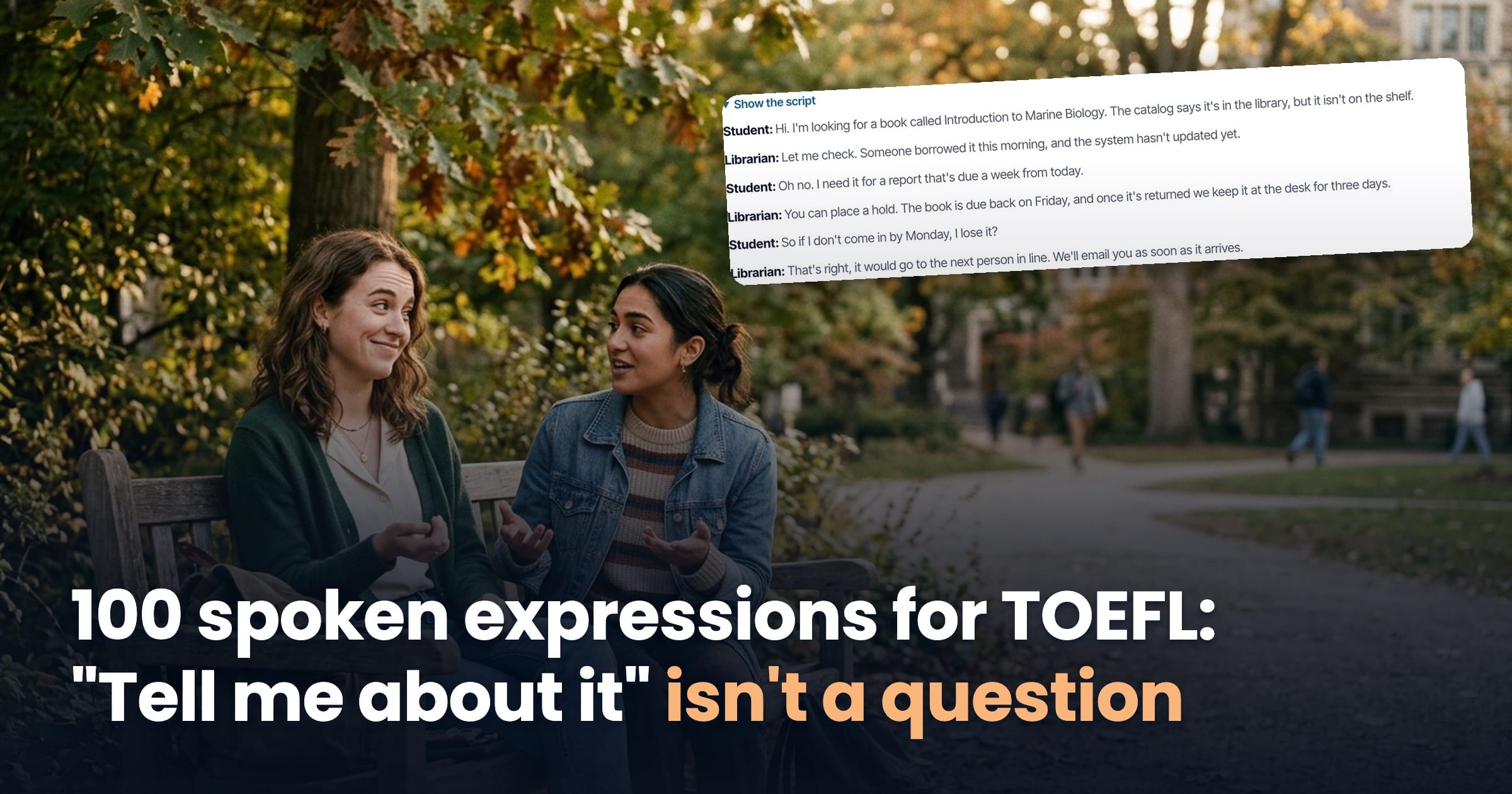
Most students who miss TOEFL Listening conversation questions follow the general situation. They know who came in and why. Where they slip is the question that asks why someone said something. They understand the scene but miss what that one line really means.
The cause is how they practice. Prep tends to focus on academic passages and lectures, so students get strong at written English and stay weak at the small spoken expressions people use every day. When a friend says "Tell me about it," they aren't asking for details. They mean "I know, same here." Listening practice alone rarely builds this. These expressions need to be memorized on their own, separately from written English.
So here are 100 spoken expressions that come up often in campus conversations, sorted into 10 groups by what the speaker is trying to do. Each one has its real meaning and a short campus example. For how to work through the conversation task as a whole, see TOEFL Listen to a Conversation: 6 Tips.

What we counted in our own listening scripts
We gathered every Listening script from our 12 TOEFL full practice tests (conversations, Choose a Response, announcements, academic talks) plus the scripts from our listening practice pages: 43,956 words in total. Then we counted how often each of the 100 expressions below appears.
The result stung a little, because these are our own materials. You can work through a lot of practice questions and still meet these expressions far less often than you'd think. That's why this list exists.
Source: testpracticelab TOEFL full tests, 12 sets of listening scripts (34,885 words) plus listening practice page scripts (9,071 words). Only exact matches of each expression's core phrase were counted, ignoring case.
Six that mean something else if you translate them word by word
These six lead to wrong answers on speaker-intent questions more often than the rest. Put the word meanings together literally and you pick the wrong option.
Why don't you try the third floor?
It isn't asking for a reason. It's a suggestion: "Try the third floor." If the question asks what the man suggests, this is the line.
Tell me about it.
Not a request for more details. It means "I know exactly what you mean." After a complaint, it almost always means this.
No way! That's great.
Surprise, not refusal. With That's great after it, it's happy surprise.
I'm with you.
It can mean "I'm on your side," but in the middle of an explanation it means "I'm following you." Don't assume agreement.
I see where you're coming from, but...
It only means "I understand your reasons." The real message is the disagreement after but.
Good luck with that.
Usually not encouragement. It's sarcasm: "That won't work." A flat, falling tone is the giveaway.
100 spoken expressions in 10 intent groups
Each group name is the speaker's intent. The correct option on a speaker-intent question is usually worded with that same idea: agrees, declines, doubts, is surprised. Tap a group to jump to it.
- Agreeing (10)
- Saying no politely (10)
- Doubting (10)
- Surprise (10)
- Worry and reassurance (10)
- Suggesting (10)
- Correcting and changing your mind (10)
- Understanding and checking (10)
- Frustration and stress (10)
- Plans and status (10)
Agreeing
| Expression | What it really means | Example |
|---|---|---|
| Tell me about it. | I know exactly what you mean; same here. Not a request for more information | A: This lab report is taking forever. B: Tell me about it. I've been on mine since Monday. |
| You can say that again. | I completely agree | A: The new library hours are terrible. B: You can say that again. |
| I'm all for it. | I fully support the idea | A: Should we start the project this weekend? B: I'm all for it. |
| Fair enough. | That's a reasonable point; I accept it | A: I can't meet Friday because I work. B: Fair enough. How about Thursday? |
| That makes sense. | I understand and the reasoning seems right | A: The form needs your adviser's signature first. B: That makes sense. |
| Sounds like a plan. | Agreed; let's do that | A: Library at six, then dinner? B: Sounds like a plan. |
| I couldn't agree more. | I agree completely | A: We should ask the professor before changing the topic. B: I couldn't agree more. |
| Count me in. | Include me; I'll join | A: A few of us are going to the career fair. B: Count me in. |
| You've got a point. | What you said is valid; I'm partly persuaded | A: If we split the reading, we'll finish sooner. B: You've got a point. |
| Works for me. | That's fine with me | A: Can we move the meeting to two? B: Works for me. |
Saying no politely
| Expression | What it really means | Example |
|---|---|---|
| I'm not so sure about that. | I disagree, said softly | A: Online sections are always easier. B: I'm not so sure about that. |
| I'd rather not. | I prefer not to; a polite no | A: Want to present first? B: I'd rather not. |
| I'll pass. | No thanks; I won't join | A: We're grabbing pizza after the lab. B: I'll pass. I have an early shift. |
| That's a stretch. | That claim goes too far | A: One survey proves students prefer mornings. B: That's a stretch. |
| I see your point, but... | I understand, but I disagree; the real answer follows but | A: We should drop the interview part. B: I see your point, but the professor asked for it. |
| Not really. | Mostly no | A: Did the review session help? B: Not really. |
| I wish I could, but... | A polite refusal | A: Can you cover my shift Saturday? B: I wish I could, but I'm going home. |
| Maybe some other time. | Not now; usually a soft no | A: Join our study group tonight? B: Maybe some other time. |
| I'm afraid that won't work. | No, said politely, often by staff or professors | A: Could I submit it next month? B: I'm afraid that won't work. |
| That's not really my thing. | I'm not interested in that kind of thing | A: You should join the debate club. B: That's not really my thing. |
Doubting
| Expression | What it really means | Example |
|---|---|---|
| I wouldn't count on it. | Don't expect that to happen | A: Maybe the professor will cancel the quiz. B: I wouldn't count on it. |
| I doubt it. | I think the answer is no | A: Will the shuttle run during break? B: I doubt it. |
| Easier said than done. | It sounds simple but it's hard to do | A: Just finish the thesis by May. B: Easier said than done. |
| I'll believe it when I see it. | I don't trust that promise | A: They promised the Wi-Fi will be fixed this week. B: I'll believe it when I see it. |
| Don't get your hopes up. | Expect disappointment | A: I applied for the scholarship late. B: Don't get your hopes up. |
| Good luck with that. | Sarcastic: I don't think you can do that | A: I'll read all six chapters tonight. B: Good luck with that. |
| Yeah, right. | Sarcastic: I don't believe you | A: The exam will be easy. B: Yeah, right. |
| That sounds too good to be true. | There must be a catch | A: The course has no exams and no papers. B: That sounds too good to be true. |
| I have my doubts. | I'm not convinced | A: The new schedule will fix the overcrowding. B: I have my doubts. |
| It's a long shot. | Possible but unlikely | A: Could I still get into the full class? B: It's a long shot. |
Surprise
| Expression | What it really means | Example |
|---|---|---|
| No way! | Really? That's surprising; not a refusal | A: I got an A on the final. B: No way! That's great. |
| You're kidding. | I can't believe it | A: The deadline moved up to Monday. B: You're kidding. |
| That's news to me. | I didn't know that | A: Office hours moved to Thursday. B: That's news to me. |
| I had no idea. | I didn't know at all | A: The gym is free for students. B: I had no idea. |
| Since when? | That's new to me; when did that change? | A: You need a permit to park there now. B: Since when? |
| Who would have thought? | Nobody expected that | A: Our small club won the grant. B: Who would have thought? |
| That came out of nowhere. | It happened suddenly, without warning | A: The professor gave a pop quiz. B: That came out of nowhere. |
| I didn't see that coming. | I never expected that | A: Mark switched his major to music. B: I didn't see that coming. |
| Seriously? | Really? Often surprise mixed with annoyance | A: The printer is broken again. B: Seriously? |
| That's a first. | This never happened before; usually it doesn't | A: The bus actually came on time. B: That's a first. |
Worry and reassurance
| Expression | What it really means | Example |
|---|---|---|
| I'm freaking out. | I'm very anxious | A: How's the thesis? B: I'm freaking out. It's due in two days. |
| It's been on my mind. | I keep thinking about it | A: Did you decide about studying abroad? B: Not yet. It's been on my mind. |
| I'm a nervous wreck. | I'm extremely nervous | A: Ready for your presentation? B: I'm a nervous wreck. |
| Don't sweat it. | Don't worry about it | A: Sorry I'm late. B: Don't sweat it. |
| You'll be fine. | Everything will go well for you | A: I've never done an interview. B: You'll be fine. |
| It's not the end of the world. | It's a small problem; you can recover | A: I failed the first quiz. B: It's not the end of the world. |
| Take it easy. | Relax; don't overdo it | A: I've been up studying since four. B: Take it easy. |
| No big deal. | It doesn't matter much | A: I forgot to bring your notes. B: No big deal. |
| You've got this. | You can do it | A: My defense is tomorrow. B: You've got this. |
| Hang in there. | Keep going; it will get better | A: Three exams this week. B: Hang in there. |
Suggesting
| Expression | What it really means | Example |
|---|---|---|
| Why don't you...? | A suggestion, not a question about reasons | A: I can't find a quiet place to study. B: Why don't you try the third floor? |
| How about...? | A suggestion | A: When should we meet? B: How about after lunch? |
| You might want to... | Polite advice; you should | A: My essay is due Friday. B: You might want to start the outline today. |
| It wouldn't hurt to... | You should; there's no downside | A: Should I email the professor? B: It wouldn't hurt to ask. |
| If I were you, I'd... | Direct advice | A: Two courses I like meet at the same time. B: If I were you, I'd take the one that fills up first. |
| Have you thought about...? | A suggestion framed as a question | A: I need money for books. B: Have you thought about the library job? |
| What if we...? | Let's consider this option | A: The room is booked. B: What if we meet in the lounge? |
| I'd go with... | My choice would be... | A: Statistics or economics? B: I'd go with statistics. |
| It might be worth... | This could be useful to try | A: The class is full. B: It might be worth joining the waiting list. |
| Let's play it by ear. | Let's decide later, depending on how things go | A: Should we book the room for two hours? B: Let's play it by ear. |
Correcting and changing your mind
| Expression | What it really means | Example |
|---|---|---|
| Actually, ... | Signals a correction; the new information matters | A: So the paper is due Monday? B: Actually, it's Wednesday. |
| On second thought, ... | I've changed my mind | A: Let's take the bus. On second thought, let's walk. It's nice out. |
| Come to think of it, ... | I just remembered or realized something | A: Did anyone mention the deadline? B: Come to think of it, the TA did. |
| Scratch that. | Ignore what I just said | A: Meet at noon. Scratch that, I have a lab. Meet at one. |
| I take that back. | I withdraw what I said | A: The class is easy. Well, I take that back. The final is hard. |
| What I meant was... | Clarifying an earlier statement | A: You don't like my topic? B: What I meant was it's too broad. |
| Let me put it another way. | I'll explain it differently | A: I don't follow. B: Let me put it another way. |
| That's not what I meant. | You misunderstood me | A: So you want to quit the group? B: That's not what I meant. |
| I stand corrected. | I admit I was wrong | A: The lab closes at eight, not nine. B: I stand corrected. |
| Never mind. | Forget it; it's no longer needed | A: Can you... never mind, I found it. |
Understanding and checking
| Expression | What it really means | Example |
|---|---|---|
| So what you're saying is... | Checking that I understood correctly | B: So what you're saying is I need two signatures? |
| Got it. | I understand | A: Submit it through the portal, not by email. B: Got it. |
| I'm with you. | I'm following you; not always agreement | A: First we collect data, then we code it. B: I'm with you. |
| I'm lost. | I don't understand anymore | A: Then the variable becomes the control. B: Sorry, I'm lost. |
| That went over my head. | It was too difficult for me to understand | A: Did you get the lecture on quantum states? B: That went over my head. |
| Could you run that by me again? | Please explain it again | A: Could you run that by me again? The part about the forms. |
| Fill me in. | Tell me what I missed | A: I missed the meeting. Fill me in. |
| Does that make sense? | Do you understand? | A: You take the core courses first. Does that make sense? |
| I see where you're coming from. | I understand your reasons, without agreeing | A: I think grades shouldn't count participation. B: I see where you're coming from, but... |
| Point taken. | I accept your criticism | A: You keep starting too late. B: Point taken. |
Frustration and stress
| Expression | What it really means | Example |
|---|---|---|
| I'm swamped. | I'm extremely busy; often the reason for saying no | A: Can you help me edit this? B: Sorry, I'm swamped this week. |
| I'm fed up with... | I'm tired of and annoyed by something | A: I'm fed up with the noise in my dorm. |
| It's driving me crazy. | It's very annoying | A: The Wi-Fi keeps dropping. It's driving me crazy. |
| That's the last straw. | I won't accept this anymore; action follows | A: They lost my form again? That's the last straw. |
| I've had it with... | I've reached my limit with something | A: I've had it with this group. Nobody does their part. |
| It's a pain. | It's annoying and inconvenient | A: Renewing the permit online is a pain. |
| What a hassle. | How inconvenient | A: I have to go to three offices for one signature. What a hassle. |
| I'm running on empty. | I have no energy left | A: You okay? B: I'm running on empty. Three hours of sleep. |
| I'm stuck. | I can't make progress | A: How's the coding assignment? B: I'm stuck on the second part. |
| I'm behind on... | I haven't kept up with the work | A: I'm behind on the readings for this class. |
Plans and status
| Expression | What it really means | Example |
|---|---|---|
| I'm on it. | I'll take care of it | A: Can someone book the room? B: I'm on it. |
| It's up in the air. | It hasn't been decided | A: Is the trip still on? B: It's up in the air. |
| I'll get back to you. | I'll answer later, not now | A: Can you join the panel? B: I'll get back to you tomorrow. |
| It slipped my mind. | I forgot | A: Did you send the form? B: Oh no, it slipped my mind. |
| I'm cutting it close. | I have barely enough time | A: The bus leaves at 8:50 and class starts at nine. I'm cutting it close. |
| It came down to the wire. | It was finished at the very last moment | A: Did you finish on time? B: It came down to the wire. |
| It's a done deal. | It's final and decided | A: Did they approve your transfer? B: It's a done deal. |
| Let's call it a day. | Let's stop working for today | A: We've been here five hours. Let's call it a day. |
| Keep me posted. | Update me when you know more | A: I'll hear about the internship next week. B: Keep me posted. |
| Off the top of my head, ... | From memory, without checking; may not be certain | A: Which professor teaches that? B: Off the top of my head, Dr. Lee. |
How to memorize them
- Learn the example, not just the phrase. A phrase on its own won't come back to you mid-conversation. Learn what the other person said right before it, as one chunk.
- Shrink the meaning to one intent word. Write "doubt" next to Easier said than done. Answer options are often worded with that single idea.
- Practice the tone too. Good luck with that and Yeah, right can be friendly or sarcastic depending on tone. Say each example out loud both ways.
- Mark them in real scripts. After a conversation question, open the script and underline any expression from this list. Meeting a phrase once in a test context makes it stick.
One group today
You don't need all 100 at once. Learn one group of ten today, examples included, then try the conversations in TOEFL Full Practice Test 001. Afterward, open the scripts on the answer key page and you'll see exactly where each expression was used.
For the order of steps and how to take notes in this task, read TOEFL Listen to a Conversation: 6 Tips. For more conversations and lectures, go to TOEFL listening practice.