TOEFL リスニング会話によく出る英語の話し言葉表現100
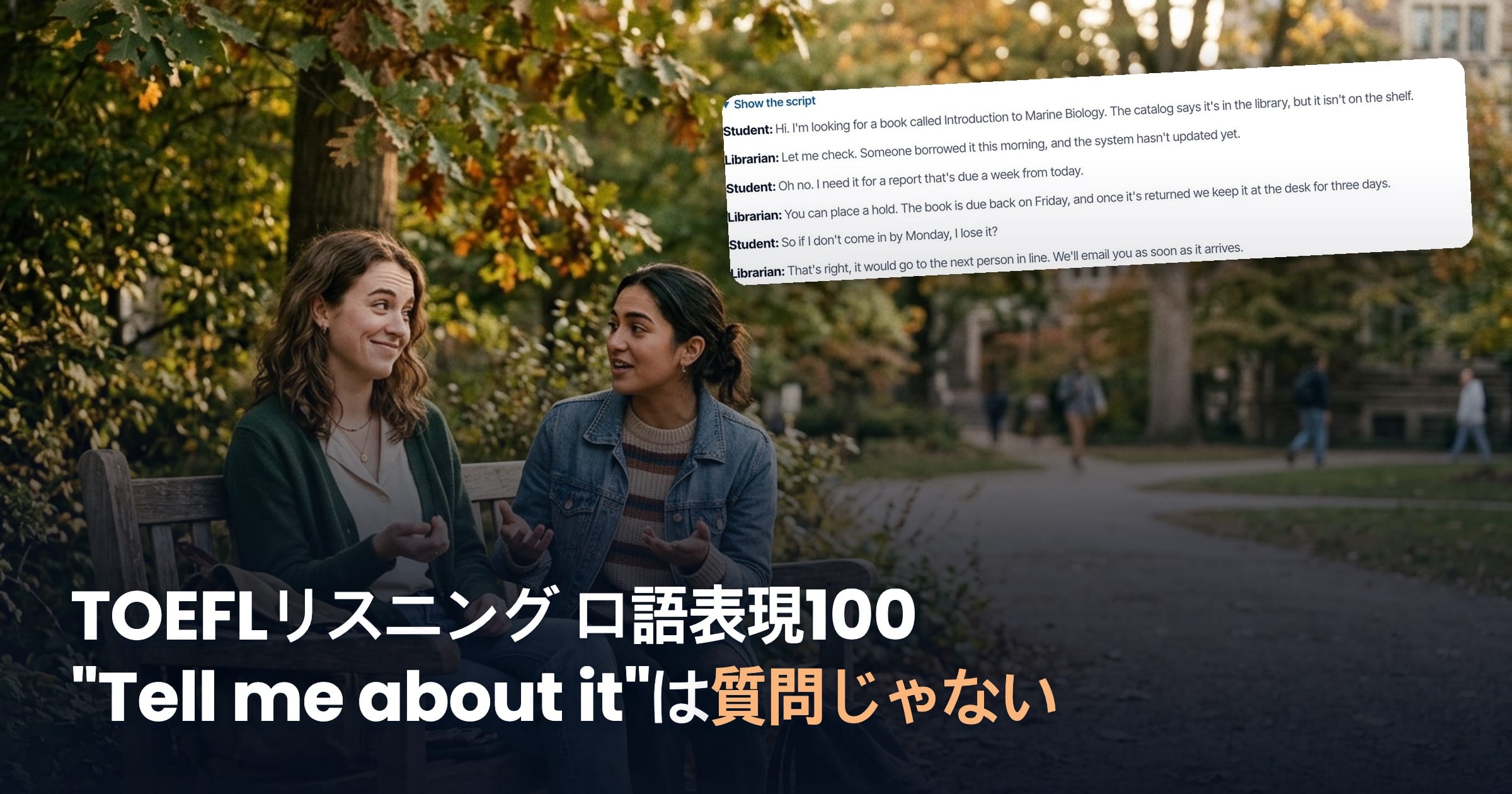
TOEFLリスニングの会話問題で点を落とす生徒のほとんどは、全体の状況はつかめています。誰がなぜ来たのかはわかっているのです。つまずくのは、なぜその人がそう言ったのかを聞く問題です。場面は理解できているのに、その1行の本当の意味を取り違えてしまいます。
原因は練習のしかたにあります。対策はアカデミックな文章や講義に偏りがちなので、書き言葉の英語には強くなっても、人が毎日使う小さな話し言葉の表現には弱いままです。友だちが "Tell me about it" と言ったら、詳しく話してと頼んでいるのではありません。「わかる、私も同じ」という意味です。リスニング練習だけでは、これはなかなか身につきません。こうした表現は書き言葉の英語とは別に、それだけで覚える必要があります。
そこで、キャンパスの会話によく出てくる話し言葉の表現100個を、話し手が何をしようとしているかで10グループに分けました。それぞれに本当の意味と短いキャンパスでの例文をつけています。会話問題全体の解き方は TOEFL Listen to a Conversation のコツ6つ を見てください。

当サイトのリスニングスクリプトで数えてみた
当サイトの TOEFL 模試12回分のリスニングスクリプト(会話、Choose a Response、アナウンス、講義)と、リスニング練習ページのスクリプトをすべて集めました。合計43,956語です。そのうえで、下の100表現がそれぞれ何回出てくるかを数えました。
結果は少し耳が痛いものでした。自分たちの教材だからです。練習問題をたくさん解いても、これらの表現に出会う回数は思っているよりずっと少ない。このリストがあるのはそのためです。
出典: testpracticelab TOEFL 模試12セットのリスニングスクリプト(34,885語)とリスニング練習ページのスクリプト(9,071語)。各表現の核となるフレーズが完全一致したものだけを、大文字小文字を区別せずに数えました。
直訳すると意味が変わってしまう6つ
この6つは、話し手の意図を問う問題でほかの表現より誤答につながりやすいものです。単語の意味をそのままつなげると、違う選択肢を選んでしまいます。
Why don't you try the third floor?
理由を聞いているのではありません。「3階に行ってみたら」という提案です。男性が何を提案しているかを聞く問題なら、この行が根拠です。
Tell me about it.
もっと詳しく話してという頼みではありません。「本当にそうだよね」という意味です。誰かが不満を言ったあとなら、ほぼ必ずこの意味です。
No way! That's great.
断りではなく驚きです。あとに That's great が続けば、うれしい驚きです。
I'm with you.
「あなたの味方だ」という意味にもなりますが、説明の途中なら「話についていけている」という意味です。同意だと決めつけないでください。
I see where you're coming from, but...
「そう考える理由はわかる」という意味でしかありません。本当に言いたいのは but のあとの反対意見です。
Good luck with that.
たいていは励ましではありません。「それはうまくいかないよ」という皮肉です。平坦で下がり調子の言い方が手がかりです。
意図別10グループの話し言葉表現100個
グループ名は話し手の意図です。話し手の意図を問う問題の正解は、たいていこの意図と同じ考えで書かれています。同意する、断る、疑う、驚く、などです。グループ名をタップするとその場所に移動します。
- 相づち・同意 (10)
- 遠回しな断り・反対 (10)
- 疑い・懐疑 (10)
- 驚き・意外 (10)
- 心配と励まし (10)
- 提案・勧め (10)
- 訂正・言い直し (10)
- 理解・確認 (10)
- 不満・疲れ (10)
- 予定・状況 (10)
相づち・同意 (Agreeing)
| 表現 | 本当の意味 | 例文 |
|---|---|---|
| Tell me about it. | 本当にそう、私も同じ(共感)。詳しく話してという意味ではない | A: This lab report is taking forever. B: Tell me about it. I've been on mine since Monday. |
| You can say that again. | まったくその通り | A: The new library hours are terrible. B: You can say that again. |
| I'm all for it. | 大賛成 | A: Should we start the project this weekend? B: I'm all for it. |
| Fair enough. | それならしかたない(理由を受け入れる) | A: I can't meet Friday because I work. B: Fair enough. How about Thursday? |
| That makes sense. | なるほど、納得できる | A: The form needs your adviser's signature first. B: That makes sense. |
| Sounds like a plan. | いいね、そうしよう(合意) | A: Library at six, then dinner? B: Sounds like a plan. |
| I couldn't agree more. | 全面的に賛成 | A: We should ask the professor before changing the topic. B: I couldn't agree more. |
| Count me in. | 私も入れて、参加する | A: A few of us are going to the career fair. B: Count me in. |
| You've got a point. | 一理ある(考えが変わりかけている) | A: If we split the reading, we'll finish sooner. B: You've got a point. |
| Works for me. | 私はそれで大丈夫 | A: Can we move the meeting to two? B: Works for me. |
遠回しな断り・反対 (Saying no politely)
| 表現 | 本当の意味 | 例文 |
|---|---|---|
| I'm not so sure about that. | それはどうかな(やんわりした反対) | A: Online sections are always easier. B: I'm not so sure about that. |
| I'd rather not. | できれば遠慮したい(丁寧な断り) | A: Want to present first? B: I'd rather not. |
| I'll pass. | やめておく、参加しない | A: We're grabbing pizza after the lab. B: I'll pass. I have an early shift. |
| That's a stretch. | それは言い過ぎ、こじつけ | A: One survey proves students prefer mornings. B: That's a stretch. |
| I see your point, but... | 言いたいことはわかるが反対。本音は but のあと | A: We should drop the interview part. B: I see your point, but the professor asked for it. |
| Not really. | あまりそうではない(ほぼノー) | A: Did the review session help? B: Not really. |
| I wish I could, but... | 丁寧な断り | A: Can you cover my shift Saturday? B: I wish I could, but I'm going home. |
| Maybe some other time. | 今はやめておく(たいていは遠回しな断り) | A: Join our study group tonight? B: Maybe some other time. |
| I'm afraid that won't work. | それはできない(職員や教授の丁寧な断り) | A: Could I submit it next month? B: I'm afraid that won't work. |
| That's not really my thing. | そういうのはあまり興味がない | A: You should join the debate club. B: That's not really my thing. |
疑い・懐疑 (Doubting)
| 表現 | 本当の意味 | 例文 |
|---|---|---|
| I wouldn't count on it. | 期待しないほうがいい | A: Maybe the professor will cancel the quiz. B: I wouldn't count on it. |
| I doubt it. | たぶん無理だと思う | A: Will the shuttle run during break? B: I doubt it. |
| Easier said than done. | 言うのは簡単だが、実際は難しい | A: Just finish the thesis by May. B: Easier said than done. |
| I'll believe it when I see it. | その約束は信用できない | A: They promised the Wi-Fi will be fixed this week. B: I'll believe it when I see it. |
| Don't get your hopes up. | あまり期待しないで | A: I applied for the scholarship late. B: Don't get your hopes up. |
| Good luck with that. | 皮肉: それは無理だと思う | A: I'll read all six chapters tonight. B: Good luck with that. |
| Yeah, right. | 皮肉: 信じられない | A: The exam will be easy. B: Yeah, right. |
| That sounds too good to be true. | 話がうますぎる、何か裏がある | A: The course has no exams and no papers. B: That sounds too good to be true. |
| I have my doubts. | まだ納得できない | A: The new schedule will fix the overcrowding. B: I have my doubts. |
| It's a long shot. | 可能性はあるが低い | A: Could I still get into the full class? B: It's a long shot. |
驚き・意外 (Surprise)
| 表現 | 本当の意味 | 例文 |
|---|---|---|
| No way! | 本当に? 驚いた(断りではない) | A: I got an A on the final. B: No way! That's great. |
| You're kidding. | 信じられない | A: The deadline moved up to Monday. B: You're kidding. |
| That's news to me. | それは初耳 | A: Office hours moved to Thursday. B: That's news to me. |
| I had no idea. | まったく知らなかった | A: The gym is free for students. B: I had no idea. |
| Since when? | 初耳だ、いつから変わったの? | A: You need a permit to park there now. B: Since when? |
| Who would have thought? | 誰も予想しなかった | A: Our small club won the grant. B: Who would have thought? |
| That came out of nowhere. | 前触れもなく突然起きた | A: The professor gave a pop quiz. B: That came out of nowhere. |
| I didn't see that coming. | まったく予想していなかった | A: Mark switched his major to music. B: I didn't see that coming. |
| Seriously? | 本当に? (驚きにいら立ちが混じることが多い) | A: The printer is broken again. B: Seriously? |
| That's a first. | こんなことは初めて(普段はない) | A: The bus actually came on time. B: That's a first. |
心配と励まし (Worry and reassurance)
| 表現 | 本当の意味 | 例文 |
|---|---|---|
| I'm freaking out. | すごく不安で焦っている | A: How's the thesis? B: I'm freaking out. It's due in two days. |
| It's been on my mind. | ずっと気になっている | A: Did you decide about studying abroad? B: Not yet. It's been on my mind. |
| I'm a nervous wreck. | ものすごく緊張している | A: Ready for your presentation? B: I'm a nervous wreck. |
| Don't sweat it. | 気にしないで | A: Sorry I'm late. B: Don't sweat it. |
| You'll be fine. | きっとうまくいく | A: I've never done an interview. B: You'll be fine. |
| It's not the end of the world. | 大した問題じゃない、挽回できる | A: I failed the first quiz. B: It's not the end of the world. |
| Take it easy. | 気楽にね、無理しないで | A: I've been up studying since four. B: Take it easy. |
| No big deal. | 大したことじゃない | A: I forgot to bring your notes. B: No big deal. |
| You've got this. | あなたならできる | A: My defense is tomorrow. B: You've got this. |
| Hang in there. | がんばって、きっとよくなる | A: Three exams this week. B: Hang in there. |
提案・勧め (Suggesting)
| 表現 | 本当の意味 | 例文 |
|---|---|---|
| Why don't you...? | 提案。理由を聞いているのではない | A: I can't find a quiet place to study. B: Why don't you try the third floor? |
| How about...? | 提案 | A: When should we meet? B: How about after lunch? |
| You might want to... | 丁寧なアドバイス(〜したほうがいい) | A: My essay is due Friday. B: You might want to start the outline today. |
| It wouldn't hurt to... | やっておいたほうがいい、損はない | A: Should I email the professor? B: It wouldn't hurt to ask. |
| If I were you, I'd... | はっきりしたアドバイス | A: Two courses I like meet at the same time. B: If I were you, I'd take the one that fills up first. |
| Have you thought about...? | 質問の形をとった提案 | A: I need money for books. B: Have you thought about the library job? |
| What if we...? | この案を考えてみよう | A: The room is booked. B: What if we meet in the lounge? |
| I'd go with... | 私なら〜を選ぶ | A: Statistics or economics? B: I'd go with statistics. |
| It might be worth... | 試してみる価値があるかも | A: The class is full. B: It might be worth joining the waiting list. |
| Let's play it by ear. | 様子を見てあとで決めよう | A: Should we book the room for two hours? B: Let's play it by ear. |
訂正・言い直し (Correcting and changing your mind)
| 表現 | 本当の意味 | 例文 |
|---|---|---|
| Actually, ... | 訂正の合図。このあとの新しい情報が大事 | A: So the paper is due Monday? B: Actually, it's Wednesday. |
| On second thought, ... | 考えが変わった | A: Let's take the bus. On second thought, let's walk. It's nice out. |
| Come to think of it, ... | 今思い出した、今気づいた | A: Did anyone mention the deadline? B: Come to think of it, the TA did. |
| Scratch that. | 今のは忘れて | A: Meet at noon. Scratch that, I have a lab. Meet at one. |
| I take that back. | さっきの発言は取り消す | A: The class is easy. Well, I take that back. The final is hard. |
| What I meant was... | さっきの発言をはっきりさせる | A: You don't like my topic? B: What I meant was it's too broad. |
| Let me put it another way. | 別の言い方で説明する | A: I don't follow. B: Let me put it another way. |
| That's not what I meant. | 誤解している、そういう意味じゃない | A: So you want to quit the group? B: That's not what I meant. |
| I stand corrected. | 私が間違っていたと認める | A: The lab closes at eight, not nine. B: I stand corrected. |
| Never mind. | もういい、気にしないで(もう必要ない) | A: Can you... never mind, I found it. |
理解・確認 (Understanding and checking)
| 表現 | 本当の意味 | 例文 |
|---|---|---|
| So what you're saying is... | 自分の理解が正しいか確認している | B: So what you're saying is I need two signatures? |
| Got it. | わかった | A: Submit it through the portal, not by email. B: Got it. |
| I'm with you. | 話についていけている(同意とは限らない) | A: First we collect data, then we code it. B: I'm with you. |
| I'm lost. | もうわからなくなった | A: Then the variable becomes the control. B: Sorry, I'm lost. |
| That went over my head. | 難しすぎて理解できなかった | A: Did you get the lecture on quantum states? B: That went over my head. |
| Could you run that by me again? | もう一度説明してほしい | A: Could you run that by me again? The part about the forms. |
| Fill me in. | 聞き逃したことを教えて | A: I missed the meeting. Fill me in. |
| Does that make sense? | わかりましたか? | A: You take the core courses first. Does that make sense? |
| I see where you're coming from. | そう考える理由はわかる(賛成ではない) | A: I think grades shouldn't count participation. B: I see where you're coming from, but... |
| Point taken. | 指摘は受け入れる | A: You keep starting too late. B: Point taken. |
不満・疲れ (Frustration and stress)
| 表現 | 本当の意味 | 例文 |
|---|---|---|
| I'm swamped. | ものすごく忙しい(断る理由になることが多い) | A: Can you help me edit this? B: Sorry, I'm swamped this week. |
| I'm fed up with... | 〜にうんざりしている | A: I'm fed up with the noise in my dorm. |
| It's driving me crazy. | すごくイライラする | A: The Wi-Fi keeps dropping. It's driving me crazy. |
| That's the last straw. | もう我慢できない(このあと行動に出る) | A: They lost my form again? That's the last straw. |
| I've had it with... | 〜はもう限界 | A: I've had it with this group. Nobody does their part. |
| It's a pain. | 面倒で迷惑 | A: Renewing the permit online is a pain. |
| What a hassle. | なんて面倒なんだ | A: I have to go to three offices for one signature. What a hassle. |
| I'm running on empty. | もう気力が残っていない | A: You okay? B: I'm running on empty. Three hours of sleep. |
| I'm stuck. | 行き詰まっている | A: How's the coding assignment? B: I'm stuck on the second part. |
| I'm behind on... | 〜が遅れている、追いついていない | A: I'm behind on the readings for this class. |
予定・状況 (Plans and status)
| 表現 | 本当の意味 | 例文 |
|---|---|---|
| I'm on it. | 私がやっておく | A: Can someone book the room? B: I'm on it. |
| It's up in the air. | まだ決まっていない | A: Is the trip still on? B: It's up in the air. |
| I'll get back to you. | 今ではなく、あとで返事する | A: Can you join the panel? B: I'll get back to you tomorrow. |
| It slipped my mind. | うっかり忘れていた | A: Did you send the form? B: Oh no, it slipped my mind. |
| I'm cutting it close. | 時間がぎりぎり | A: The bus leaves at 8:50 and class starts at nine. I'm cutting it close. |
| It came down to the wire. | 最後の最後でやっと終わった | A: Did you finish on time? B: It came down to the wire. |
| It's a done deal. | もう決定済み | A: Did they approve your transfer? B: It's a done deal. |
| Let's call it a day. | 今日はここまでにしよう | A: We've been here five hours. Let's call it a day. |
| Keep me posted. | 何かわかったら知らせて | A: I'll hear about the internship next week. B: Keep me posted. |
| Off the top of my head, ... | 確認せずに記憶で言うと(確かではないかも) | A: Which professor teaches that? B: Off the top of my head, Dr. Lee. |
覚え方
- フレーズだけでなく例文ごと覚える。フレーズ単体では、会話の途中で思い出せません。直前に相手が言ったことまで含めて、ひとかたまりで覚えましょう。
- 意味を意図ひと言に縮める。Easier said than done の横には「疑い」と書いておきます。選択肢はその1つの考えで書かれていることが多いからです。
- 口調も練習する。Good luck with that や Yeah, right は、口調しだいで友好的にも皮肉にもなります。例文を両方の言い方で声に出してみてください。
- 本物のスクリプトで印をつける。会話問題を解いたらスクリプトを開き、このリストにある表現に線を引きます。試験の文脈で一度出会うと、記憶に残ります。
今日は1グループだけ
100個を一度に覚える必要はありません。今日は1グループ10個を例文ごと覚えて、TOEFL 模試 001 の会話問題を解いてみてください。そのあと 解答ページ でスクリプトを開けば、それぞれの表現がどこで使われたかがはっきりわかります。
この問題の解く順番とメモの取り方は TOEFL Listen to a Conversation のコツ6つ を読んでください。さらに多くの会話と講義は TOEFL リスニング練習 にあります。