100 expresiones del inglés hablado para las conversaciones de TOEFL Listening
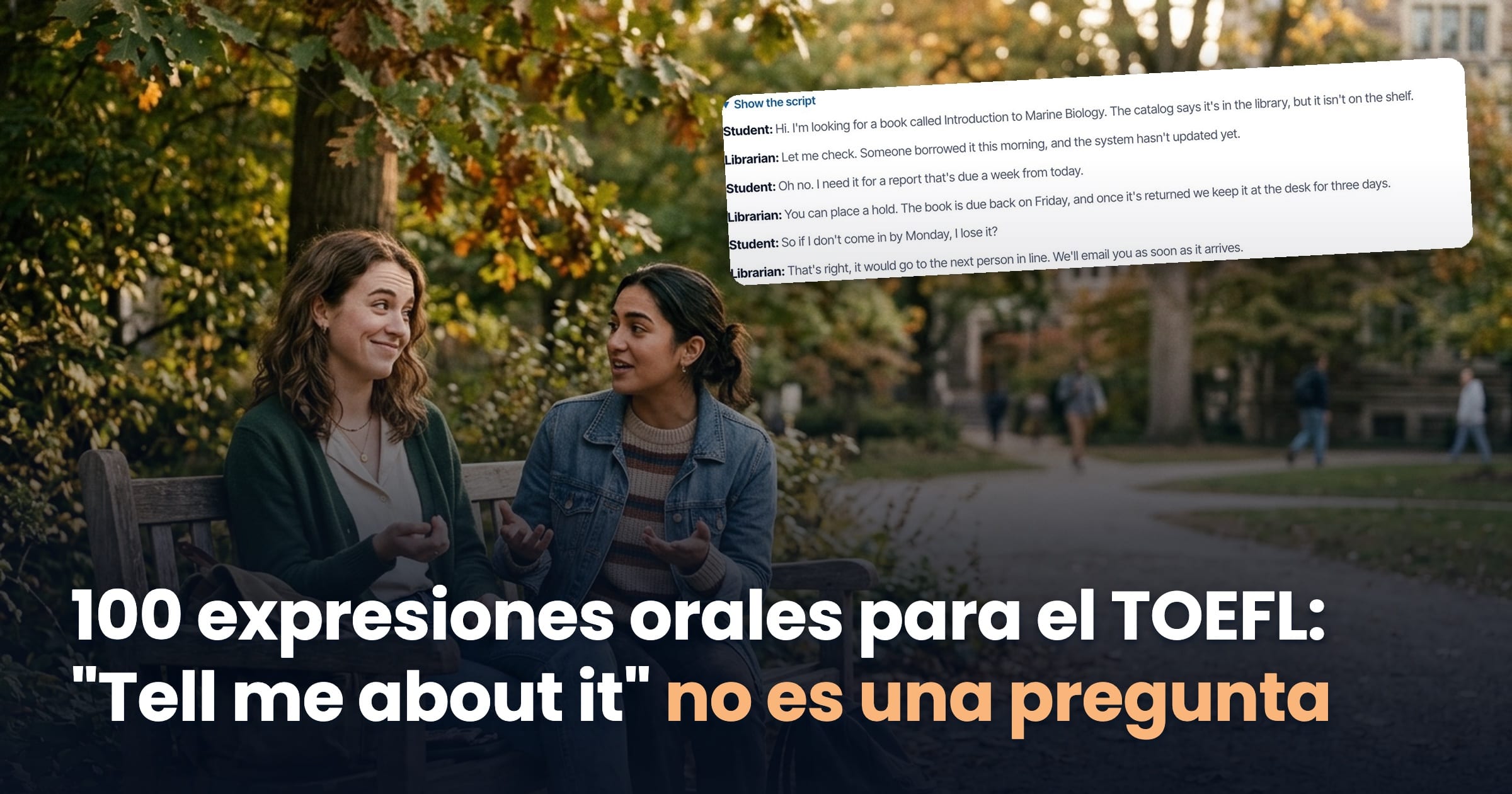
La mayoría de los estudiantes que fallan las preguntas de conversación de TOEFL Listening entiende la situación general. Saben quién llegó y para qué. Donde tropiezan es en la pregunta que pregunta por qué alguien dijo algo. Entienden la escena, pero se les escapa lo que realmente significa esa línea.
La causa está en cómo practican. La preparación suele centrarse en textos académicos y conferencias, así que los estudiantes se vuelven fuertes en inglés escrito y siguen flojos en las pequeñas expresiones habladas que la gente usa todos los días. Cuando un amigo dice "Tell me about it", no te está pidiendo detalles. Quiere decir "Lo sé, a mí me pasa igual". Con solo practicar listening esto casi nunca se adquiere. Estas expresiones hay que memorizarlas por su cuenta, aparte del inglés escrito.
Por eso aquí tienes 100 expresiones habladas que aparecen a menudo en las conversaciones del campus, ordenadas en 10 grupos según lo que el hablante intenta hacer. Cada una trae su significado real y un ejemplo breve en el campus. Para ver cómo abordar la tarea de conversación en conjunto, lee TOEFL Listen to a Conversation: 6 consejos.

Lo que contamos en nuestros propios guiones de listening
Reunimos todos los guiones de Listening de nuestros 12 exámenes completos de práctica del TOEFL (conversaciones, Choose a Response, anuncios, charlas académicas) más los guiones de nuestras páginas de práctica de listening: 43,956 palabras en total. Luego contamos cuántas veces aparece cada una de las 100 expresiones de abajo.
El resultado nos dolió un poco, porque son nuestros propios materiales. Puedes resolver muchísimas preguntas de práctica y aun así toparte con estas expresiones mucho menos de lo que crees. Por eso existe esta lista.
Fuente: exámenes completos de TOEFL de testpracticelab, guiones de listening de 12 sets (34,885 palabras) más los guiones de las páginas de práctica de listening (9,071 palabras). Solo se contaron coincidencias exactas de la frase central de cada expresión, sin distinguir mayúsculas y minúsculas.
Seis que significan otra cosa si las traduces palabra por palabra
Estas seis llevan a respuestas incorrectas en las preguntas de intención del hablante más que las demás. Si juntas el significado literal de las palabras, eliges la opción equivocada.
Why don't you try the third floor?
No pregunta por una razón. Es una sugerencia: "Prueba en el tercer piso". Si la pregunta es qué sugiere el hombre, esta es la línea.
Tell me about it.
No pide más detalles. Significa "Te entiendo perfectamente". Después de una queja, casi siempre significa esto.
No way! That's great.
Es sorpresa, no rechazo. Con That's great después, es una sorpresa alegre.
I'm with you.
Puede significar "Estoy de tu lado", pero en medio de una explicación significa "Te sigo". No des por hecho que está de acuerdo.
I see where you're coming from, but...
Solo significa "Entiendo tus razones". El mensaje real es el desacuerdo que viene después de but.
Good luck with that.
Casi nunca es un ánimo. Es sarcasmo: "Eso no va a funcionar". El tono plano y descendente lo delata.
100 expresiones habladas en 10 grupos de intención
El nombre de cada grupo es la intención del hablante. En las preguntas de intención del hablante, la opción correcta suele estar redactada con esa misma idea: está de acuerdo, rechaza, duda, se sorprende. Toca un grupo para ir directo a él.
- Estar de acuerdo (10)
- Decir que no con tacto (10)
- Dudar (10)
- Sorpresa (10)
- Preocupación y tranquilizar (10)
- Sugerir (10)
- Corregir y cambiar de idea (10)
- Entender y confirmar (10)
- Frustración y estrés (10)
- Planes y situación (10)
Estar de acuerdo (Agreeing)
| Expresión | Lo que realmente significa | Ejemplo |
|---|---|---|
| Tell me about it. | Te entiendo perfectamente, a mí me pasa igual. No es una petición de más detalles | A: This lab report is taking forever. B: Tell me about it. I've been on mine since Monday. |
| You can say that again. | Estoy totalmente de acuerdo | A: The new library hours are terrible. B: You can say that again. |
| I'm all for it. | Apoyo la idea por completo | A: Should we start the project this weekend? B: I'm all for it. |
| Fair enough. | Es razonable; lo acepto | A: I can't meet Friday because I work. B: Fair enough. How about Thursday? |
| That makes sense. | Lo entiendo y el razonamiento me parece lógico | A: The form needs your adviser's signature first. B: That makes sense. |
| Sounds like a plan. | De acuerdo; hagámoslo así | A: Library at six, then dinner? B: Sounds like a plan. |
| I couldn't agree more. | Estoy completamente de acuerdo | A: We should ask the professor before changing the topic. B: I couldn't agree more. |
| Count me in. | Cuenta conmigo; me apunto | A: A few of us are going to the career fair. B: Count me in. |
| You've got a point. | Lo que dices tiene sentido; me estás convenciendo en parte | A: If we split the reading, we'll finish sooner. B: You've got a point. |
| Works for me. | Por mí, perfecto | A: Can we move the meeting to two? B: Works for me. |
Decir que no con tacto (Saying no politely)
| Expresión | Lo que realmente significa | Ejemplo |
|---|---|---|
| I'm not so sure about that. | No estoy de acuerdo, dicho con suavidad | A: Online sections are always easier. B: I'm not so sure about that. |
| I'd rather not. | Prefiero no hacerlo; un no educado | A: Want to present first? B: I'd rather not. |
| I'll pass. | No, gracias; no me apunto | A: We're grabbing pizza after the lab. B: I'll pass. I have an early shift. |
| That's a stretch. | Eso ya es exagerar; la conclusión va demasiado lejos | A: One survey proves students prefer mornings. B: That's a stretch. |
| I see your point, but... | Te entiendo, pero no estoy de acuerdo; lo que importa viene después de but | A: We should drop the interview part. B: I see your point, but the professor asked for it. |
| Not really. | En realidad no | A: Did the review session help? B: Not really. |
| I wish I could, but... | Un rechazo educado | A: Can you cover my shift Saturday? B: I wish I could, but I'm going home. |
| Maybe some other time. | Ahora no; casi siempre es un no suave | A: Join our study group tonight? B: Maybe some other time. |
| I'm afraid that won't work. | No, dicho con cortesía, a menudo por personal o profesores | A: Could I submit it next month? B: I'm afraid that won't work. |
| That's not really my thing. | Eso no me interesa mucho | A: You should join the debate club. B: That's not really my thing. |
Dudar (Doubting)
| Expresión | Lo que realmente significa | Ejemplo |
|---|---|---|
| I wouldn't count on it. | No cuentes con eso; no va a pasar | A: Maybe the professor will cancel the quiz. B: I wouldn't count on it. |
| I doubt it. | Creo que no | A: Will the shuttle run during break? B: I doubt it. |
| Easier said than done. | Suena fácil, pero hacerlo es difícil | A: Just finish the thesis by May. B: Easier said than done. |
| I'll believe it when I see it. | No me fío de esa promesa | A: They promised the Wi-Fi will be fixed this week. B: I'll believe it when I see it. |
| Don't get your hopes up. | No te hagas ilusiones | A: I applied for the scholarship late. B: Don't get your hopes up. |
| Good luck with that. | Sarcasmo: no creo que puedas lograrlo | A: I'll read all six chapters tonight. B: Good luck with that. |
| Yeah, right. | Sarcasmo: no te lo creo | A: The exam will be easy. B: Yeah, right. |
| That sounds too good to be true. | Seguro que hay trampa | A: The course has no exams and no papers. B: That sounds too good to be true. |
| I have my doubts. | No estoy convencido | A: The new schedule will fix the overcrowding. B: I have my doubts. |
| It's a long shot. | Es posible, pero poco probable | A: Could I still get into the full class? B: It's a long shot. |
Sorpresa (Surprise)
| Expresión | Lo que realmente significa | Ejemplo |
|---|---|---|
| No way! | ¿En serio? ¡Qué sorpresa! No es un rechazo | A: I got an A on the final. B: No way! That's great. |
| You're kidding. | No me lo puedo creer | A: The deadline moved up to Monday. B: You're kidding. |
| That's news to me. | No lo sabía | A: Office hours moved to Thursday. B: That's news to me. |
| I had no idea. | No tenía ni idea | A: The gym is free for students. B: I had no idea. |
| Since when? | Eso es nuevo para mí; ¿desde cuándo cambió? | A: You need a permit to park there now. B: Since when? |
| Who would have thought? | Nadie se lo esperaba | A: Our small club won the grant. B: Who would have thought? |
| That came out of nowhere. | Pasó de repente, sin aviso | A: The professor gave a pop quiz. B: That came out of nowhere. |
| I didn't see that coming. | Eso no me lo esperaba | A: Mark switched his major to music. B: I didn't see that coming. |
| Seriously? | ¿En serio? Suele ser sorpresa mezclada con fastidio | A: The printer is broken again. B: Seriously? |
| That's a first. | Esto nunca había pasado; normalmente no ocurre | A: The bus actually came on time. B: That's a first. |
Preocupación y tranquilizar (Worry and reassurance)
| Expresión | Lo que realmente significa | Ejemplo |
|---|---|---|
| I'm freaking out. | Estoy muy angustiado | A: How's the thesis? B: I'm freaking out. It's due in two days. |
| It's been on my mind. | No dejo de darle vueltas | A: Did you decide about studying abroad? B: Not yet. It's been on my mind. |
| I'm a nervous wreck. | Estoy nerviosísimo | A: Ready for your presentation? B: I'm a nervous wreck. |
| Don't sweat it. | No te preocupes por eso | A: Sorry I'm late. B: Don't sweat it. |
| You'll be fine. | Te va a ir bien | A: I've never done an interview. B: You'll be fine. |
| It's not the end of the world. | Es un problema pequeño; te puedes recuperar | A: I failed the first quiz. B: It's not the end of the world. |
| Take it easy. | Tranquilo; no te exijas tanto | A: I've been up studying since four. B: Take it easy. |
| No big deal. | No tiene importancia | A: I forgot to bring your notes. B: No big deal. |
| You've got this. | Tú puedes | A: My defense is tomorrow. B: You've got this. |
| Hang in there. | Aguanta; ya va a mejorar | A: Three exams this week. B: Hang in there. |
Sugerir (Suggesting)
| Expresión | Lo que realmente significa | Ejemplo |
|---|---|---|
| Why don't you...? | Una sugerencia, no una pregunta sobre razones | A: I can't find a quiet place to study. B: Why don't you try the third floor? |
| How about...? | Una sugerencia | A: When should we meet? B: How about after lunch? |
| You might want to... | Un consejo educado; deberías | A: My essay is due Friday. B: You might want to start the outline today. |
| It wouldn't hurt to... | Deberías hacerlo; no pierdes nada | A: Should I email the professor? B: It wouldn't hurt to ask. |
| If I were you, I'd... | Un consejo directo | A: Two courses I like meet at the same time. B: If I were you, I'd take the one that fills up first. |
| Have you thought about...? | Una sugerencia en forma de pregunta | A: I need money for books. B: Have you thought about the library job? |
| What if we...? | Consideremos esta opción | A: The room is booked. B: What if we meet in the lounge? |
| I'd go with... | Yo elegiría... | A: Statistics or economics? B: I'd go with statistics. |
| It might be worth... | Podría valer la pena intentarlo | A: The class is full. B: It might be worth joining the waiting list. |
| Let's play it by ear. | Decidamos sobre la marcha, según cómo vaya todo | A: Should we book the room for two hours? B: Let's play it by ear. |
Corregir y cambiar de idea (Correcting and changing your mind)
| Expresión | Lo que realmente significa | Ejemplo |
|---|---|---|
| Actually, ... | Señala una corrección; la información nueva es la que importa | A: So the paper is due Monday? B: Actually, it's Wednesday. |
| On second thought, ... | Cambié de opinión | A: Let's take the bus. On second thought, let's walk. It's nice out. |
| Come to think of it, ... | Acabo de recordar o darme cuenta de algo | A: Did anyone mention the deadline? B: Come to think of it, the TA did. |
| Scratch that. | Olvida lo que acabo de decir | A: Meet at noon. Scratch that, I have a lab. Meet at one. |
| I take that back. | Retiro lo dicho | A: The class is easy. Well, I take that back. The final is hard. |
| What I meant was... | Aclaro lo que dije antes | A: You don't like my topic? B: What I meant was it's too broad. |
| Let me put it another way. | Te lo explico de otra manera | A: I don't follow. B: Let me put it another way. |
| That's not what I meant. | Me entendiste mal | A: So you want to quit the group? B: That's not what I meant. |
| I stand corrected. | Reconozco que me equivoqué | A: The lab closes at eight, not nine. B: I stand corrected. |
| Never mind. | Olvídalo; ya no hace falta | A: Can you... never mind, I found it. |
Entender y confirmar (Understanding and checking)
| Expresión | Lo que realmente significa | Ejemplo |
|---|---|---|
| So what you're saying is... | Compruebo que entendí bien | B: So what you're saying is I need two signatures? |
| Got it. | Entendido | A: Submit it through the portal, not by email. B: Got it. |
| I'm with you. | Te sigo; no siempre significa que esté de acuerdo | A: First we collect data, then we code it. B: I'm with you. |
| I'm lost. | Ya no entiendo nada | A: Then the variable becomes the control. B: Sorry, I'm lost. |
| That went over my head. | Fue demasiado difícil para mí; no lo entendí | A: Did you get the lecture on quantum states? B: That went over my head. |
| Could you run that by me again? | ¿Me lo explicas otra vez? | A: Could you run that by me again? The part about the forms. |
| Fill me in. | Cuéntame lo que me perdí | A: I missed the meeting. Fill me in. |
| Does that make sense? | ¿Se entiende? | A: You take the core courses first. Does that make sense? |
| I see where you're coming from. | Entiendo tus razones, aunque no esté de acuerdo | A: I think grades shouldn't count participation. B: I see where you're coming from, but... |
| Point taken. | Acepto la crítica | A: You keep starting too late. B: Point taken. |
Frustración y estrés (Frustration and stress)
| Expresión | Lo que realmente significa | Ejemplo |
|---|---|---|
| I'm swamped. | Estoy hasta arriba de trabajo; suele ser la razón para decir que no | A: Can you help me edit this? B: Sorry, I'm swamped this week. |
| I'm fed up with... | Estoy harto de algo | A: I'm fed up with the noise in my dorm. |
| It's driving me crazy. | Me tiene desesperado | A: The Wi-Fi keeps dropping. It's driving me crazy. |
| That's the last straw. | Ya no lo acepto más; viene una acción | A: They lost my form again? That's the last straw. |
| I've had it with... | Llegué a mi límite con algo | A: I've had it with this group. Nobody does their part. |
| It's a pain. | Es molesto y engorroso | A: Renewing the permit online is a pain. |
| What a hassle. | Qué lata, qué engorro | A: I have to go to three offices for one signature. What a hassle. |
| I'm running on empty. | No me queda energía | A: You okay? B: I'm running on empty. Three hours of sleep. |
| I'm stuck. | Estoy atascado; no puedo avanzar | A: How's the coding assignment? B: I'm stuck on the second part. |
| I'm behind on... | Voy atrasado con el trabajo | A: I'm behind on the readings for this class. |
Planes y situación (Plans and status)
| Expresión | Lo que realmente significa | Ejemplo |
|---|---|---|
| I'm on it. | Yo me encargo | A: Can someone book the room? B: I'm on it. |
| It's up in the air. | Todavía no está decidido | A: Is the trip still on? B: It's up in the air. |
| I'll get back to you. | Te respondo después, ahora no | A: Can you join the panel? B: I'll get back to you tomorrow. |
| It slipped my mind. | Se me olvidó | A: Did you send the form? B: Oh no, it slipped my mind. |
| I'm cutting it close. | Voy muy justo de tiempo | A: The bus leaves at 8:50 and class starts at nine. I'm cutting it close. |
| It came down to the wire. | Lo terminé en el último momento | A: Did you finish on time? B: It came down to the wire. |
| It's a done deal. | Ya es definitivo | A: Did they approve your transfer? B: It's a done deal. |
| Let's call it a day. | Dejémoslo por hoy | A: We've been here five hours. Let's call it a day. |
| Keep me posted. | Avísame cuando sepas algo más | A: I'll hear about the internship next week. B: Keep me posted. |
| Off the top of my head, ... | De memoria, sin comprobarlo; puede que no sea exacto | A: Which professor teaches that? B: Off the top of my head, Dr. Lee. |
Cómo memorizarlas
- Aprende el ejemplo, no solo la frase. Una frase suelta no te va a venir a la mente en plena conversación. Aprende lo que la otra persona dijo justo antes, todo como un solo bloque.
- Reduce el significado a una palabra de intención. Escribe "duda" al lado de Easier said than done. Las opciones de respuesta suelen redactarse con esa sola idea.
- Practica también el tono. Good luck with that y Yeah, right pueden ser amistosas o sarcásticas según el tono. Di cada ejemplo en voz alta de las dos maneras.
- Márcalas en guiones reales. Después de una pregunta de conversación, abre el guion y subraya cualquier expresión de esta lista. Encontrarte una frase una vez en un contexto de examen hace que se te quede.
Un grupo hoy
No necesitas las 100 de una vez. Aprende hoy un grupo de diez, con sus ejemplos, y luego prueba las conversaciones de TOEFL Full Practice Test 001. Después, abre los guiones en la página de respuestas y verás exactamente dónde se usó cada expresión.
Para el orden de los pasos y cómo tomar notas en esta tarea, lee TOEFL Listen to a Conversation: 6 consejos. Para más conversaciones y conferencias, entra en práctica de TOEFL listening.