Middle Schoolers Should Start TOEFL Now, Not Suneung English
Why middle schoolers should start TOEFL instead of Suneung English
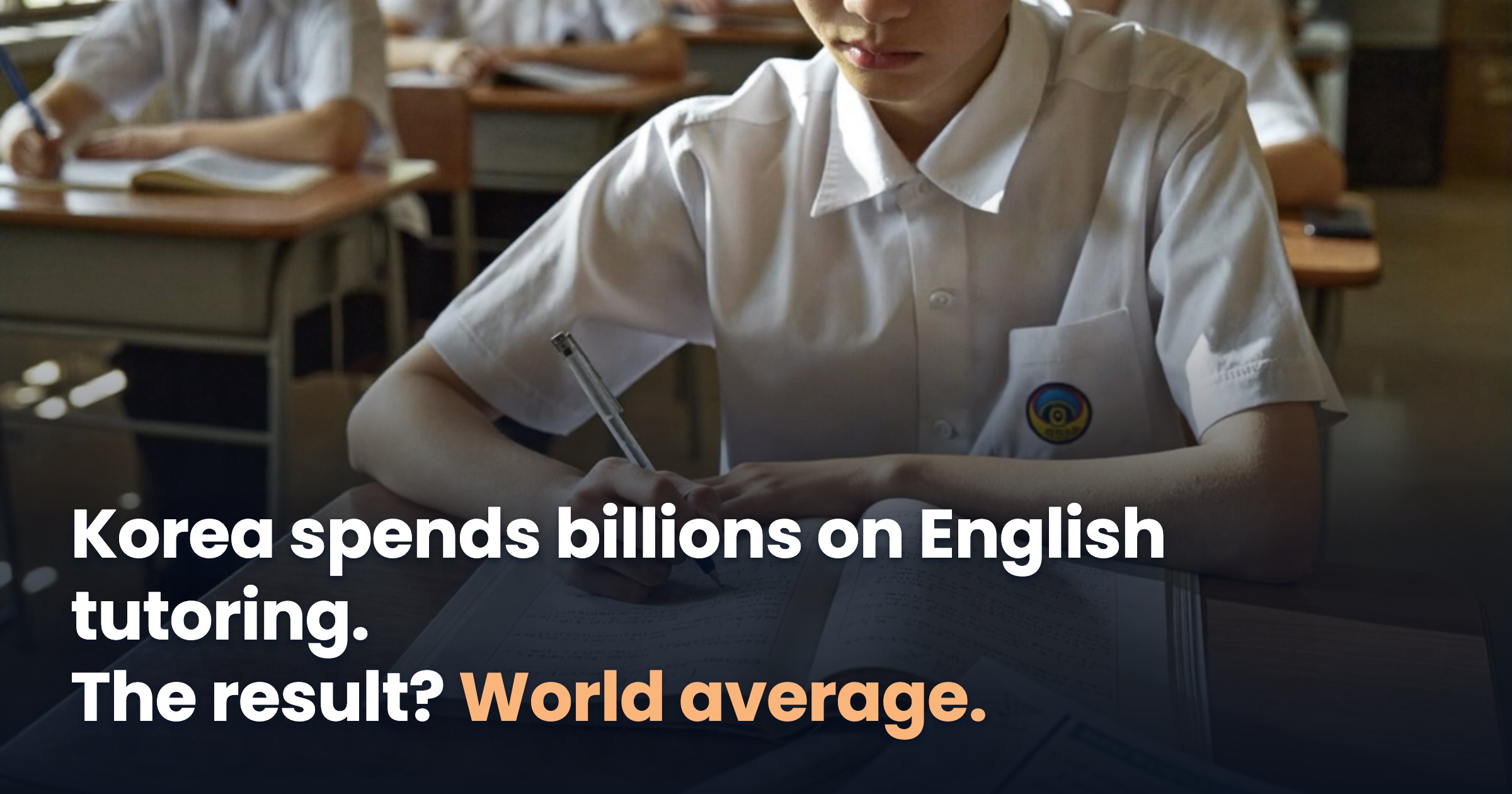
Korea pours enormous money into English private education every year. Is it paying off? Honestly, I'm skeptical. It's worth asking seriously whether the hours a kid spends at hagwon actually turn into English they can use later.
Korean middle schoolers are stuck memorizing grammar in fragments
Most Korean middle schoolers study English the way the Suneung and school exams demand. That means burning their time memorizing chopped-up grammar rules to answer test questions, while speaking and writing get pushed to the back burner.
The EF EPI 2025 survey ranked Korea 48th in the world for English proficiency. A score of 522, above the world average of 488, but disappointing given how much money goes into it. What bothers me most is the speaking score. Speaking came in at 489 while reading hit 540, a 51-point gap. That's what teaching to the test looks like.
Professor Samuel Denny of Sangmyung University made the same point in an interview with the Korea Times: "Suneung English doesn't reflect real communication ability." The Suneung English section is 45 questions total: 17 listening, 28 reading. Not one question tests speaking or writing. Using English in the real world runs all four skills at once, and two of them are missing entirely.
British Council research found Korean college students spend an average of 3.94 hours a week on English study, nearly double the 1.98 hours they spend on their actual majors. And yet ETS 2023 data puts Korea's average TOEFL score at 86, barely above the world average of 87. All that time and money, and the result is exactly average. That number genuinely surprised me.
TOEFL measures the "academic English" you actually need
What TOEFL measures is "academic English": the English you need to sit through a lecture, join a discussion, write a paper. It tests all four areas: reading, listening, speaking, writing. Speaking and writing, in particular, are areas our kids have rarely even encountered on a test before.
I think building all four together is the whole point. TOEFL doesn't stop at reading a passage. It goes further, asking you to speak and write your own opinion based on what you read. Suneung-style studying never gets to that step at all.
The real advantage of starting TOEFL in middle school
Starting TOEFL in middle school doesn't just leave you with a score. It builds English you can actually use, and it does that while the golden window for language acquisition is still open.
A joint MIT and Harvard research team analyzed 670,000 people, the largest language acquisition study ever conducted. It was published in the journal Cognition. The team (Hartshorne, Tenenbaum & Pinker, 2018) concluded that reaching native-level grammar requires starting before age 10, but added that "grammar-learning ability remains high until age 17 or 18 and then declines sharply." In other words, early teens are still inside the high-efficiency window.
There's a bonus, too. TOEFL passages cover science, history, social issues, the humanities, the same subjects actually taught in university. A student studying English ends up absorbing that content along the way, something Suneung-style test prep never delivers.
The parent's dilemma: today's Suneung score vs. long-term English ability
Parents often get stuck weighing today's school grades and Suneung score against their kid's long-term English ability. I understand the hesitation: the score in front of you feels urgent, and it's not obvious that TOEFL helps with Suneung right away.
But zoom out a little. Take a kid who goes all-in on Suneung now and scores well, and a kid who's been building real ability with TOEFL since middle school. Ten years from now, who's speaking and writing more fluent English?
According to 2023 Statistics Korea data, private education spending hit an all-time high of 27.1 trillion won, roughly $20.6 billion. 78.5% of students are in hagwon or private tutoring, and English tutoring costs an average of 123,000 won a month, the highest of any subject. Spending that much and still ending up without usable English is genuinely a shame. I'd encourage parents to take the leap and focus on their kid's actual English ability instead of the score in front of them.
Middle school is the golden window for language acquisition
Going back to that MIT research, grammar-learning ability stays high through age 17 or 18. That puts the window from late elementary school through ninth grade, tenth at the latest, as the stretch where investing in TOEFL pays off the most, in my view. Get a real foundation down during this window, and a kid won't freeze up when an opportunity for study abroad or a job calls for English later. English becomes a strength instead of a weak spot.
It won't be easy, to be clear. But if a kid breaks free of rote memorization during this window and discovers the actual enjoyment of using English, that time comes back many times over. Isn't trusting a kid's potential and pointing them in the right direction the parent's job?
TOEFL 80: the most realistic, effective starting point
TOEFL doesn't have to mean chasing a top score right away. Aim for 100+ from day one and a kid burns out fast. I'd strongly recommend making 80 the first target.
A TOEFL score of 80 lines up with CEFR B2, upper-intermediate. That's enough to follow college lectures without much trouble and handle basic communication. According to PrepScholar, a score of 80 puts you around the 41st percentile of all test-takers worldwide. With the global median TOEFL score sitting at 84, 80 is a realistic, reachable target.
Working toward 80 alone gets a kid something different from school-exam English: not grammar that evaporates the moment the test ends, but English they can actually pull out later, in college or abroad. The gap between a kid who starts now and one who puts it off for a few years doesn't show up immediately. It shows up a few years later.
If you're not sure where to start, try a few free TOEFL practice questions first: no sign-up, no payment required. Passages written for a middle schooler's level make that first impression of TOEFL a lot less intimidating.