TOEFL Read an Academic Passage: How to Handle a 700-Word Text
Read an Academic Passage is the heaviest task in TOEFL Reading. You read a single passage of about 700 words, the kind of excerpt you'd find in a university textbook, and answer the questions attached to it. Unlike Read in Daily Life, where the texts are a short email or notice, the sheer amount of reading is part of the challenge. But what separates scores is less your reading speed than whether you know the routine for each question type. Here is each type with real test screens, plus 14 tips for cutting down on mistakes.
At a glance
- Passage: an academic text of about 700 words, with numbered paragraphs (¶1, ¶2...). It stays on screen while you answer.
- Questions: main ideas, key details, inferences, relationships between ideas, and rhetorical structure. Across the whole test, Academic Passage accounts for 5 to 15 questions.
- Scoring: 1 point per question, multiple choice, machine scored.
- Adaptive: the Reading section is two-stage adaptive, so your first module decides how hard the second one is.
(Sources: ETS's official 2026 TOEFL iBT Test Blueprint and Specifications. The passage length comes from the author's 12 years of teaching the test.)
The screens below are captured from testpracticelab's free practice set 010 (a passage about a bridge collapse, 11 questions). Our sets use 11 questions so you can practice every type. In the worked examples under each tip, a wavy underline marks the evidence for the answer and a strikethrough marks the choice you should rule out.
First: how to read the passage
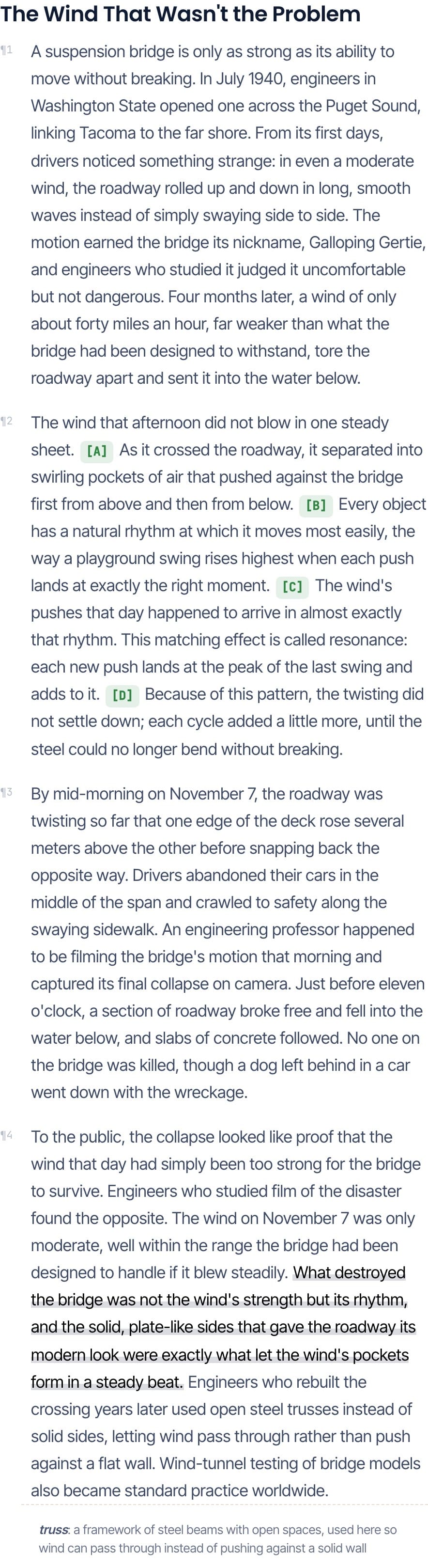
Leave one line of summary per paragraph, then move on
Try to absorb 700 words in one go and the early paragraphs fade by the end. At the end of each paragraph, leave yourself one line, in your head or on paper. When a paragraph-relation or summary question shows up, those lines become your map.
Don't grab numbers and names on the first read
You can look up numbers and proper nouns when a question asks. The passage stays on screen, so there's nothing to memorize. Instead, catch the words that signal cause and effect (why, so, because of this).
In July 1940, engineers in Washington State opened one across the Puget Sound.
Numbers and names can be looked up when a question asks.
Because of this pattern, the twisting did not settle down; each cycle added a little more.
Don't miss the cause markers. Questions ask about these most often.
1. Vocabulary and reference questions
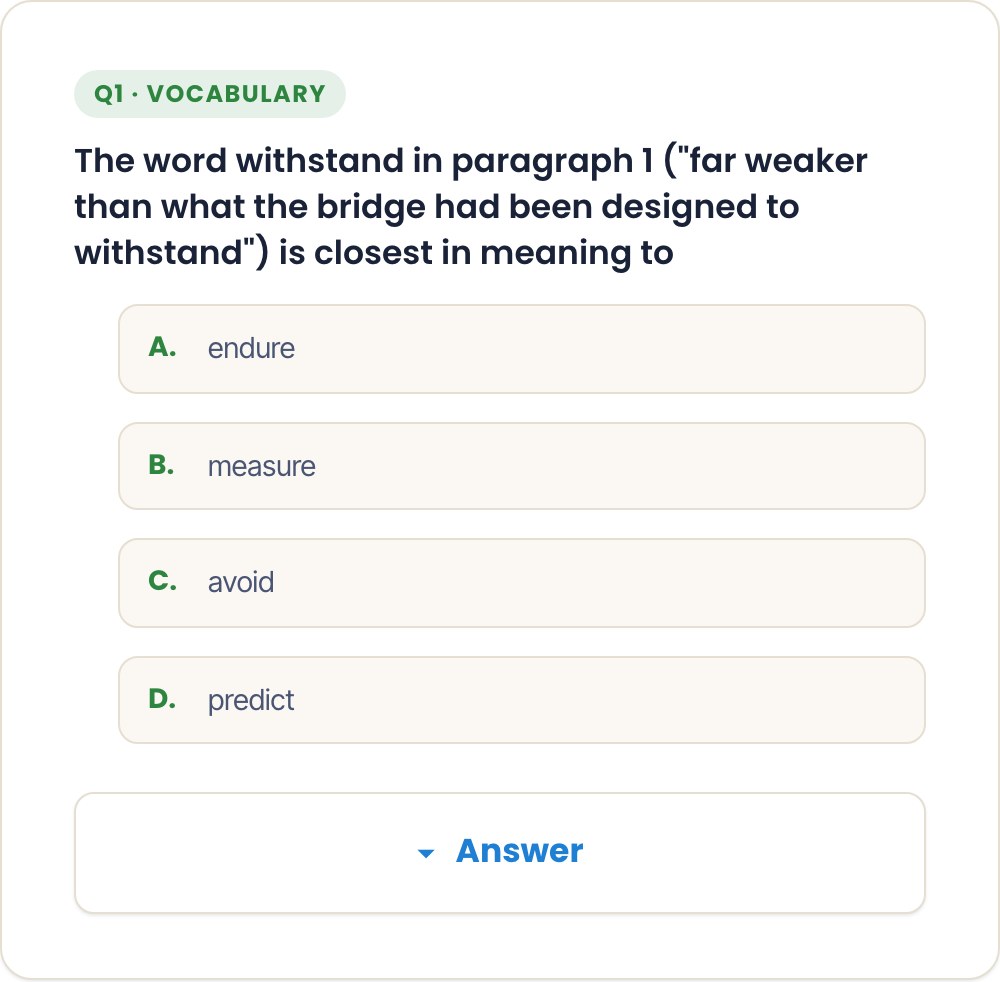
- A word or pronoun is quoted along with a paragraph number: "closest in meaning to..." or "what does it refer to?"
- The passage stays visible, so you can go straight to the sentence the question points to.
Get the meaning from the sentence before looking at the choices
Look at the choices first and you get pulled toward the meaning you already know. Read the quoted sentence, come up with what would fit that spot, then match it to a choice. When a word has several meanings, context decides.
...far weaker than what the bridge had been designed to withstand
Get the meaning from the sentence first: to hold up under.
A. endure
It fits the sentence.
C. avoid
Avoid isn't the meaning.
List every noun a pronoun could point to
When it could be the roadway or the bridge, write down all the candidates and test each one against the verb that follows. Here, "separated into swirling pockets of air" settles it.
As it crossed the roadway, it separated into swirling pockets of air
the roadway
The verb doesn't fit.
the bridge
The verb doesn't fit.
the wind
Only wind separates into pockets of air.
2. Finding information: Factual Information, Negative Fact, Essential Term
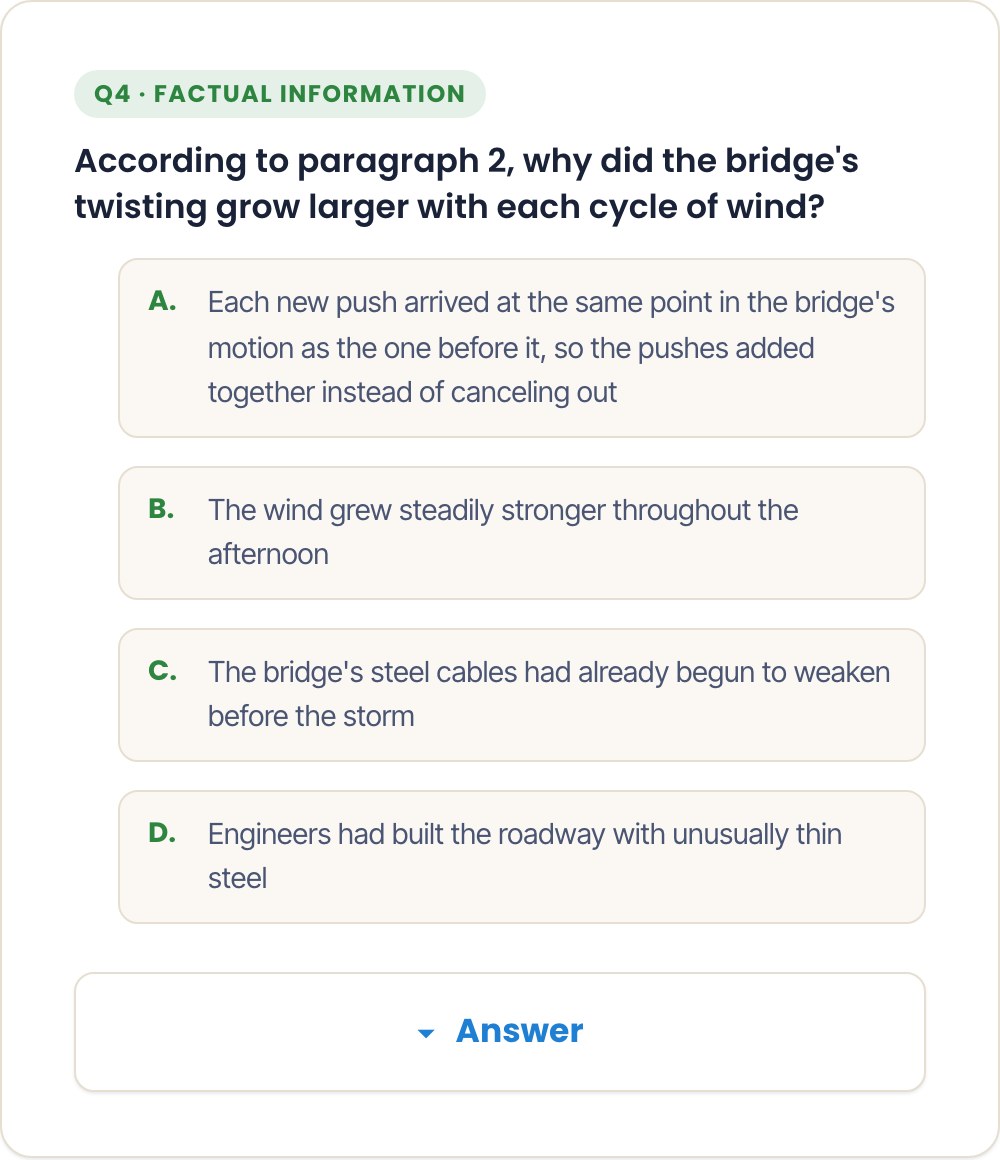
- Factual Information sends you to one spot in the passage: "According to paragraph N, why or what..."
- Negative Fact is the EXCEPT question. Three choices are in the passage and one is missing or different.
- Essential Term asks you to pick the definition of a term (like resonance) that the passage explains.
If the question names a paragraph, read only that paragraph
"According to paragraph 2" means no other paragraph can hold the answer. Go straight there instead of rereading everything. Rereading is where most of your time leaks.
For EXCEPT, find the evidence for each choice and mark it O or X
The structure is "all true except one," so finding three pieces of evidence takes time. Mark a choice O if you find support and X if it's missing or reversed. The single X is the answer. The wrong choice is often something the passage never says.
A. Drivers abandoned their cars ... along the swaying sidewalk
There's a supporting sentence.
B. An engineering professor recorded the collapse on film
There's a supporting sentence.
C. A section of the roadway fell into the water before the concrete slabs
There's a supporting sentence.
D. Several people were killed
The passage states that no one on the bridge was killed. This is the EXCEPT answer.
For term definitions, be suspicious of the choice that sounds like common knowledge
A choice calling resonance "a strong gust of wind" sounds plausible, but it isn't the passage's definition. Pick based on the explanation right after the passage introduces the term. This question tests the passage's definition, not general knowledge.
a general term for any strong gust of wind that damages a structure
Sounds right from common knowledge, but it isn't the passage's definition.
a repeated matching between a push's rhythm and an object's natural rhythm
It's the passage's own definition.
3. Understanding and inference: Sentence Simplification, Inference
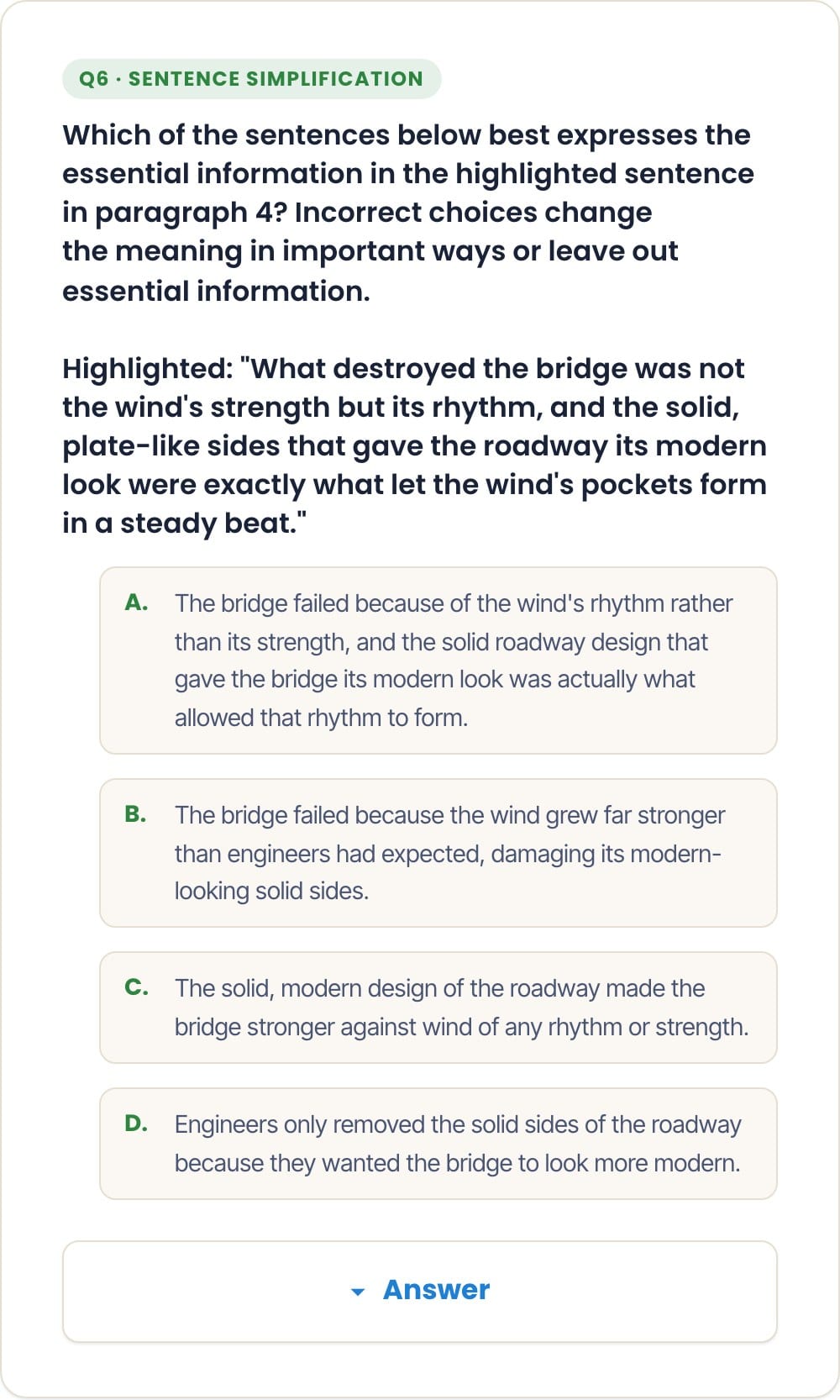
- Sentence Simplification asks which sentence best restates a highlighted sentence from the passage.
- Inference asks for something that isn't stated directly but follows clearly from the passage.
For sentence simplification, check that all three key pieces survive
The right answer keeps the essential information and doesn't change the meaning. Wrong answers drop information, add a cause that wasn't there, or reverse the claim. Split the original into three pieces, then check that each choice keeps all three.
B. ...the wind grew far stronger than engineers had expected
It flips "not the strength" into "grew stronger."
The right inference answer says less than you'd expect
The correct choice is usually phrased like "might not have" rather than "definitely would have," claiming only as much as the passage supports. A choice that is too absolute, or that adds information the passage doesn't have, is wrong.
A. It would have caused the same kind of resonance and destroyed the bridge just as quickly
Too absolute. It claims more than the passage supports.
B. It might not have caused the same destructive twisting, since resonance depends on matching rhythm
It claims only as much as the passage supports.
4. Structure: Rhetorical Purpose, Paragraph Relation
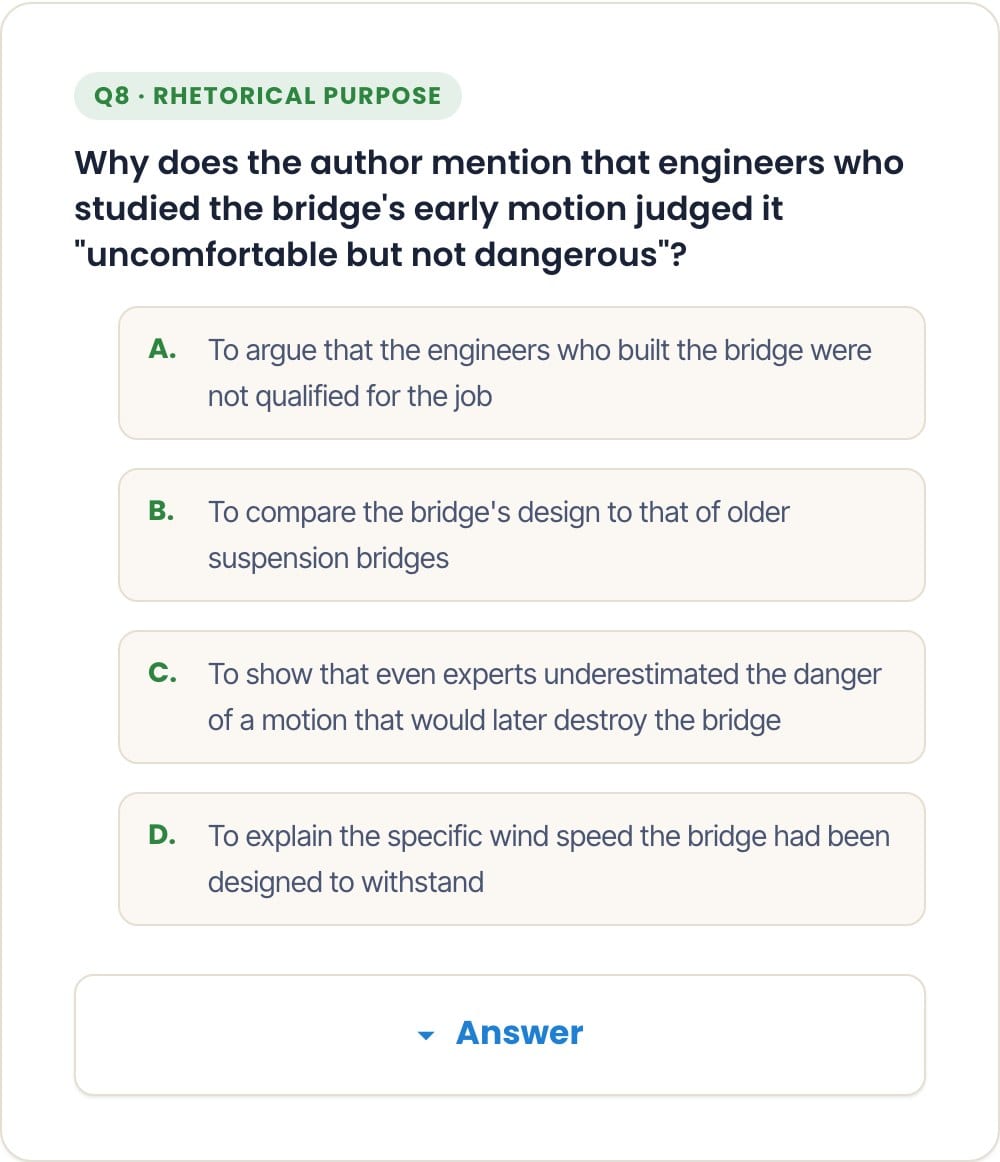
- Rhetorical Purpose asks why the author included a particular sentence or example. The role is the answer, not the content.
- Paragraph Relation asks how two paragraphs connect: cause and effect, problem and solution, and so on.
Answer "what is this sentence doing," not "what does it say"
Don't summarize the quoted sentence. Ask what the passage would be missing if you deleted it. That gap is its function. The right choice states a function ("to show that..."), and a choice that pulls in a claim the passage never made is wrong.
Question: Why does the author mention that engineers judged the bridge "uncomfortable but not dangerous"?
...engineers who studied it judged it uncomfortable but not dangerous
Remove this phrase and the twist that even experts underestimated the danger disappears.
C. To show that even experts underestimated the danger
Its function is to show the twist.
A. To argue that the engineers who built the bridge were not qualified
The passage never makes this claim.
Line up your one-line summaries side by side for paragraph relations
This is where the summaries from Tip 01 pay off. Put the two paragraphs' lines next to each other and label the relationship, like "first the principle, then the real result," and the choices sort themselves out.
5. Putting it together: Insert Text, Prose Summary
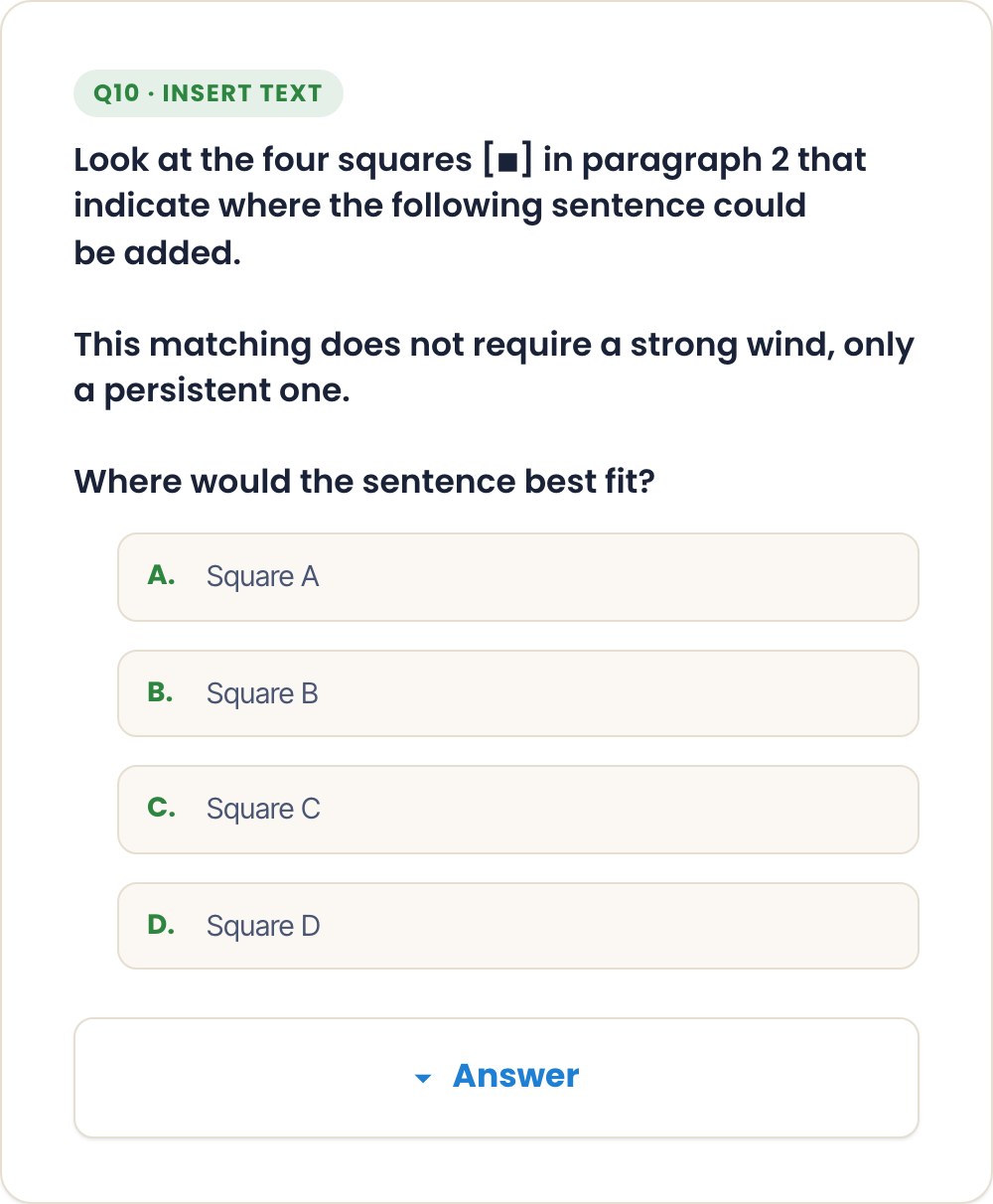
- Insert Text: choose which of four positions, [A] through [D], the given sentence fits.
- Prose Summary: choose the 3 of 6 sentences that capture the passage's main points. The other 3 are minor details or not in the passage.
Narrow the insert position with pointer words and connectors
Words like this, however, and for example in the given sentence tell you what has to come before it. Find the spot where the thing it points to has just been explained, then read the sentence in place to check.
This matching does not require a strong wind, only a persistent one.
"Matching" was already explained earlier. This sentence comes right after that, so [D].
For summaries, cross out details and off-passage ideas first
The 3 right answers are the skeleton of the whole passage, not the details of one paragraph. Pick the choices that overlap with your one-line summaries from Tip 01 first, and leave the ones that stay stuck on a single example or number for last.
Time management: don't spend it all on the passage
Read roughly the first time, precisely at the question
The passage stays on screen, so you don't need to understand everything up front. Go into the questions with a one-line-per-paragraph grasp and read closely only where each question points. Spend all your time at the top of the passage and you'll rush through the last questions.
read the passage twice, carefully, then start the questions
You burn your time and rush the later questions.
leave one line per paragraph, then go to the questions
Read closely where the question points.
Wrapping up
Read an Academic Passage looks like a test of reading long texts, but really it rewards the person who knows where to look and how to read for each question type. Getting a skeleton from one line per paragraph, then reading closely only where the question points, protects both your time and your accuracy.
Start practicing like it's the real thing. testpracticelab has free TOEFL Reading practice sets you can pick by difficulty. Try set 010, the one whose screens are used in this article, with a timer, then apply the tips one at a time.