2 Mistakes Almost Every First-Time TOEFL Taker Makes

When students walk out of their first TOEFL, they usually say one of two things. "I didn't realize how fast the time would go." Or: "I'd never thought about that topic, so I had nothing to say." After 12 years of watching first-time test takers, I've noticed that students who have the English but still lose points on their first attempt almost always break down in one of these two places. That's usually about how they prepared, not how good their English is, so you can fix it before test day.
Mistake 1: Freezing on a topic you know nothing about
Over the years I've found that students tend to fall into two groups. The first group treats English like a system of rules. Their grammar is solid, and they build their answers step by step, logically. The second group makes more grammar slips, but they're good at improvising. Give them any topic and they'll start talking.
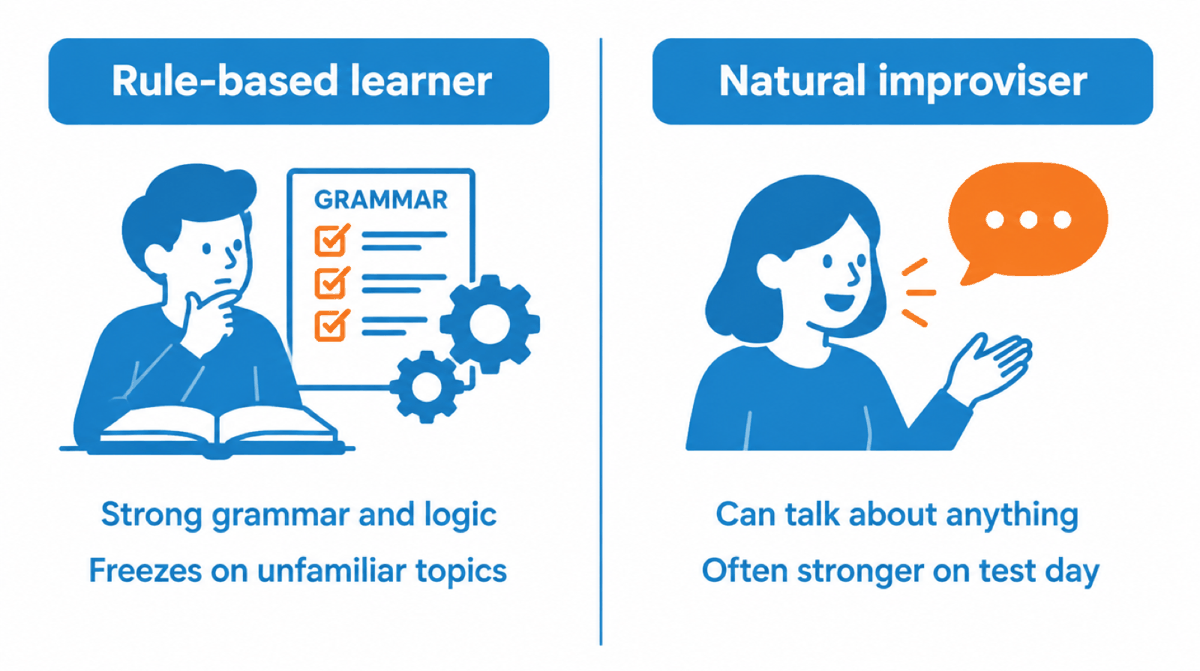
You might expect the rule-based students to do better, but on test day it's usually the improvisers. Rule-based students score well on practice questions, then get Speaking and Writing scores lower than they expected on the real test. Those two sections don't give you much time to think. You see the question and you have to start speaking or writing almost right away. If the topic has nothing to do with your life, the students who want to build a perfect argument first are the ones who can't get the first sentence out.
Here are two real cases. One student barely listened to music. The only songs they knew were the ones they'd learned in school, and the test asked them to talk about their favorite music genre. Another student had lived in a big city their whole life, and so had both of their parents. Their question asked them to describe time they had spent in the countryside. Look through official sample questions and you'll see topics like these all the time.


Raters don't check whether your story is true. They're listening to your English. So if you don't have the experience, invent it. Make up a believable weekend at your grandmother's farm. Pretend you love jazz and give two reasons why. Rule-based students find this surprisingly hard. A lot of them ask me, "Wait, I'm allowed to lie?" Yes. The test is grading your English, not your life story.
The practice method is simple. Pick topics you have never experienced on purpose, then plan and give your answer on the spot. Each time you do it, the next unfamiliar topic feels a little less scary. Our Speaking and Writing practice sets include plenty of these unfamiliar topics.
Mistake 2: Taking only one or two full tests before the real thing
The second mistake is timing. The TOEFL is long and tiring, so most people practice one section at a time. They do plenty of Reading sets and plenty of Listening sets, but they sit a full test from start to finish only once or twice before test day.
So each section feels familiar, but they have no feel for the test as a whole. They don't know where they should be at a given point, and they don't know how quickly time goes in the later sections when their focus starts to fade.
If you only have one or two chances to take a full practice test, here's how I'd use them:
- Take the first one with no plan. Just go start to finish and notice where your time goes and where you start to get tired.
- Take the second one with a plan. Set checkpoints like "by this point, I'll have finished this part," and practice sticking to them.
Just make sure the second plan is one you can actually keep. Base it on the pace you really had in your first full test. If you make the plan too tight, you'll panic even more on test day the moment it falls apart.
Before your first TOEFL
A lot of the time, first-time test takers lose points because of how they prepared, not because of their English. Practice inventing an answer for topics you know nothing about, and use full tests to build your sense of timing before the real day. Do those two things and you're much less likely to walk out saying, "That wasn't my real level." If note-taking worries you too, read our post on common listening note-taking mistakes.
Start practicing like it's the real test today. You can try free Speaking, Writing, Reading, and Listening practice questions right here on our site. When you hit a topic you know nothing about, that's your chance to practice.