5 Tips for Fill in the Missing Letters in TOEFL Reading
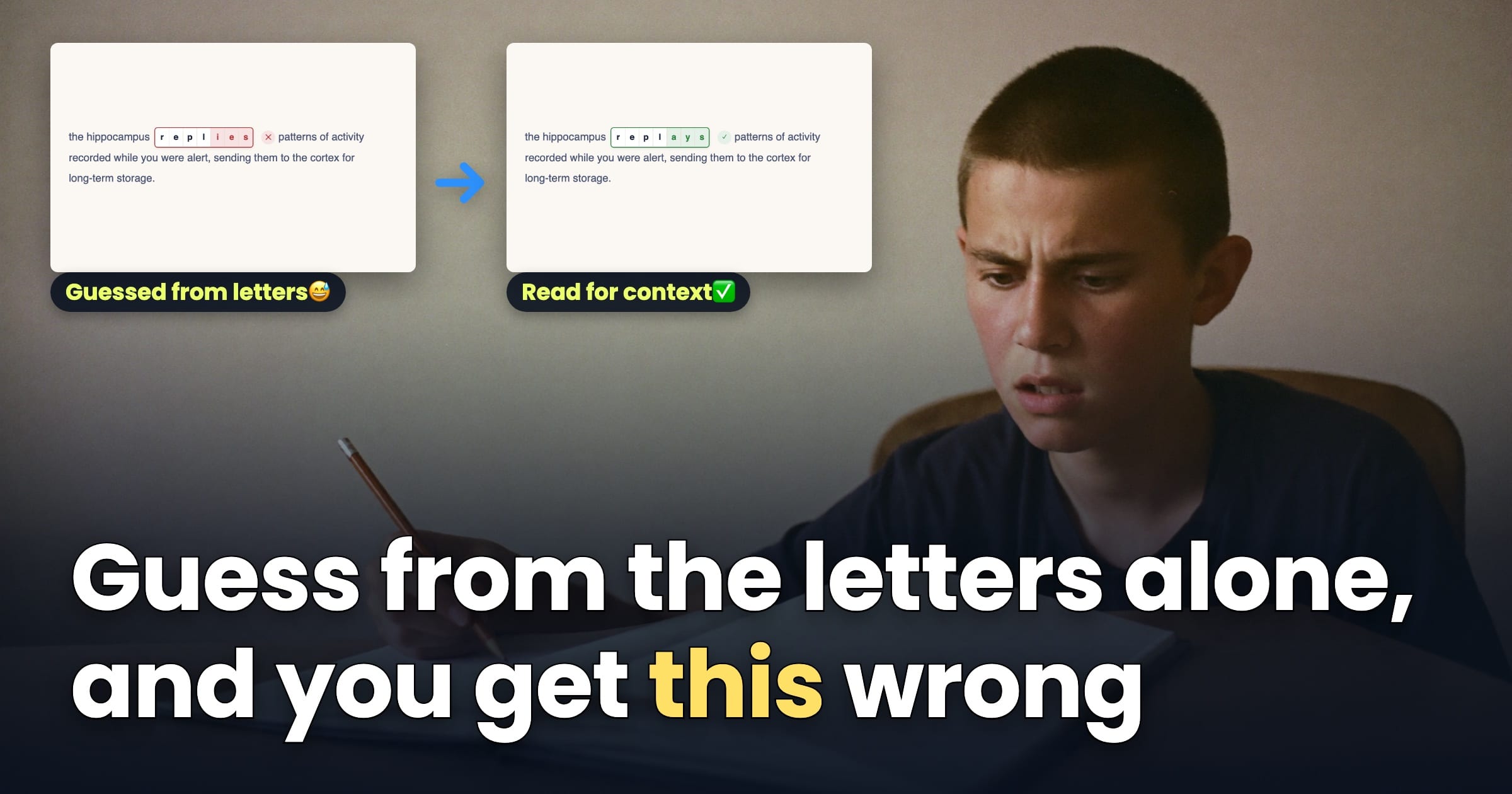
If you're prepping for the revised 2026 TOEFL, you'll run into a task you've never seen before, right at the start of Reading. Fill in the Missing Letters. You get a short academic paragraph with ten words missing about half their letters, and you type in what's gone. At first glance it looks like a spelling test, so most students breeze past it without much thought. But when you actually sit students down and watch them work through it, this one task ends up separating scores more than you'd expect. After 12 years of teaching Reading, here are the 5 tips I actually give students.
Tip 1: Understand it's reconstruction, not spelling
Looking at the blanks, it seems like you're just checking whether someone memorized a word. But that's not really what the task is testing. You have to figure out whether the slot wants a noun or a verb, narrow down the ending using the letters you're given and the number of empty boxes, and sometimes you need to read past the blank to get the answer. The passage itself is short, an academic paragraph of maybe 60 to 70 words, and it packs in ten blanks. If you don't understand the whole paragraph, you can't fill in a single one with real confidence.
So this task is less a vocabulary test and more a test of rebuilding a word from context. Even a word you already know has to be reshaped to fit its slot in the passage. And a word you don't know can often be worked out just from the context, the part of speech, and common suffix patterns. Knowing a lot of vocabulary doesn't automatically make this task easy, either.
Tip 2: Never guess from the blank letters alone
Sit students down with this task and the mistake patterns show up fast. The most common one: they skip the surrounding context and try to guess the word from just the few letters sitting in the blank. They land on something that looks plausible, but it doesn't match the logic the passage is building. Skip the context and you end up with an answer that's grammatically fine but doesn't fit what the passage is actually saying.
Tip 3: Train the meaning-to-word muscle separately
There's a deeper issue underneath the guessing habit. Students with genuinely strong reading skills still get stuck on this task more often than you'd think. The reason is simple. Normal reading only asks you to look at a word and pull up its meaning. This task asks for the opposite: pull the word's form out of the meaning and context. If that instant conversion from meaning to word is weak, a student who has no trouble with regular passages can suddenly find this task much harder than expected. Reading and retrieving are different muscles.
Tip 4: Don't breeze through it just because it's short
Here's my own take on it: this task functions as the gate for the entire Reading section. The 2026 TOEFL Reading section is structured so your early performance determines how hard the rest of the section gets, and from what I've seen coaching students, a low accuracy rate on Fill in the Missing Letters keeps you from advancing into the harder module. I've watched that lead to Reading scores getting stuck in the low 4s more than once. To be clear, ETS hasn't published an official number on this. It's a pattern I've picked up from coaching, not an official statistic. But it's consistent enough that I don't think this task deserves to be treated as "short, so just breeze through it." If anything, it's one of the few spots in Reading where you can protect your score cheaply.
Tip 5: Build vocabulary steadily and drill real sets
Honestly, there's no special trick for this task specifically. Your existing vocabulary is what decides the outcome. Memorize more words, work through real practice sets, there's no shortcut past that. But I do want to be clear about one thing. Vocabulary doesn't jump after a cram session or two. It builds slowly, the way rain soaks through fabric over time. If you try to cram this task alone in the last few days before the test, you'll get the worst return on your time of anything you could study.
That said, it's still worth getting familiar with the format ahead of time. The first time you see it, figuring out how to combine the letter count with the given letters isn't intuitive. After a few practice sets, though, judging part of speech first and narrowing by ending becomes second nature. There's one set I recommend to students a lot, about how sleep stores what you learn. It's intermediate difficulty, which makes it a good place to get a feel for the task, and the passage itself is interesting enough that it's not a slog to finish.
Start practicing like it's the real thing
Fill in the Missing Letters isn't a task you can afford to coast through. It takes a habit of reading for context, a real sense for pulling word forms out of meaning, and vocabulary you've built up steadily over time, and all three have to come together to solve it. Get that right, and it becomes one of the things protecting your Reading score, not costing it. You can work through the full set of practice paragraphs for free, and if you want to build up your Reading skills more broadly, there's more free practice waiting.