Duolingo Speak About the Photo: 5 Tips

Duolingo's 2026 Scoring Guide for Teachers includes three Speak About the Photo answers with their scores: Speaking 145, 115 and 85. I counted the words in each transcript: 148, 133 and 118. Sixty points apart, and only thirty words apart. All three test takers used plenty of their time.
So in this task, talking for a long time is the baseline. The score is decided somewhere else, and this article uses those three official answers to find where. When I run this task in class, students don't usually get stuck at the end of the 90 seconds. They get stuck on the first word. They stare at the photo for 20 seconds, the recording starts, and nothing comes out. So the focus here is what to recall in those 20 seconds and what order to use for the 90.
What the task looks like
- Screen: one photo. You look at it for 20 seconds, then recording begins.
- Time: up to 90 seconds. The photo stays on screen while you speak.
- Attempts: one. You can't re-record.
- Frequency: one question per test. Not adaptive.
- Photos: real photos of people, animals or objects in different situations.
- Score: counts toward the Speaking subscore, judged on six criteria: content, discourse coherence, fluency, grammar, lexis and pronunciation.
(Source: Duolingo English Test, Scoring Guide for Teachers 2026, section 4.4)
Older prep material often says "speak for at least 30 seconds and you're fine." The current official guide sets no minimum and only says "up to 90 seconds." All three answers above ran past 118 words.
Tip 1. Order matters more than length (official 145, 115 and 85 answers)
| Score | Length | What the official comments point out |
|---|---|---|
| 145 | 148 words, 9 sentences | Moves from setting → people → interpretation. Goes as far as a reasonable guess that the three are colleagues. Speaks about 30 seconds without a break early on. Pauses only fall between ideas |
| 115 | 133 words, 12 sentences | Has a structure: the scene, then each person in turn. But unfinished and awkward sentences break the flow, and there are moments of losing track and restarting |
| 85 | 118 words, 7 sentences | Plenty of detail. But ideas come out in no clear order, with frequent repetition ("with with") and restarts |
(Count: the three samples in section 6.3 of the official guide. Word and sentence counts are our own count of the transcripts. Scores are the test taker's Speaking subscore.)
Three things stand out.
- The 85 answer had plenty of detail too. Sunglasses, a gray T-shirt, a yellow T-shirt, two bottles of water. The official comment even notes "many relevant details." What it lacked was an order for laying them out.
- The 115 answer has the most sentences. Twelve. Short sentences are fine, but several never finished. The comment says lines like "We cannot see as much in this picture" broke the flow.
- Only the 145 answer went beyond the photo. "They might be teachers that are having a group discussion or a meeting." "They've worked together for a long time." The official comment calls this going "beyond basic description by making reasonable inferences."
A word on hard vocabulary. The 115 answer used less common words like mannequin and disguise, and the comment gave it credit. Still, the 145 came with words like whiteboard and engaged in a conversation. Order comes before vocabulary.
Tip 2. Use the 20 seconds to murmur key words
Don't try to build sentences in those 20 seconds. I tell students to recall key words and murmur them under their breath. Once the words are on your tongue, the sentences take care of themselves.
By key words I don't mean names of things like cup or table. I mean harder words that capture the whole photo at once: mood, camera angle, texture. Those words won't suddenly come to you in the test room. You pull them from a list you memorized beforehand. Mood, texture and position words are grouped in our 100 Duolingo photo description expressions.
Camera angle phrases aren't in that list, so here are a few.
| Phrase | When to use it |
|---|---|
| a close-up shot of ~ | One person or object photographed up close |
| a wide shot / taken from a distance | The whole place is in view |
| taken from above / a bird's-eye view | Looking down on the scene |
| taken at eye level | Shot from normal eye height |
| the focus is on ~, and the background is blurred | One person is sharp and the back is soft |
| it looks like a candid shot | Natural, not posed |
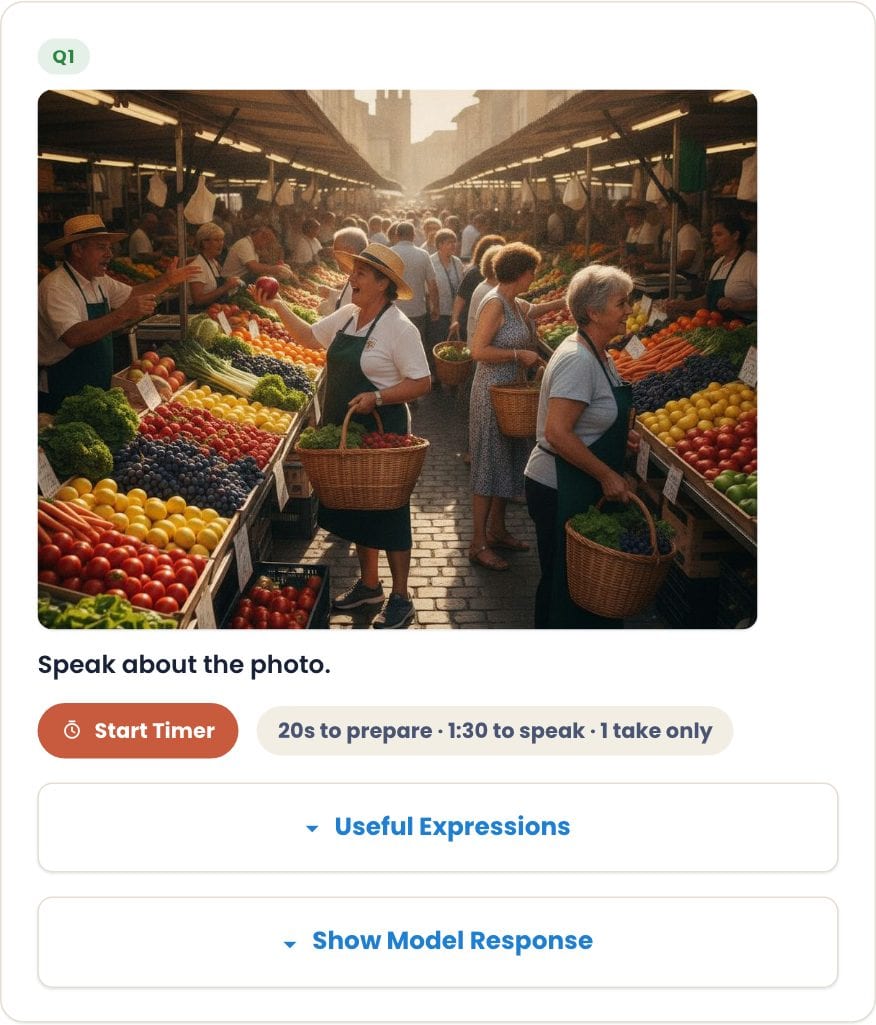
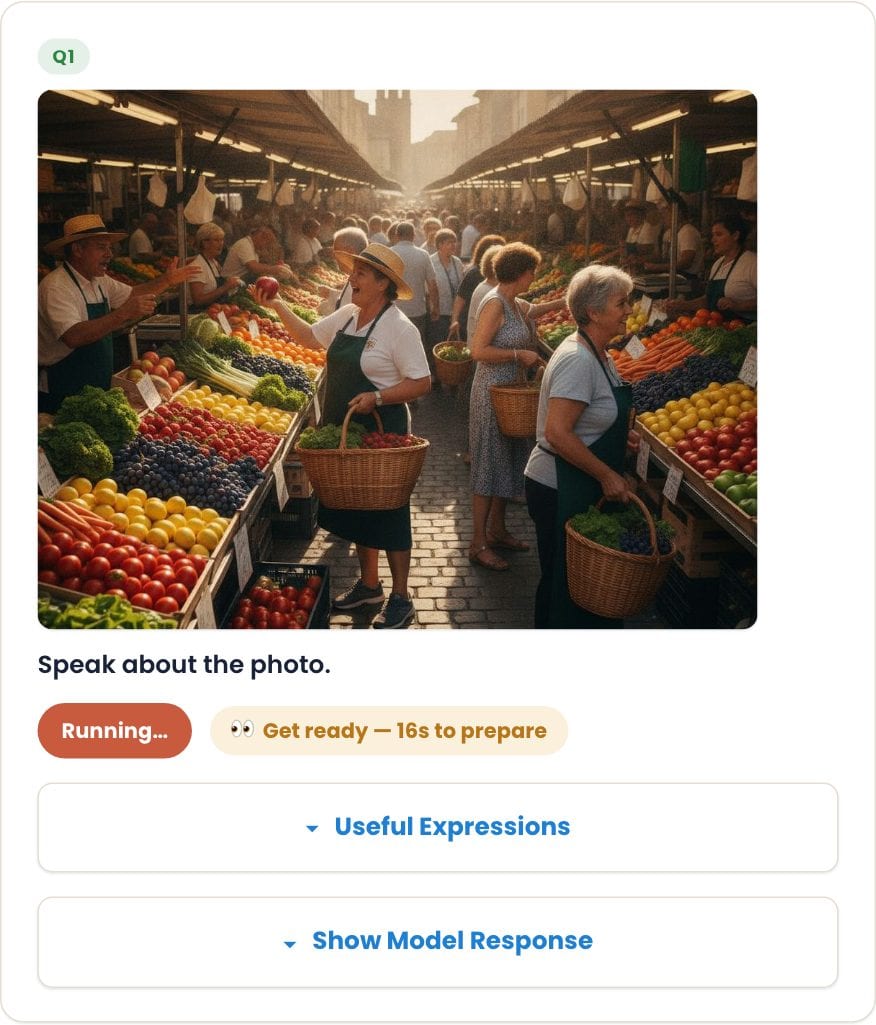
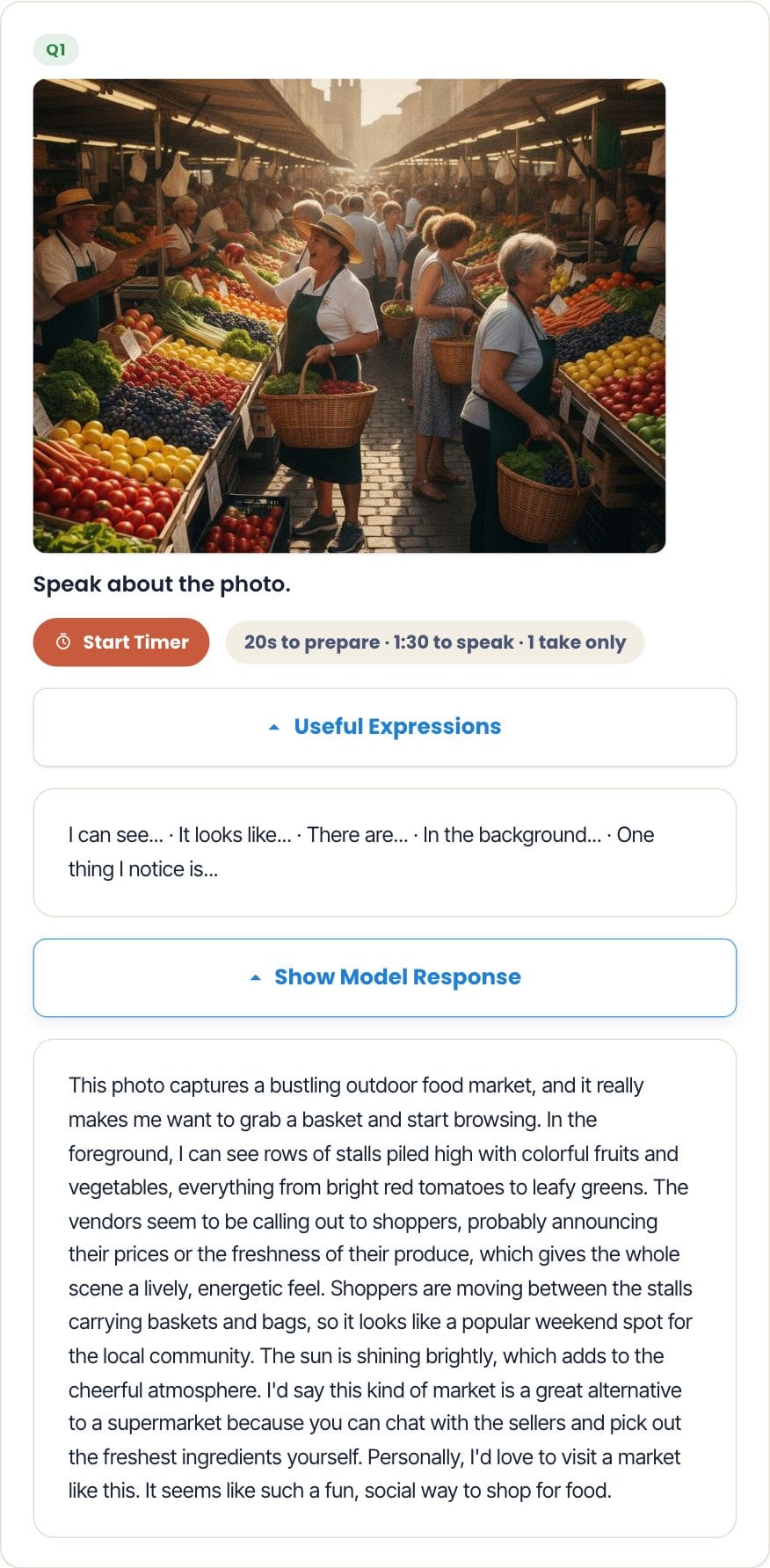
For a market photo, this is all you need to roll around in your mouth during the 20 seconds: bustling, vibrant, straw hat, wicker basket, eye level, crowded aisle.
Tip 3. Fill the 90 seconds in four chunks
The order I use in class has four chunks. Follow it and the 90 seconds always fill up.
- The main person: gaze, pose, action, and a guess about them. Start with the one person who stands out most. The woman in the straw hat is holding up a red apple and laughing at someone off to the side. She might be a vendor showing off her fruit to a regular customer.
- Mood and space. What kind of place they're in. The whole market feels bustling and vibrant, with long rows of stalls under wide awnings.
- One more guess, plus the camera angle. It's probably a weekend morning, since it's so crowded. The photo is taken at eye level, so it feels like I'm standing in the aisle myself.
- Details: what you haven't mentioned yet. Objects, colors, textures, people in the corners. Woven wicker baskets, piles of bright red tomatoes, an older man on the left calling out to shoppers.
The key is attaching a guess about the person right in chunk 1. The official 145 answer earned its points with exactly that kind of guess: the three people are probably colleagues. Chunk 4 is the one you stretch or shrink depending on how much time is left. A photo always has something you haven't said yet.
Tip 4. Keep spoken sentences short
We counted the 90 Speak About the Photo model answers on our site.
| Item | Our 90 model answers | Official 145 answer |
|---|---|---|
| Average length | 118 words | 148 words |
| Average sentences | 5.3 | 9 |
| Words per sentence | about 22 | about 16 |
(Count: 30 testpracticelab DET sets × 3 photos = 90 model answers)
The length is fine. The problem is that each sentence is long. Many of our model answers read like This photo captures a bustling outdoor food market, and it really makes me want to grab a basket and start browsing: natural in writing, hard to say in one breath. The real 145 answer kept one idea per sentence, at around 16 words.
Use the model answers as a source of phrases. When you read them aloud, split the sentence at every comma and say it as two sentences.
Tip 5. If you get stuck, don't restart
What makes this task tense is that you can't record again. The official comment on the 85 answer notes that repetition and restarting sentences from the beginning are "frequent" and that they disrupt the flow. When you restart a sentence, the listener hears the same words twice and loses the thread.
- Let a wrong word go. If you want to fix it, add I mean once and keep going.
- When you run out of things to say, move to the next chunk. If you follow the four-chunk order, you always know what comes next.
- A 2 to 3 second pause is fine. The 145 answer had pauses of 2 to 4 seconds. The official comment says they were fine because they fell between ideas.
One more thing: the AI grading on our site only looks at a transcript of your recording. The real test also scores fluency and pronunciation. Don't rely on the transcript score alone. Listen to your own recordings.
Practice really comes down to two things
1. Memorize the list. Learn mood, texture, position and camera angle words. The words you murmur in those 20 seconds have to be in your head already.
2. Practice with lots of different photos. Keep changing the scene: a market, a classroom, a kitchen, a park, an airport. If you only use one kind of photo, you'll only use one set of words. For each photo, murmur for 20 seconds, record 90 seconds in the four-chunk order, and move straight to the next photo without re-recording. The goal is to get used to having only one take, just like the real test.
Three photos today
Start practicing like it's the real test. Pick three photos from our Duolingo Speak About the Photo practice sets and record each one with 20 seconds of murmuring and 90 seconds in four chunks. Pair it with Write About the Photo, where you write about the same kind of photo, and your description words will stick twice as fast.
For another speaking task, read Read, Then Speak: 5 Tips.