Duolingo Read, Then Speak: 5 Tips
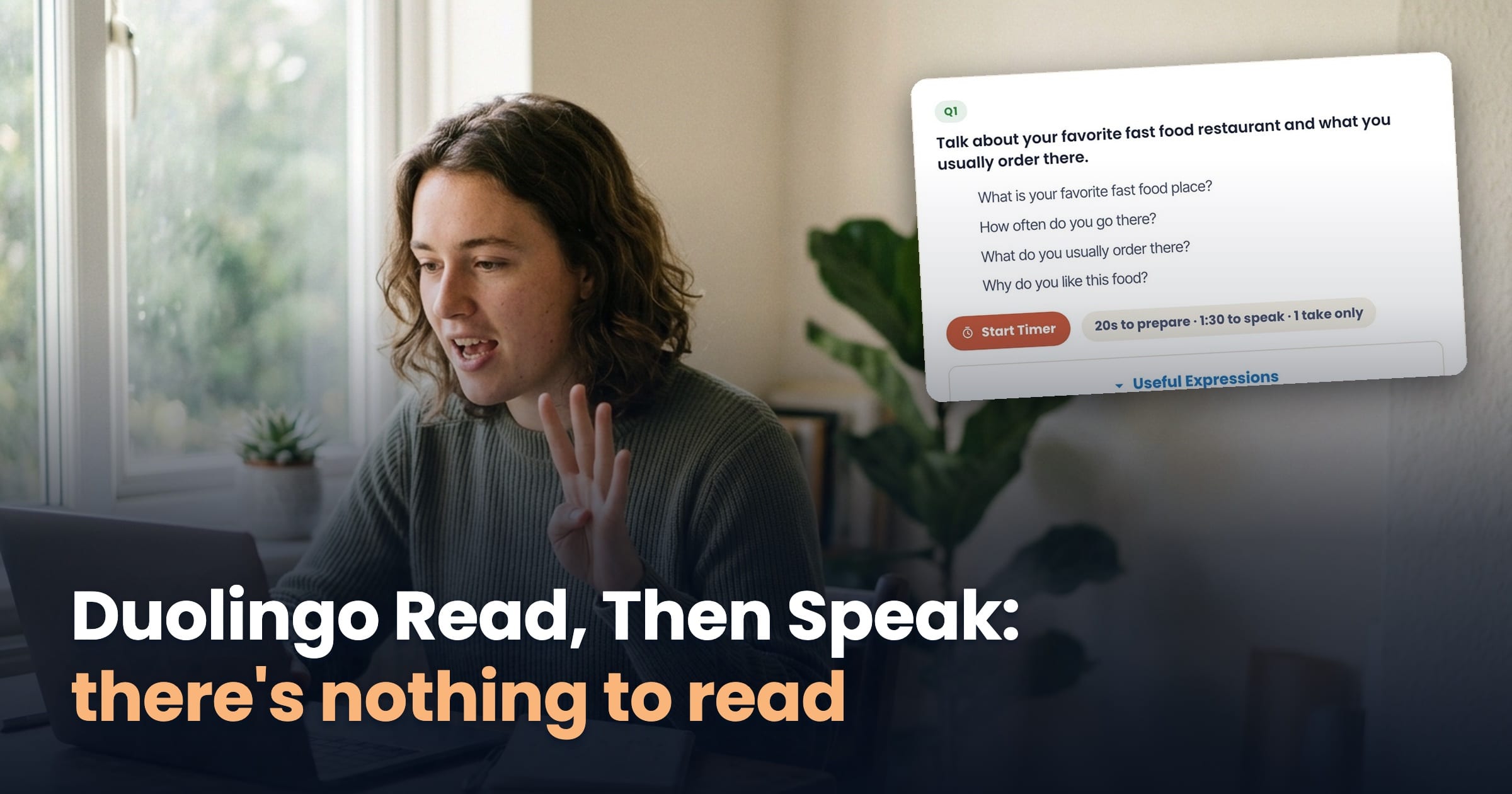
The name says Read, Then Speak, so it is easy to assume you read a passage and respond. On the real screen there is no passage. There is one topic line and four questions under it. Prepare for this task not as a reading test but as four questions answered in order within 90 seconds.
What the task looks like
- One topic line, for example: Talk about your favorite fast food restaurant and what you usually order there.
- Four guide questions: which place you like, how often you go, what you order, why you like it.
- Timing: 20 seconds to prepare, then 90 seconds to speak.
- Attempts: one recording only.
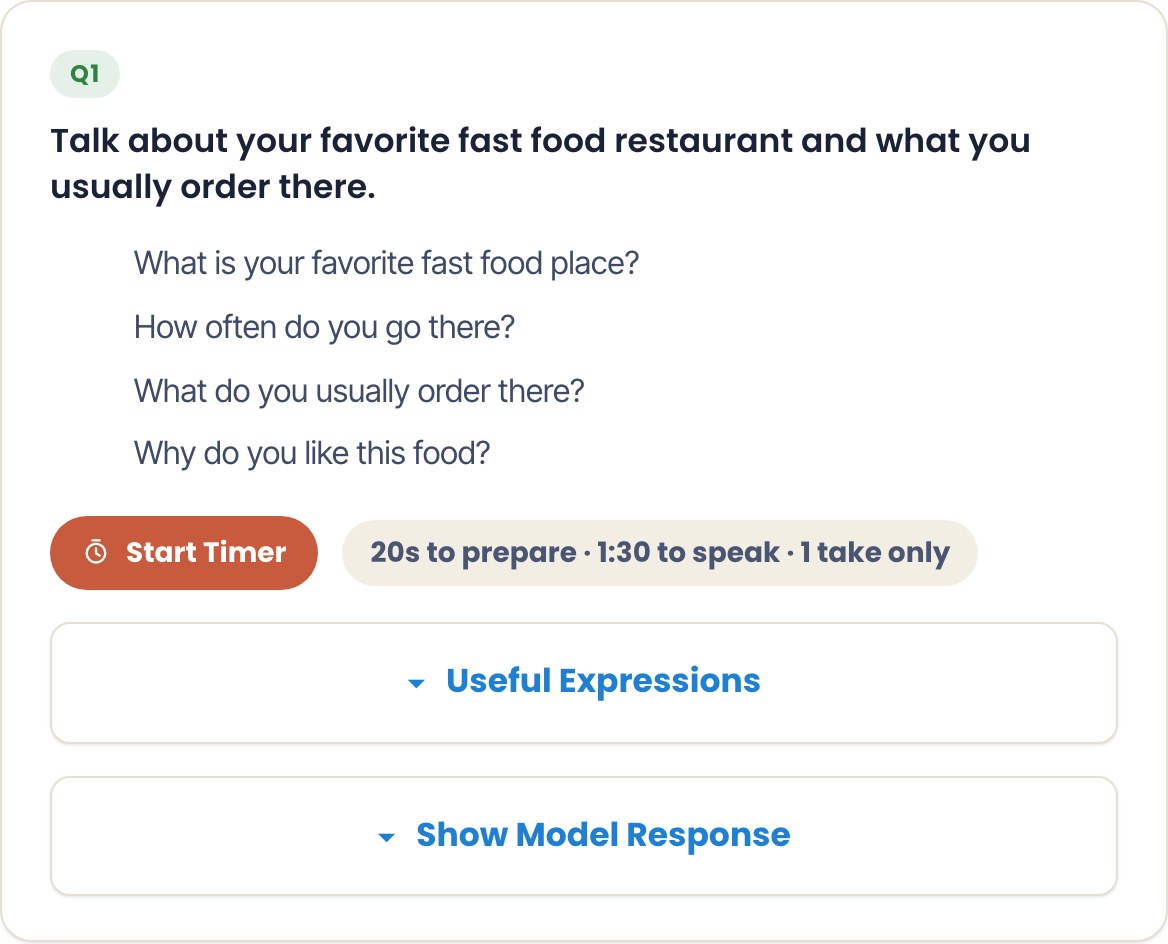
All 30 of our practice sets have exactly four guide questions, so treat touching all four as the basic requirement. The timing above is from our practice screen. Check the official guide for finer details such as any minimum speaking time before your test.
Tip 1. The four questions are the skeleton, not the topic line
Look at the four questions first, not the topic sentence. They are the outline of your answer. If you start talking from the topic line alone, it is easy to spend too long on the first question and run out of time with the last one empty.
Tip 2. In 20 seconds, grab one keyword per question
Twenty seconds is not enough to build sentences. Hold one keyword per question. For the screen above:
| Question | Keyword to grab in 20 seconds |
|---|---|
| Which place do you like? | Subway |
| How often do you go? | twice a week |
| What do you order? | turkey sandwich |
| Why do you like it? | fresh, customize |
Four keywords give you the frame for 90 seconds. It is safer to put one word in each of four slots than to try to prepare sentences for every question and settle none.
Tip 3. Split 90 seconds into about 20 per question, three sentences each
Four slots in 90 seconds is a little over 20 seconds each. Fill each slot with three sentences.
- A direct answer, using your keyword. My favorite place is Subway.
- One specific detail: a number, a place or a name. I go there about twice a week, usually after work.
- A bridge to the next slot. When I order, I almost always get a turkey sandwich.
The third sentence works as the opening of the next question. Chaining them this way keeps you from stalling between questions.
Tip 4. Don't speed up to fill the time (we counted our 30 model answers)
Our 30 model answers run from 182 to 271 words, 229 on average. At about 130 words per minute you say roughly 195 words in 90 seconds. 26 of our 30 model answers are above that line, and 18 are still above it at 150 words per minute. They read well, but memorize and recite them and you speed up until your pronunciation falls apart.
So use the model answers only as examples of structure. When you speak, two or three sentences per question and about 150 to 190 words in total is enough. Finishing early is fine. Use leftover time to add one concrete example after you have covered all four questions, not to talk faster. (The speed figures are our own arithmetic, not an official number.)
Tip 5. When you stall, don't go back to the start
You get one recording, so a stall makes you want to restart the sentence. Then the same words are heard twice, time shrinks, and the last question ends up empty.
- Let a wrong word go. If you want to fix it, add I mean once and keep going.
- If you run out of things to say, move to the next question. The four questions set the order for you.
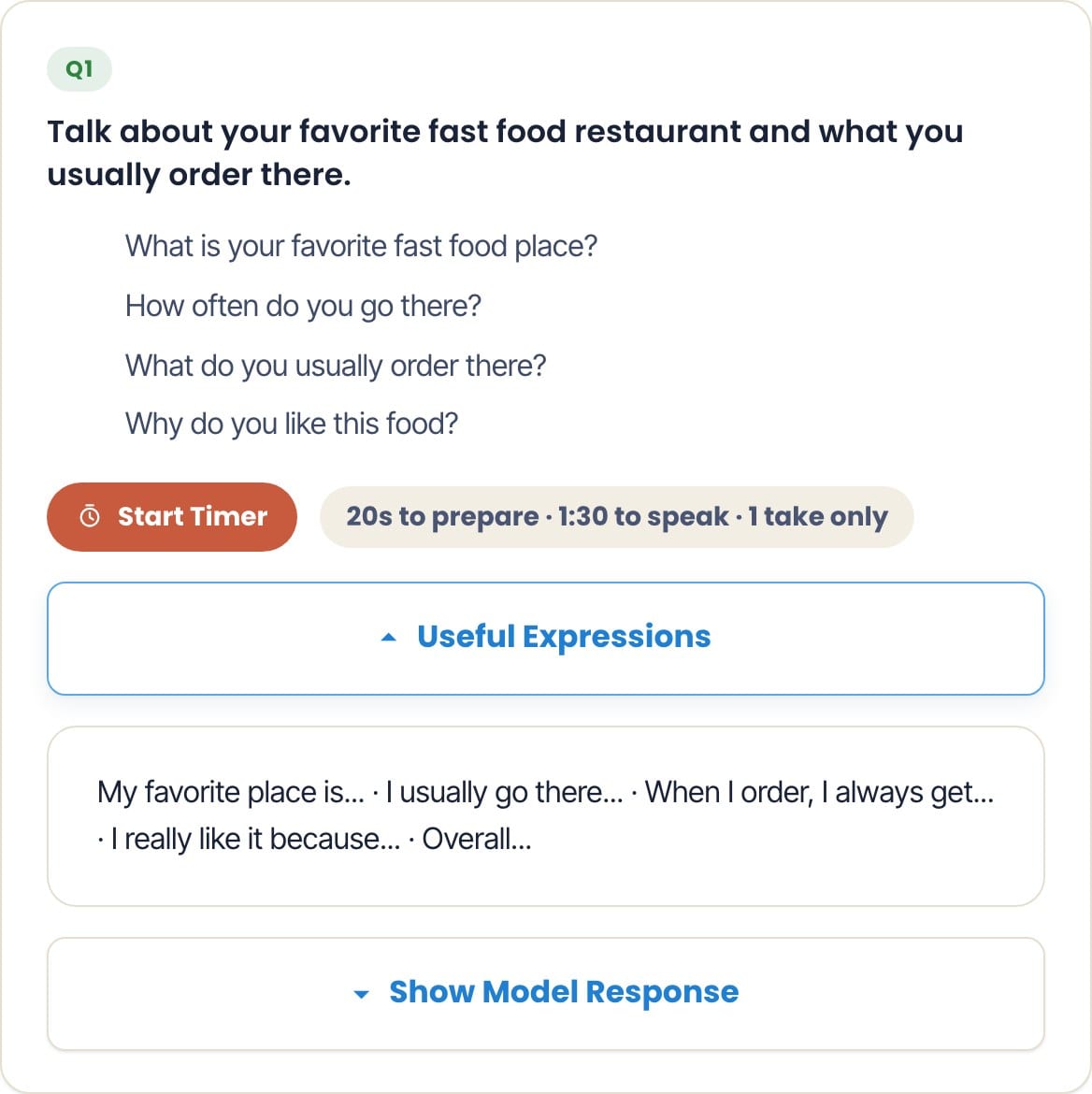
- Don't leave the last question (usually why) empty. One reason is enough to close. Overall, I like it because it's quick and fresh.
One more thing: our AI grading looks only at the transcript of your recording. The real test also considers fluency and pronunciation, so listen to your recording yourself instead of trusting the transcript alone.
How to practice
1. Keyword drill, 20 seconds. Press Start Timer on a practice page and pick only four keywords in 20 seconds. Even without speaking, this is useful.
2. Don't stop for 90 seconds. When stuck, jump to Let me give an example and add one concrete example.
3. Record, transcribe, count the words. Around 150 words with all four questions covered is plenty. If a question is missing, start with that question's keyword next time.
One set today
Pick one set on the Duolingo Read, Then Speak practice page and do it like the real thing. For the photo-based speaking task, continue with Speak About the Photo: 5 Tips.