TOEFL Take an Interview: Hear the Question Once, Answer in 45 Seconds
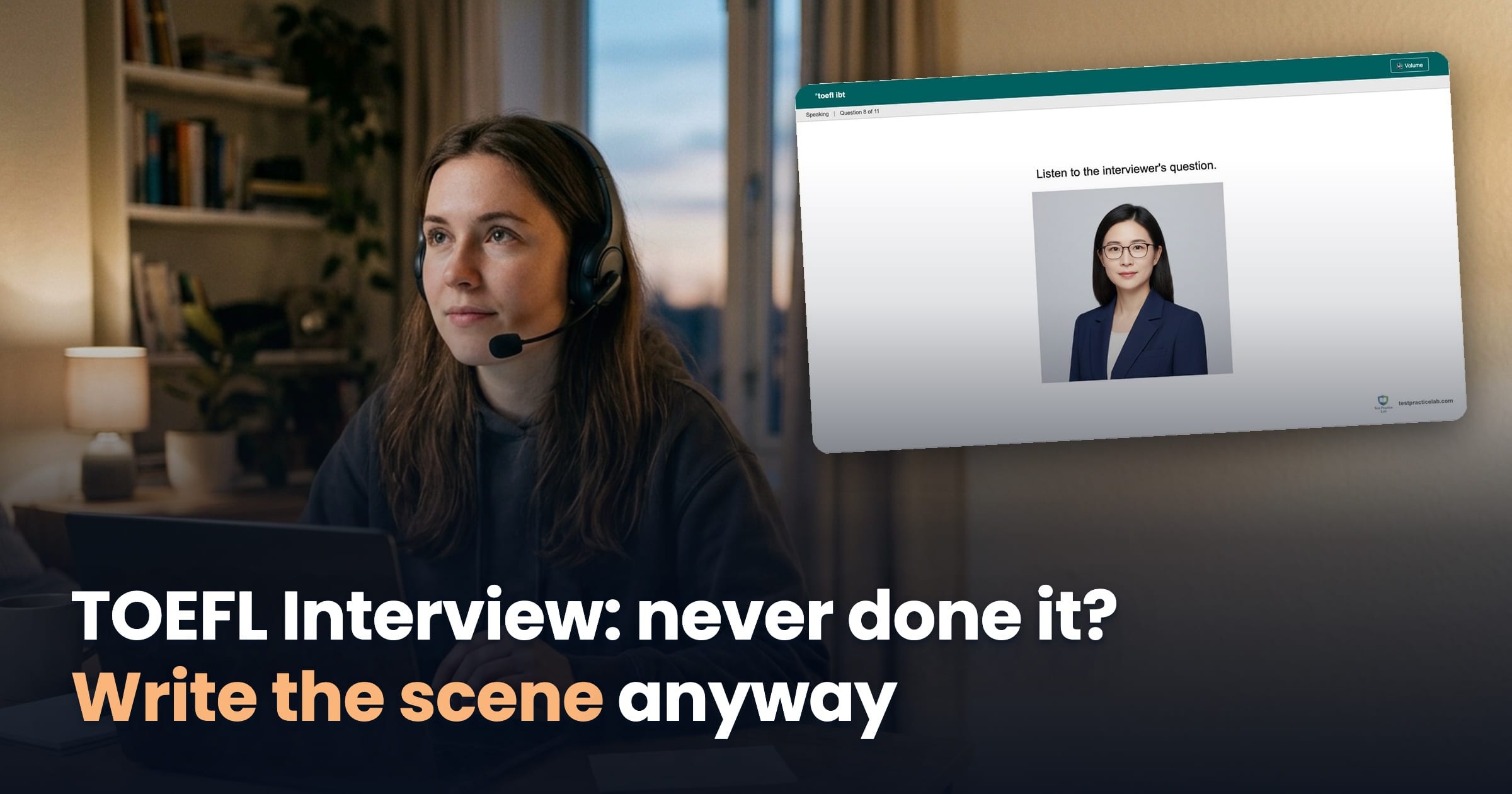
A student who has lived in a city all their life gets asked, "Tell me about a time you spent in the countryside." A student who hasn't seen a movie in years gets asked, "What kind of movies do you like?" When I run interview practice, this is exactly where students fall apart. Their English doesn't fail them. Their mind goes blank because it never happened.
In the 2026 TOEFL, Take an Interview plays each question once, gives you no prep time, and lets you talk for 45 seconds. The question never appears on screen as text. So this task comes down to two things: catching the question by ear, and building a story when you have no real one to tell.
What the task looks like
- Screen: a photo of the interviewer and the line "Listen to the interviewer's question." The question is audio only.
- Questions: four, all on one topic. They usually widen as they go: your routine → your experience → your opinion → your view on a social issue.
- Time: 45 seconds per question. No prep time.
- Score: 0 to 5 for each response. ETS describes the task as a simulated interview where you answer questions about your experiences and opinions.
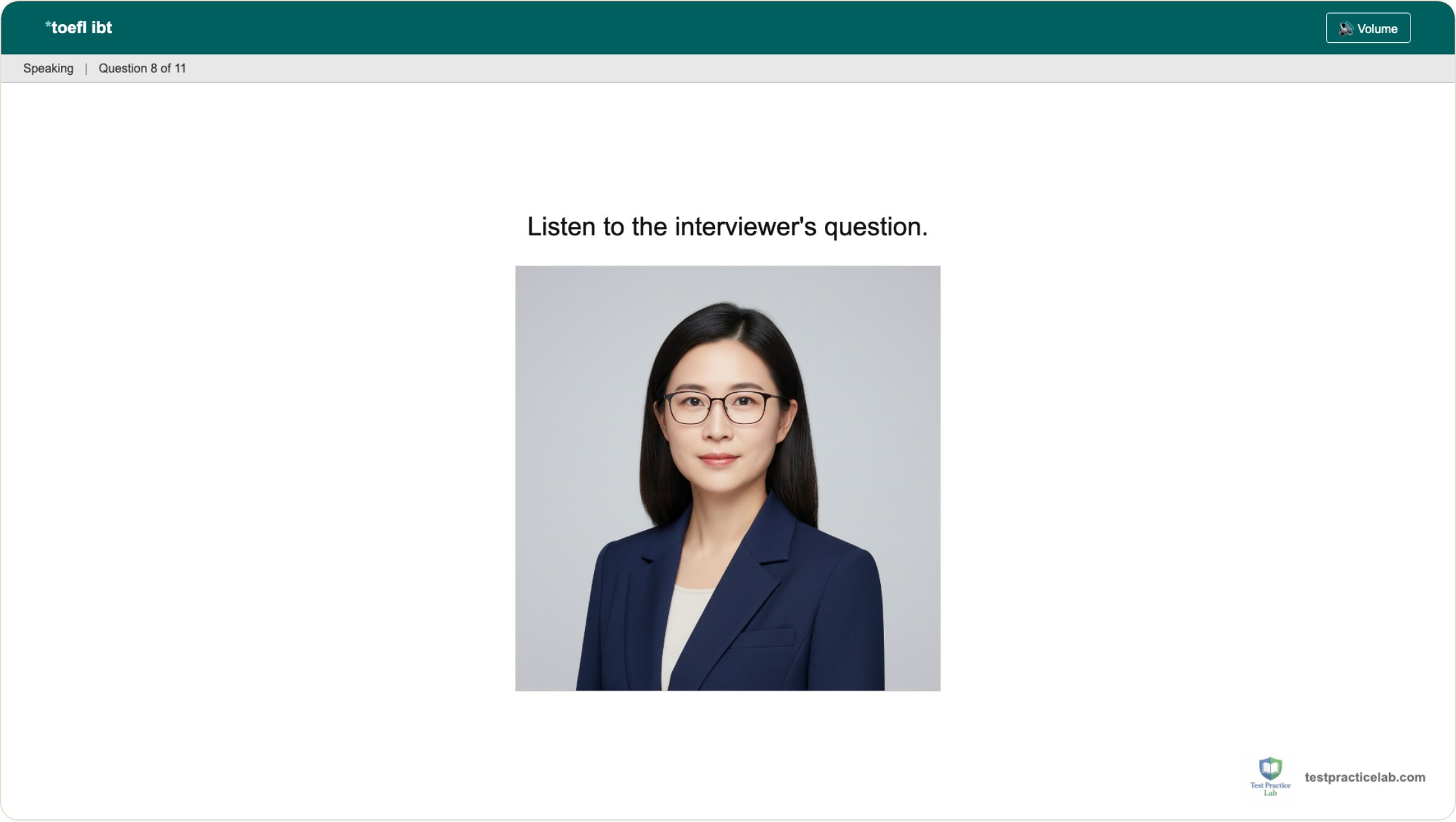
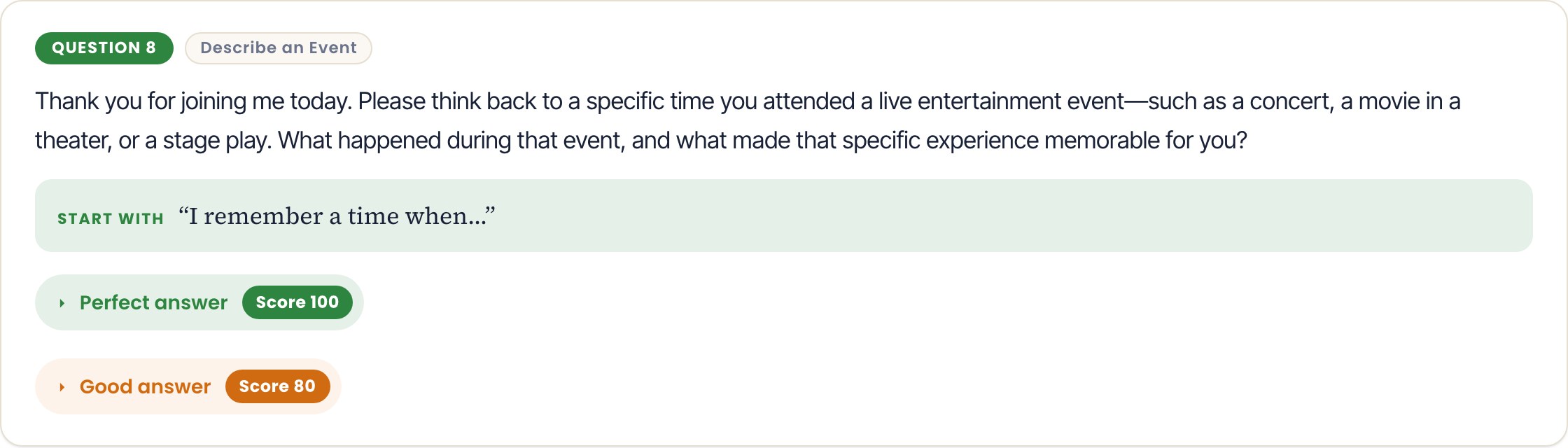
Our practice pages are built for study, so they also print the question and a starter phrase (Start with) under the screen. You won't get either on test day. When you practice, cover the text and take the question in by ear first.
The line that separates a 5 from a 4
Read the official ETS Speaking Scoring Guide for Take an Interview and you'll notice each band uses almost the same sentences. Only a few words change. Those few words are what you should study.
| Score | What the guide says (summary) | What to work on |
|---|---|---|
| 5 | On topic and well elaborated. Good conversational pace with natural pauses | You give a reason and a scene |
| 4 | Elaborated, but may lack effective sentence-level connectors | You list reasons with no "so" between them |
| 3 | Limited elaboration. Frequent pauses and filler words (um, uh) | You run out of things to say after one sentence |
| 2 | Minimally connected to the question, consists mainly of language from the question | You repeat the question to buy time |
(Source: ETS TOEFL iBT Speaking Scoring Guide, Take an Interview)
Two pieces of common advice don't survive this table.
- "Repeat the question to give yourself time to think." That is almost word for word how the guide describes a 2. If your first sentence reads the question back, several of your 45 seconds go to words that earn nothing. Borrow one or two words from the question and give your answer right away.
- "The faster and longer you talk, the better." A 5 calls for good conversational pace, not a fast one. And what moves a 4 to a 5 is how your sentences connect, not how much you say.
One honest note. The AI grading on our site scores a written transcript of your answer. The real ETS guide also listens for pace, pauses, pronunciation and intonation. Even if your transcript score looks good, keep listening to your own recordings.
Splitting 45 seconds on the clock
I have students practice with 45 seconds cut into four slots.
0 to 5 seconds: the answer
Your answer to the question in one sentence. I usually travel somewhere new, even if it's close.
5 to 20 seconds: one reason
One reason is enough. Two reasons side by side both end up thin.
20 to 38 seconds: one scene
When, where, what happened. This is where the guide's "elaboration" comes from.
38 to 45 seconds: back to the reason
Tie the scene to your answer in one sentence. So that's why ~, That's the reason ~. This is the "connector" the 4 band says is missing.
Leftover time isn't the problem. Getting cut off mid-sentence is. The goal is to feel, without looking, when you're around 38 seconds and start your closing line.
Asked about something you've never done? Become a screenwriter
The thing I say to students most is "Stop thinking of it as your story." If the question asks about an experience you've never had, imagine you're creating a character and write what happened to that character. I call it becoming a screenwriter.
The order is always the same: when, where, who, what, why. Fill those five slots and you have a 45-second scene.
| Slot | Countryside question (student who has always lived in a city) | Favorite movie question (student who hasn't seen a movie in years) |
|---|---|---|
| When | Summer vacation in middle school | Last winter, on a plane |
| Where | Grandmother's fishing village by the sea | A twelve-hour flight |
| Who | Me and my younger cousin | Just me, the passenger next to me asleep |
| What | Went out on a boat at dawn and helped pull in the nets | Picked an animated film at random and watched to the end |
| Why it stuck | I had never watched the sun rise in the city | I expected nothing and got choked up at the last scene |
Nothing in the scoring guide checks whether your story is true. It checks whether you answered the question, gave specifics, and connected your ideas. If you have a real experience, use it. If you don't, make one. Most students who freeze are stuck on "but that never happened to me."
One story can carry all four questions
The four questions share a topic. Settle on one story, real or invented, and you can tell it in detail for question 2 (experience), then bring it back as evidence in question 3 (opinion) and question 4 (social issue). That stalls you far less than hunting for a new example every time.
Here is how it plays out with a travel set we wrote.
| Question | What it asks | Story to use |
|---|---|---|
| 1. On free days, do you travel or stay home? | Your routine | Last month I took a train to a small town two hours away |
| 2. Tell me about a trip that didn't go as planned. | Your experience | Beach trip, rain for three straight days. Switched to a museum and a cooking class |
| 3. Plan everything, or decide as you go? | Opinion | Use story 2: "I book the hotel and leave the rest open" |
| 4. Should cities limit the number of tourists? | Social issue | Use story 1: "Small towns get crowded fast" |
Questions 3 and 4 aren't about you, so answers drift toward the abstract. Pulling back one sentence from an earlier story fills the "specific support" slot. The score-100 model answers on our practice pages do the same thing. In the music set, the concert story from question 1 comes back as the example in the question 3 opinion answer.
How much should you say? We recounted our own model answers
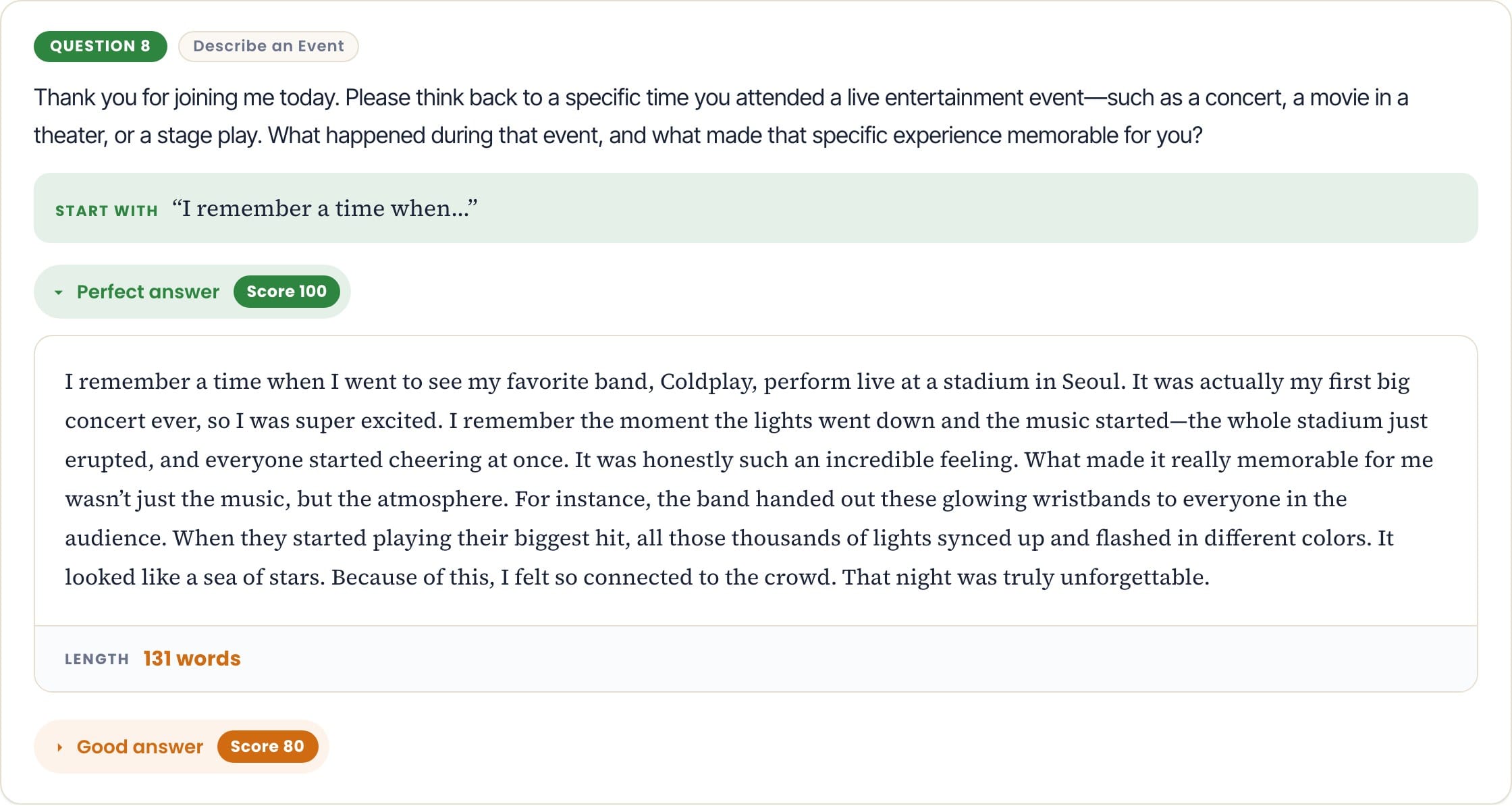
I owe you a confession about our own site. I went back and counted the interview model answers on our 90 speaking practice pages.
| Source | Count | Average length |
|---|---|---|
| Practice pages, score-100 model answers | 360 | 134 words (126 to 144) |
| Practice pages, score-80 model answers | 360 | 113 words |
| Our newer full-test sets | 48 | 95 words |
| Recommended length in our AI grader | 55 words |
(Count: interview questions on 90 testpracticelab speaking practice pages, plus 48 interview questions from 12 full-test sets)
Saying 134 words in 45 seconds means talking at 179 words a minute without a break. That's close to a news anchor. On top of that, the instructions on those pages used to say "Aim to speak for 20 to 30 seconds." The test gave 45 seconds, the instructions said less, and the model answers said far more. None of the three matched. While writing this article we changed the instructions to "45 seconds, no preparation time," and the answer lengths are being reworked separately. Until then, here is the standard to go by.
- The goal is to fill all four slots, not to hit a word count. Answer, reason, scene, close. That usually lands somewhere between 55 and 90 words.
- Read the score-100 answers to borrow phrases. You don't need to match their length.
- The gap between the 80 and the 100 isn't length. Under each question there is a "Why the 100 scores higher" note. Of those 360 notes, 301 point to a concrete scene or detail in the 100 answer. Many of the rest point to cause and effect linking up. It is the same gap as between a 4 and a 5 in the guide.
Three drills I give students
1. Cover the question and hear it once. If the page has a video, cover the text and listen to the question once through the video. If it doesn't, record yourself reading the question aloud, cover the text, and play that recording once. Right after, say the two key words of the question out loud (travel, plan / limit, tourists). If those two words end up in your first sentence, you caught the question.
2. Record 45 seconds with an alarm at 38. Set a phone timer for 38 seconds and record. When it goes off, start the sentence that takes you back to your reason. For the first week, don't judge content. Just check whether the closing sentence finishes in time.
3. Build scenarios on topics you've never thought about. This one matters most. Pick, on purpose, things you've never done or don't care about: country life, pets, camping, volunteering, a sport you don't follow. For each topic, fill a card with keywords for when, where, who, what and why, then record 45 seconds right away. Don't memorize sentences. A memorized line that fits any question sits close to the guide's description of a 2, and our AI grader marks down logic for it too. What you need on test day isn't a memorized story. It's the habit of building a scene within seconds of hearing a new question.
Just one set today
Start practicing like it's the real test. An interview set is four questions at 45 seconds each, so even with recording it takes about ten minutes. Pick a level from our TOEFL speaking practice sets, cover the question text, and record all four answers. If it feels overwhelming, start with the beginner interview practice. If your score has stalled, how to raise TOEFL speaking from 22 to 28 is worth reading alongside this one.