TOEFL Read in Daily Life: How to Handle 4 Text Types
Of everything new in the 2026 TOEFL Reading section, Read in Daily Life is the one that throws people off the most. If you trained on academic passages, an email or a notice suddenly showing up on the test feels like a glitch. But short doesn't mean easy. In 15 to 150 words, the passage packs in a purpose, specific details, and at least one word you might not know, and the questions check whether you can pull out exactly the right piece. Here's how to read all four text types (email, notice, workplace memo, social media post) with real test screens, plus how to handle each question type.
At a glance
- Questions per passage: up to 3 per text.
- Text length: 15 to 150 words. When it's short, it's really short.
- Text type: a non-linear text you'd run into in everyday life, such as a sign, a social media post, an advertisement, or similar. It's not a flowing paragraph; expect broken-up information like headings, dates, and line items.
- Scoring: multiple choice, right or wrong.
(Source: ETS's official TOEFL iBT Reading Lesson Plans, based on the exam as revised on January 21, 2026)
All the screens below are captured from one of testpracticelab's free practice sets (set 001, with 4 texts: email, notice, workplace memo, and social media post). In the worked examples under each tip, a wavy underline marks the evidence for the answer and a strikethrough marks what you should rule out.
1. Email: the subject line and first line tell you the purpose
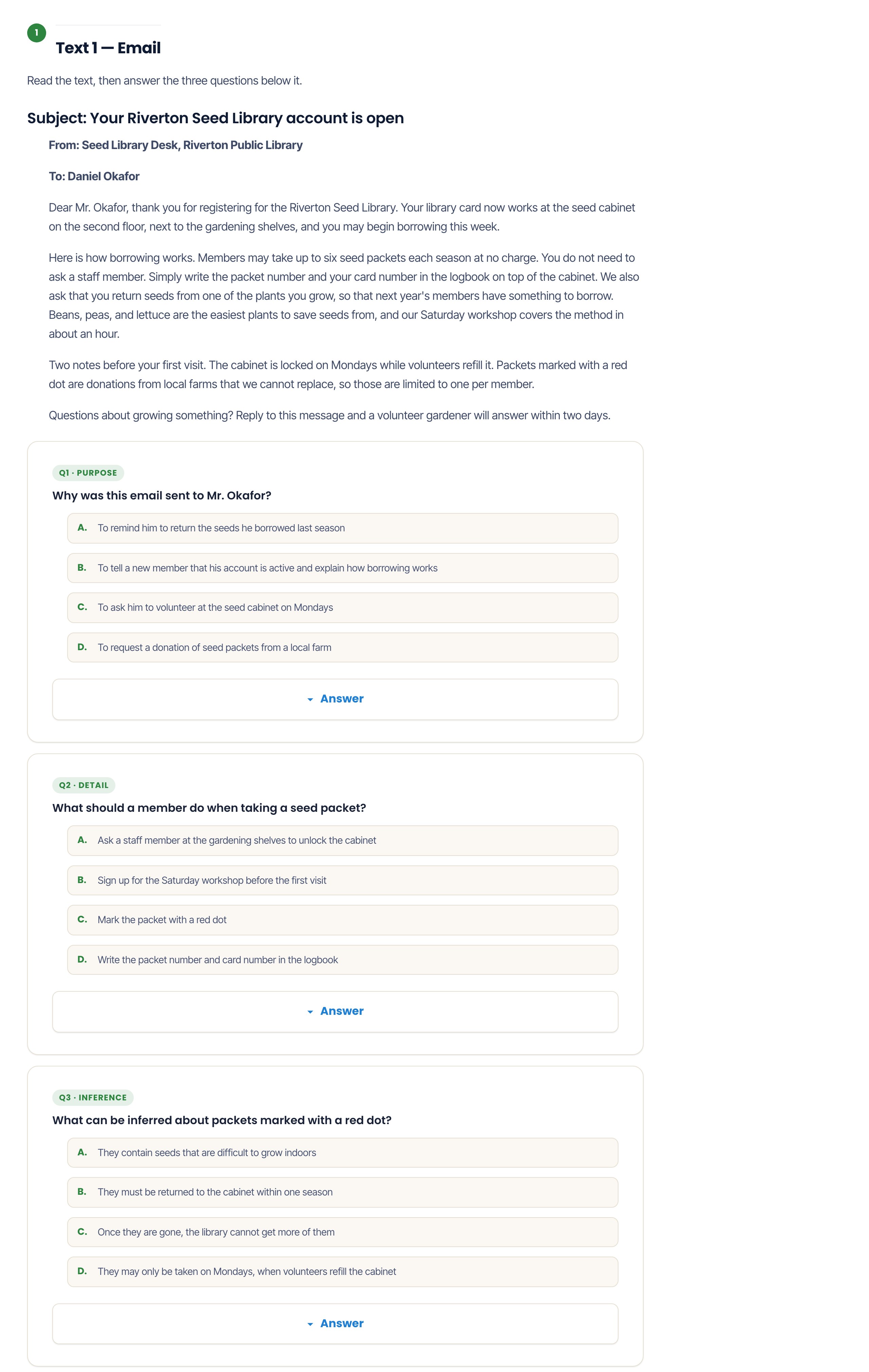
- The sender, recipient, and subject line come first, then the body.
- Emails often open with a greeting or pleasantries, but the evidence for the answer almost always starts after that.
- A purpose question is usually first. Read the subject line alone and you're often already halfway there.
Read the subject line before anything else
Read the subject line before you touch the body. It usually tells you why the email was sent in the first place, so you're walking into the body already knowing the answer to a purpose question.
Subject: Change to Thursday's shuttle pickup time
The subject line already states the purpose. You know it before you've read the body.
Skip past the pleasantries
A line like "I hope this message finds you well" carries no evidence. Let your eyes pass over it, but don't spend time on it.
Dear residents, I hope this message finds you well.
A pleasantry carries no answer.
Starting Monday, the shuttle will depart at 7:40 instead of 7:20.
The real information starts here.
2. Notice: conditions and numbers are where the answer lives
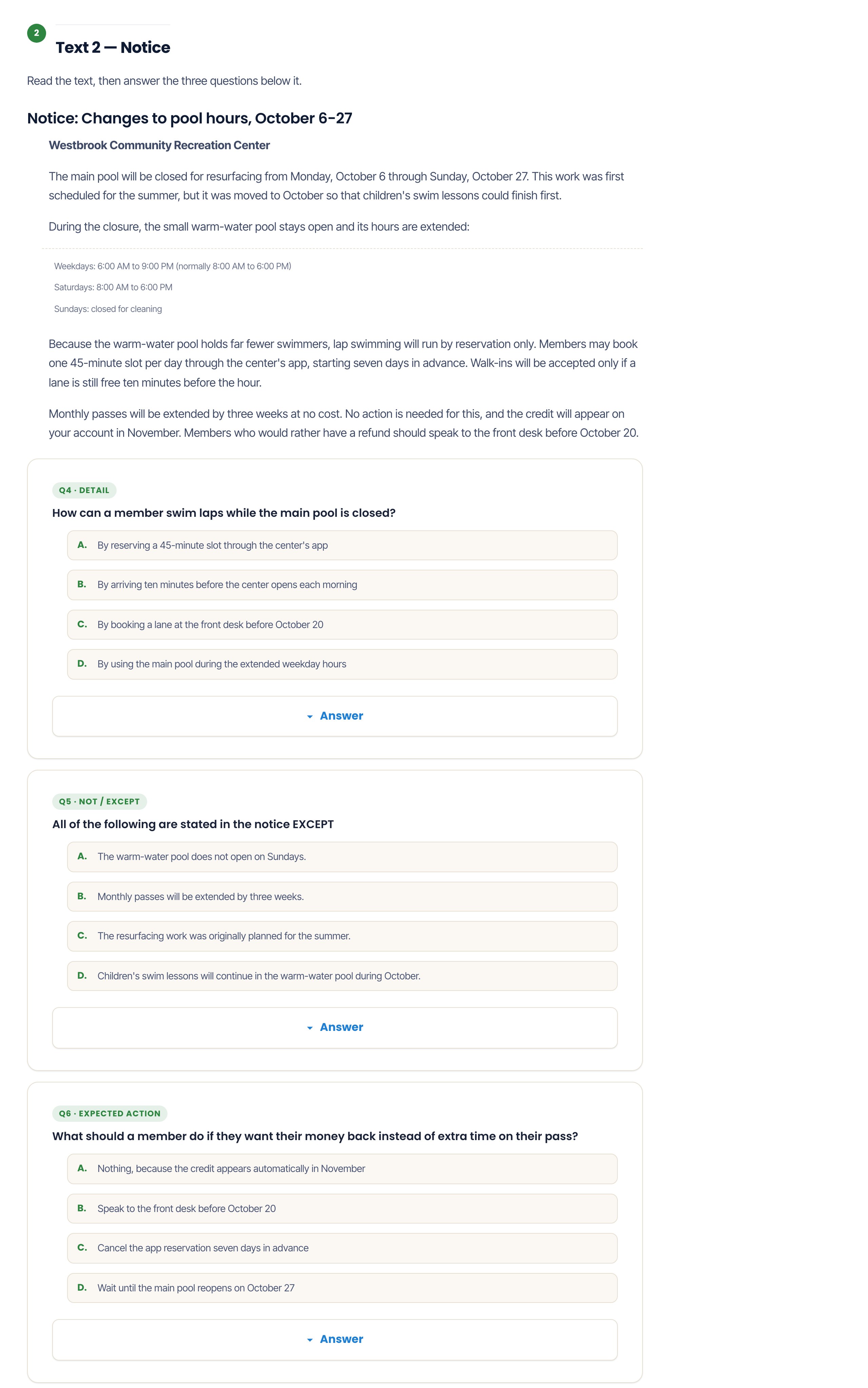
- A bold heading up top, then dates, locations, and rules laid out in short sentences.
- Conditional and time phrases (if, unless, only, after 6 PM) show up constantly. Miss the condition, and the rule itself changes.
- This is where you'll most often see a question asking what someone is supposed to do.
Treat conditions like something to grab onto, not skim past
Whatever follows if, unless, only if, after, or before flips the conclusion of that sentence. Read the sentence without registering the condition, and you'll likely pick the wrong answer.
Bikes left in the hallway after 6 PM will be removed.
Drop the condition, and the whole rule changes.
Numbers and dates mark the spot
When a notice has a number or date, the question about it usually asks about that exact number. If the question has a number in it, find that number in the passage first, then read the sentence right next to it.
3. Workplace memo: the RE line and instruction sentences are the core
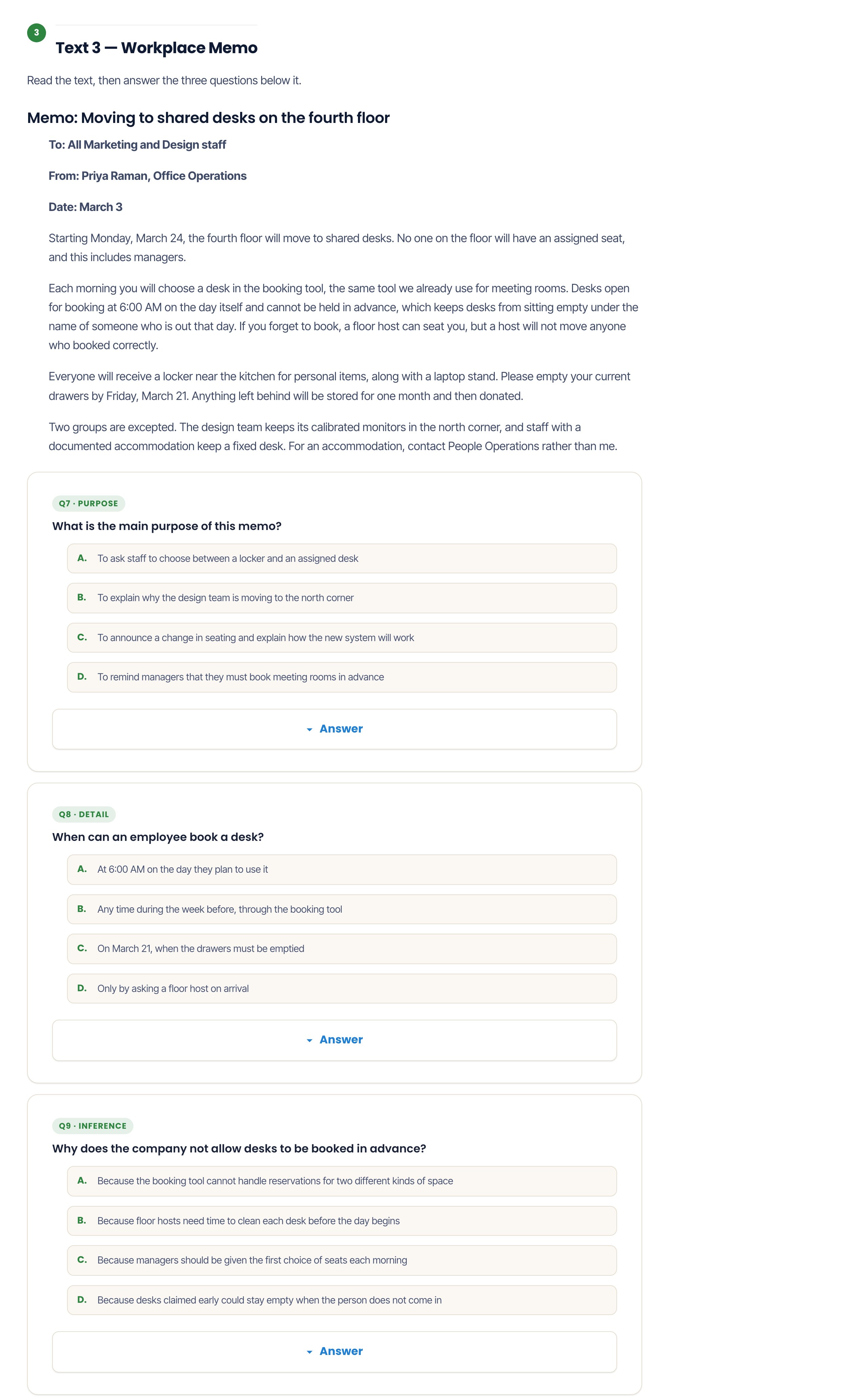
- TO, FROM, and RE (subject) lines come first, and the body is usually an instruction or an update.
- The RE line does the same job as an email's subject line: it previews the topic.
- Questions about what someone needs to do usually point straight to a sentence starting with "Please."
Read the RE line before the body
The RE (Re: ...) line summarizes what the memo is about, the same job a Subject line does in an email. You already know the topic before you've read a word of the body.
RE: Updated procedure for submitting expense reports
You already know what the memo is about before reading the body.
A "Please" sentence is the thing you need to do
In a memo, a sentence starting with "Please" is almost always something the reader needs to do. If a question asks what to do next, start there.
Please submit your timesheet by Friday afternoon.
An instruction is the thing to do. If a question asks about the next step, look here.
4. Social media post: the caption is the evidence, not the hashtags
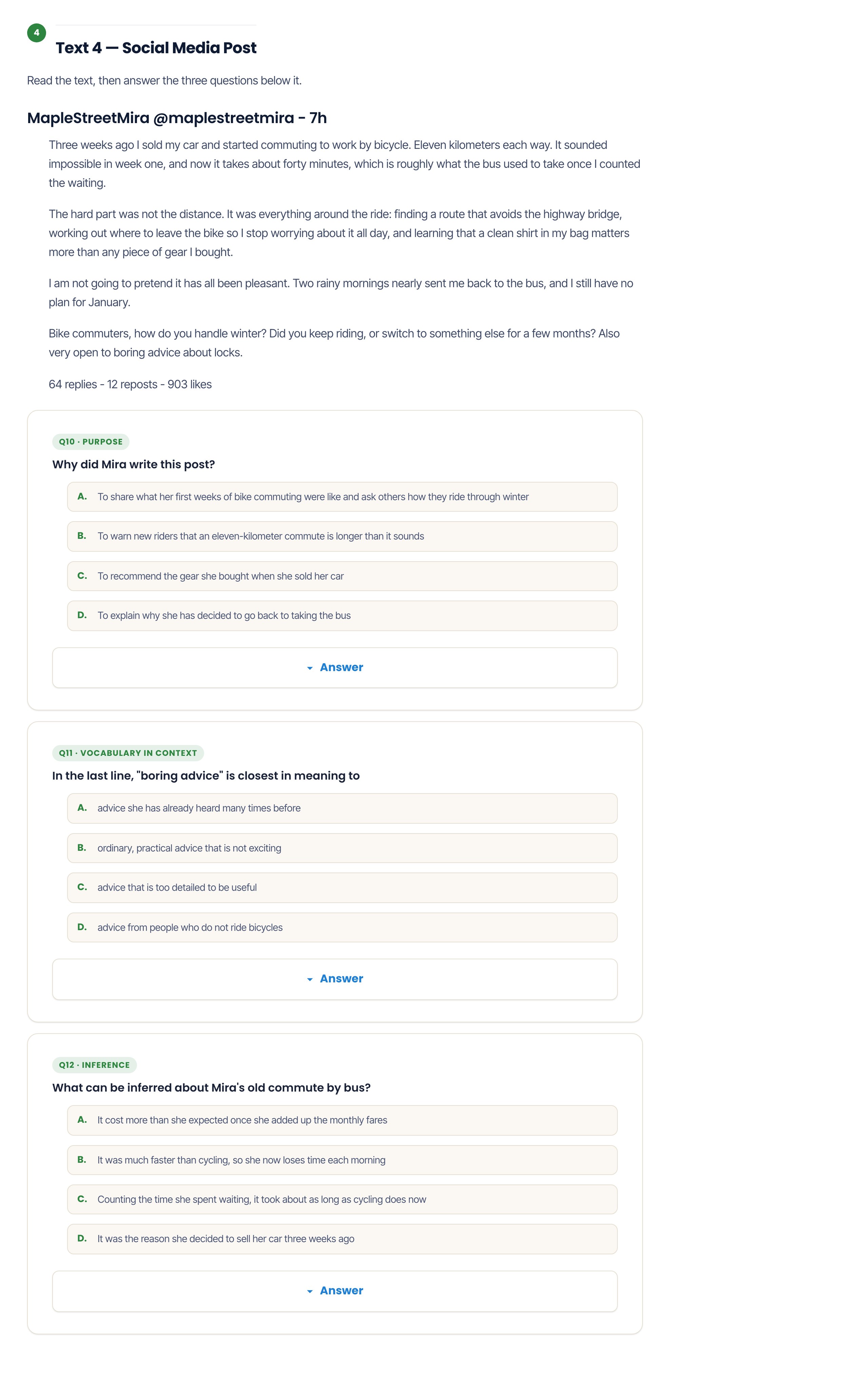
- A short caption of a few sentences, usually followed by hashtags.
- A sentence ending in a question mark is a signal that the writer wants a reaction or some kind of participation from readers.
- This is the shortest text type, so all 3 questions are answered inside just a few sentences.
Don't look for the answer in the hashtags
Hashtags exist for searchability, not for carrying the answer. The evidence is almost always inside the caption sentences themselves.
Our community garden could use a few more hands this Saturday morning! #garden #community #saturday
The answer comes from the sentence, not the hashtags.
A sentence ending in a question mark shows intent
A question like "Anyone free to help...?" tells you directly what the writer wants, which is really the same as why they wrote the post. That's often the answer to a purpose question.
Anyone free to help set up chairs at 5?
A question sentence signals what the writer wants from the reader, the answer to a purpose question.
3 question types: different text, same three things being asked
- Four text types, but ETS names three core reading skills. Whatever the text, a question is really asking about one of these three.
Purpose questions: the heading and first line are enough
A question like "Why did the writer send this message?" doesn't require rereading the whole passage. The heading (or RE line) plus the first sentence or two of the body will get you there.
Detail questions: scan the passage for the question's key word
A question like "According to the notice, when will..." wants you to find the exact key word from the question (a date, a name, a place) inside the passage. Don't reread from the top; just find the sentence with that word in it.
Question: According to the notice, what time will the shuttle depart on Monday?
According to the notice, what time will the shuttle depart on Monday?
question
Starting Monday, the shuttle will depart at 7:40 instead of 7:20.
Find the question's key word in the passage exactly as it appears.
Vocabulary questions: the sentences around the word explain it
When you hit a word you don't know, check the sentence right before and after it. Most of the time the passage restates the same idea a different way, or connects it as a cause or a result.
Construction on Main Street will cause a detour for drivers heading downtown.
construction before it, drivers heading downtown after it, the context tells you detour means a way around.
How to spend your time
Short doesn't mean fast
At 15 to 150 words, it's tempting to skim and move on. But a lot of the wrong answers reuse the exact words from the passage while quietly swapping the subject, the timing, or the condition. The shorter the text, the more each individual word is doing work, so read slower, not faster.
skim and move on
It feels short enough to know already, but the wrong answer differs by one word.
check each key word one at a time
That's how you catch a wrong answer with a swapped subject, time, or condition.
Wrapping up
Read in Daily Life looks easy because the passages are short. In reality, it's testing whether you catch the spots where information gets compressed, like a heading, a conditional, or an instruction sentence. Once you know where each text type tends to pack its information, it goes a lot faster.
Start practicing like it's the real thing. testpracticelab has a free Read in Daily Life practice set in the same format as the real test. Try set 001, the one whose screens are used in this article, and if you want to keep practicing other reading tasks, the full reading practice bank is there too.