Duolingo Interactive Writing: 5 Tips
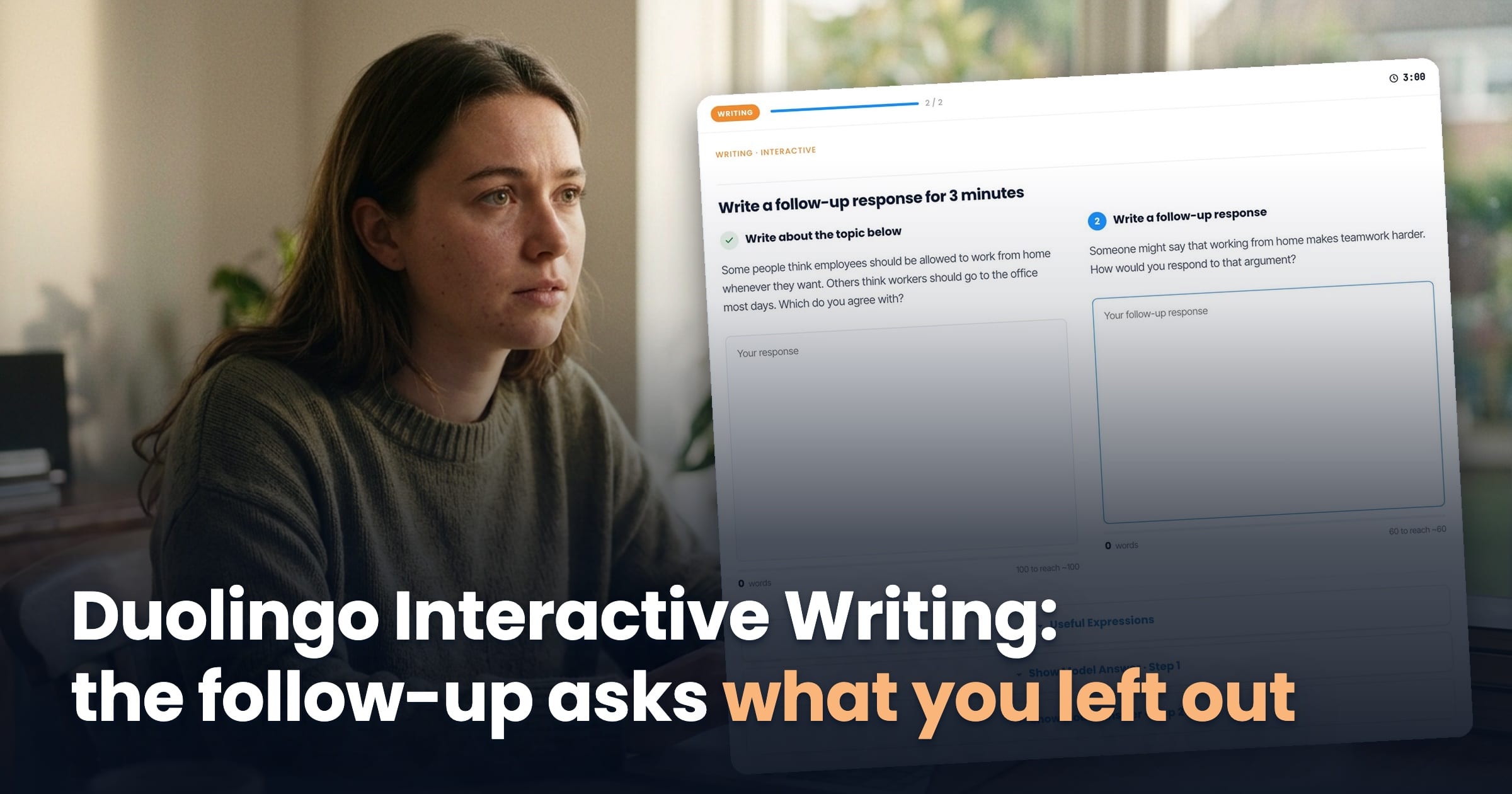
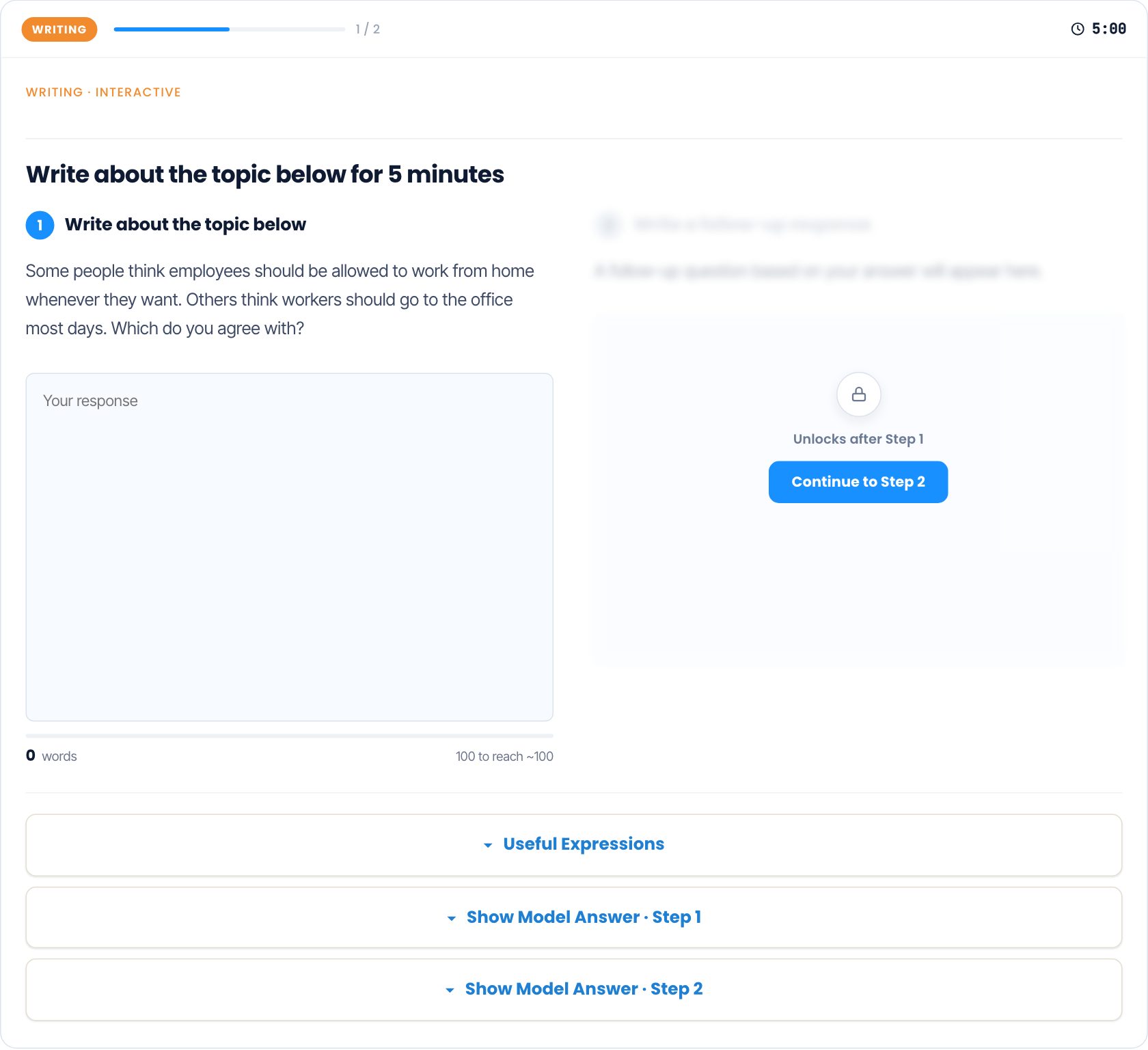
Interactive Writing is the longest writing task on the Duolingo English Test. You write about a topic for 5 minutes, then answer a follow-up question for 3 more. Eight minutes in total.
What makes it different from the other writing tasks is the second box, the 3-minute one. That follow-up question isn't fixed in advance. Duolingo reads what you wrote in the first box and picks the question on the spot. So this guide follows one question from start to finish and looks at how to write the first part so the second part gets easier.
When I teach this task, there's one order I keep coming back to. Get the logic complete first, and the word count follows on its own. Once you have a reason and an example behind it, 100 or 150 words fill themselves. This is the part students find hardest. If you watch the word counter and keep stretching sentences, you end up with something long enough that doesn't say anything.
What the task looks like
- Part 1 (5 minutes): A topic appears. Before the timer starts you get 30 seconds to read the instructions and the topic. The topic stays on screen while you write.
- Part 2 (3 minutes): The follow-up question appears. Your Part 1 response stays visible next to it.
- No going back: Once you move on, you can't edit the earlier part.
- Length: There's no official minimum word count. Duolingo tells test takers to use all the time they have and write as much as they can while staying on topic.
- Score: It counts toward Writing, and toward the Literacy and Production subscores.
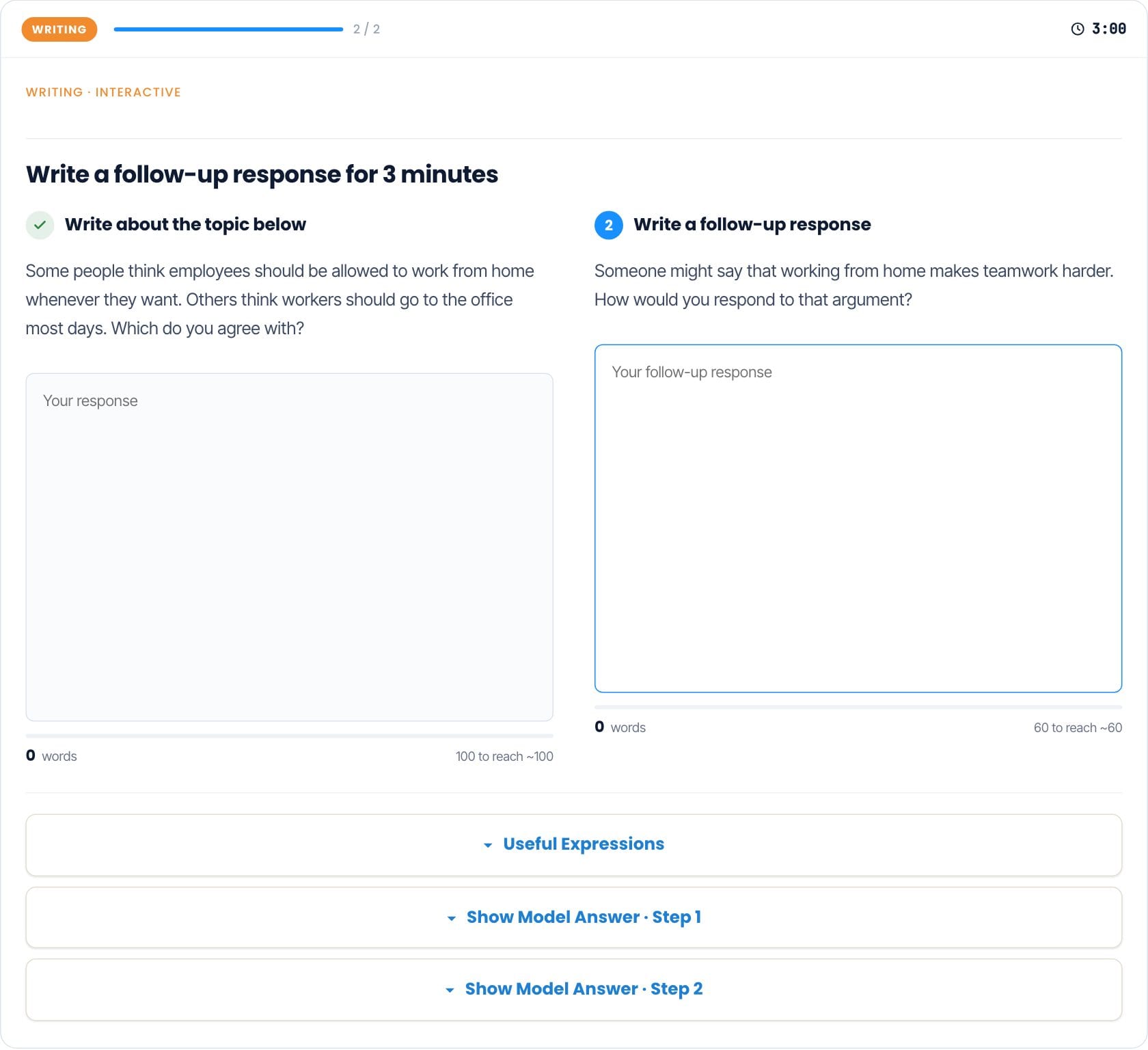
The follow-up asks about what you didn't write
A lot of guides describe this task as "respond to a counterargument." That's only half right. Duolingo published a research post on how the follow-up gets chosen. A model pulls out the main ideas in your Part 1 response, then selects a follow-up that doesn't repeat them. The point is to push you toward something you didn't cover the first time.
So the follow-up might be a counterargument. It might also be a side of the issue you skipped, or a question asking you to apply the idea to your own life or a different situation. Same topic, different question, depending on what you wrote.
(Source: Duolingo English Test official blog, "A multi-stage interactive task to assess writing proficiency")
One more finding from that post is worth noting. Human raters and AI models both found that strong second responses mostly stayed on topic, connected to the first response, and added new information. If your second box just summarizes your first, there's nothing new to score.
What our 14 sets show
I counted the 28 model responses in testpracticelab's 14 Interactive Writing practice sets (4 easy, 4 medium, 3 upper, 3 hard).
| Level | Part 1 model | Part 2 model | Total |
|---|---|---|---|
| easy | 84 to 108 words | 91 to 106 words | 175 to 213 words |
| medium | 102 to 110 words | 97 to 123 words | 202 to 233 words |
| upper | 121 to 123 words | 115 to 127 words | 236 to 249 words |
| hard | 119 to 139 words | 111 to 123 words | 230 to 262 words |
(Count: 14 testpracticelab sets, 28 model responses, words split on spaces.)
The numbers aren't the only pattern.
- All 14 Part 1 responses open with a position. 11 start with "I agree that," 3 with "I believe." None opens with background.
- All 14 Part 2 responses start by acknowledging the other side. "I understand that concern, but..." or "That risk is real, but..." In 10 of the 14, the turn with "but" happens inside that same first sentence.
- All 28 responses have three paragraphs. Three short paragraphs turned out to be the most realistic shape for 8 minutes.
I should be upfront about one thing. All 14 follow-up questions in our sets use the same counterargument format: "Someone might say... How would you respond?" The real test is more varied, as explained above. That's why Tip 3 covers two other kinds of follow-up as well.
Tip 1. Put your position in the first sentence
Most Part 1 topics ask which side you agree with or what you think. Answer that in your first sentence and build from there.
Example first sentence: I agree that employees should be allowed to work from home whenever they want.
With that sentence in place, Duolingo can clearly pick out your main idea, and the follow-up will fit your response more closely. If your position is vague, the follow-up goes after the vague part.
Tip 2. Find reasons from three angles: individual, society, government
When students get stuck because no reasons come to mind, this is the exercise I assign most. Look at the same topic from three angles.
| Angle | For the work-from-home topic |
|---|---|
| Individual | Less time commuting, and you can pick a setting where you focus well |
| Society | Less city traffic, and people can hold good jobs without living in a big city |
| Government | Less pressure on transport and environmental policy, but new rules on tracking working hours |
Filling in all three widens your view, and your writing becomes a persuasive argument rather than one person's preference. In Part 1, pick two of the angles and go deep.
Some students try to fit pros, cons, exceptions and counterarguments into 5 minutes. Every paragraph ends up one or two sentences long. You're better off choosing two reasons and giving each an example.
Don't worry about what you left out. The follow-up will ask about it anyway. Practice set #2 is a good example. The Part 1 model response covered productivity, commuting and keeping good employees, and never mentioned teamwork. The follow-up asked about exactly that.
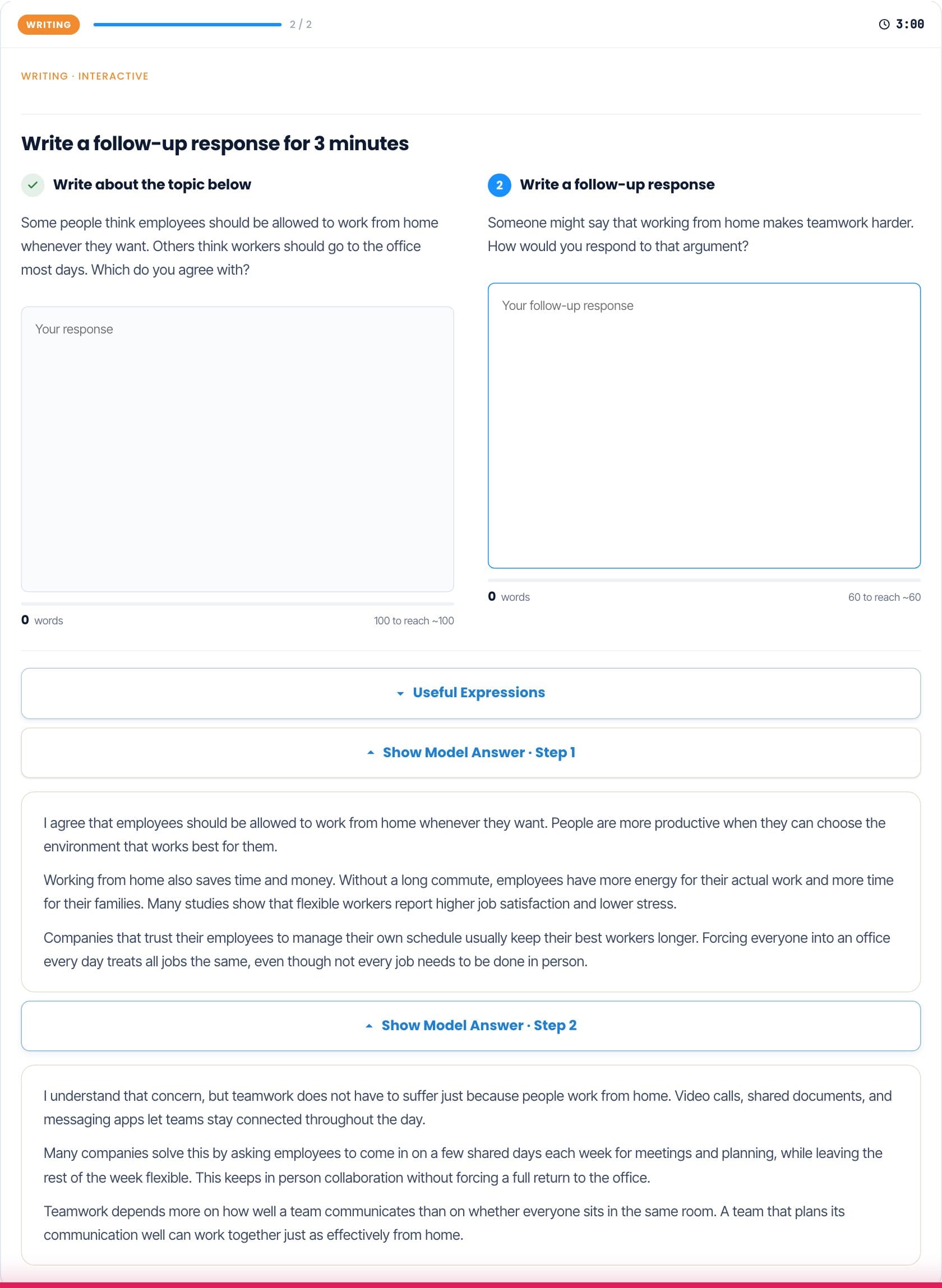
This is where the three-angle habit pays off. If the follow-up asks about an angle you didn't use in Part 1, you've already thought it through once, so you can pull it out within 3 minutes.
Tip 3. Identify the type of follow-up, then choose your first sentence
Three minutes goes fast. As soon as you read the question, figure out what kind it is and decide how your first sentence will look. We wrote the examples below on the work-from-home topic.
| Follow-up type | Example question | First sentence shape |
|---|---|---|
| Counterargument | Someone might say that working from home makes teamwork harder. How would you respond? | Acknowledge + but + your answer. "I understand that concern, but teamwork does not have to suffer." |
| Missing side | What problems might employees face when they work from home? | Answer directly + link to your position. "The biggest problem is loneliness, although it can be managed." |
| Personal or applied | Would working from home suit you personally? Why or why not? | Yes or no + one reason. "Yes, because I focus best when it is quiet." |
The rule underneath all three: your first sentence has to answer the question. Spend 15 seconds on "This is a difficult question" and you've lost almost a tenth of your 3 minutes.
Tip 4. Don't rewrite Part 1. Link to it in one phrase
The most common mistake in Part 2 is opening with a summary of Part 1.
| Avoid | Write |
|---|---|
| As I said before, working from home is good because people are more productive and save time. | Even if teamwork is harder at home, regular video meetings can solve most of the problem. |
| Repeats Part 1. Nothing new | Picks up the Part 1 position in one phrase (Even if...) and moves straight to new content |
That's what Duolingo's research means by "connected to the first response and adding new information." One linking phrase is enough. Every other sentence should be new.
Tip 5. Split your 8 minutes like this
This timing isn't an official rule. It's what we recommend.
| Time | What to do |
|---|---|
| 30-second preview | Read the topic, decide your position and two reasons |
| Part 1, 0:00 to 4:00 | Position sentence → reason 1 + example → reason 2 + example |
| Part 1, 4:00 to 5:00 | Reread. You can't fix it after you move on |
| Part 2, 0:00 to 0:20 | Identify the question type, decide your first sentence |
| Part 2, 0:20 to 2:30 | First sentence → two new reasons or examples |
| Part 2, 2:30 to 3:00 | Reread |
Leaving a minute to catch typos and missing articles does more for your score than writing until the last second and moving on with a sentence cut off.
How to practice
- Pick one of the Interactive Writing practice sets, set a 5-minute timer, and write Part 1 only.
- Before you look at the follow-up, write one line on what your response left out. Compare it with the actual follow-up and you'll see where your writing had gaps.
- Write Part 2 within 3 minutes. Then use the same Part 1 to answer the other two question types from Tip 3. If you only practice counterarguments, your first sentence will stall when the test gives you something else.
- Compare your work with the model response, but only the first sentence and the number of paragraphs. Don't memorize its wording.
There's also something to do away from the test. Writing logically takes more news and YouTube than most people expect: you need to see how different people argue about the same issue. Each time you read an article or watch a video, sort the opinions in it into individual, society or government. Do that enough and, even on a topic you've never seen, you'll fill in the three angles quickly.
If you want to warm up with a shorter task first, try one minute of writing in Write About the Photo practice.
Start practicing like it's the real test
In Interactive Writing, your first box decides the question in the second. Today, take one of the Interactive Writing practice sets and write it on the real clock: 5 minutes, then 3. To mix in other question types, keep going in the full Duolingo question bank.