Duolingo Interactive Reading: How to Solve All 6 Question Types
If you had to pick the one task that moves your Duolingo English Test (DET) reading score the most, it would be Interactive Reading. One passage comes with six questions, and each one makes you reread the same text from a different angle. It looks complicated at first because there are so many questions. Once you see the structure, though, each question turns out to be a hint for the next one. Below, I walk through the six questions in order with real screens and show how to handle each type, with examples.
At a glance
- Time: 7 or 8 minutes for all six questions together. The clock covers the whole set, not each question. There is no preparation time.
- How often: 2 to 3 sets per test. You get at least two kinds of passage: one story (narrative) and one that gives facts or information (expository).
- Order: Complete the Sentences → Complete the Passage → Highlight the Answer ×2 → Identify the Idea → Title the Passage. The questions appear one at a time.
- Scoring: Most questions are simply right or wrong. Only Highlight the Answer gives partial credit, based on how accurately you highlight. It counts toward your Reading subscore.
(Source: Duolingo's official DET Question Guide 2026)
Every screen below comes from one of testpracticelab's free practice sets (a passage about public libraries, medium level). In the examples under each tip, a wavy underline marks the clue to the answer and a strikethrough marks an option to cross out.
1. Complete the Sentences: choose the missing words
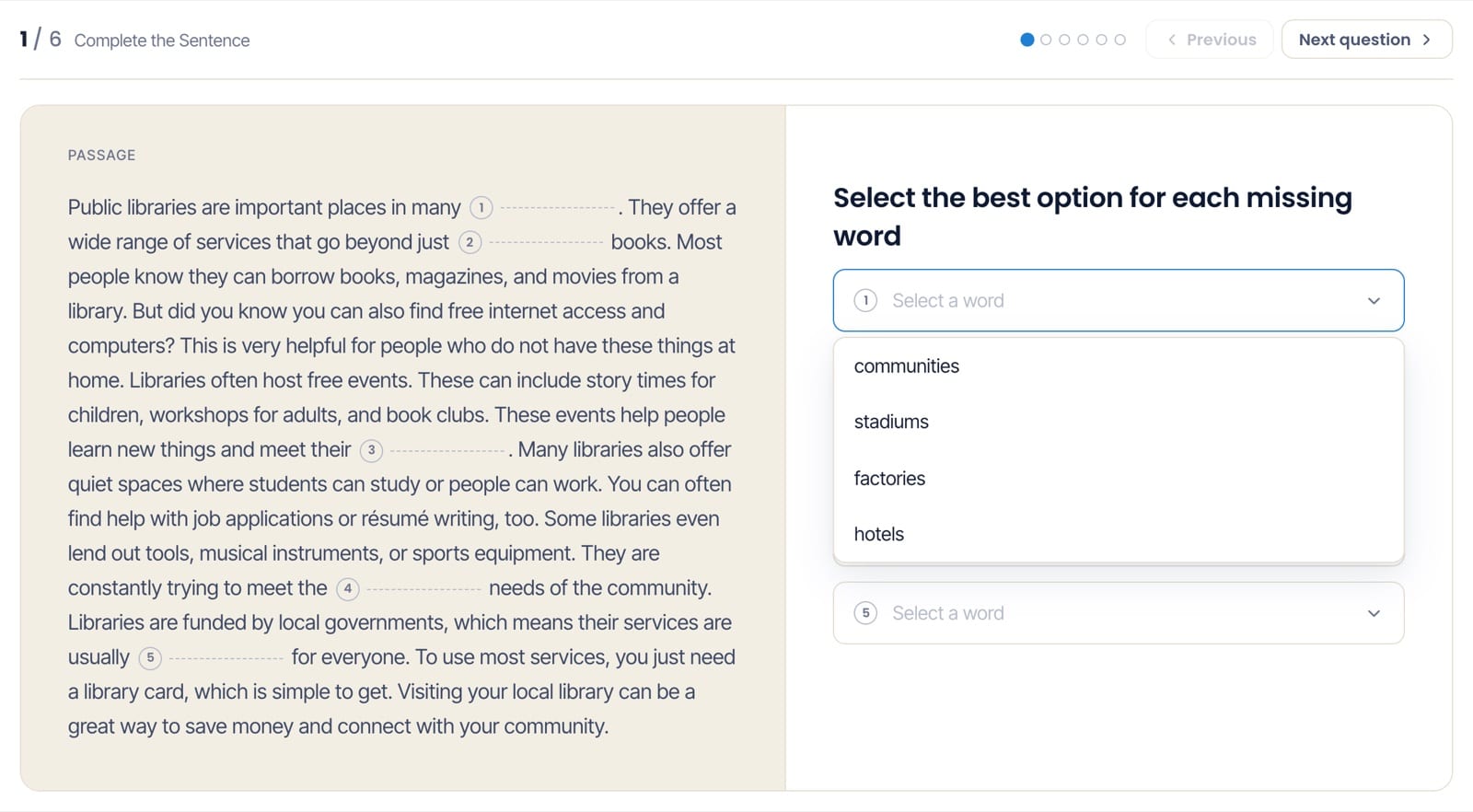
- You see only the first half of the passage, with some words removed (3 to 10, according to the official guide).
- For each blank you pick one word from a dropdown. Every blank is scored on its own.
- This question is really your first read of the passage. Understand the first half well here and the other five questions all go faster.
Cross out by grammar before you think about meaning
Check whether there is a modal verb before the blank, whether a noun follows it, and whether the word should be singular or plural. That alone usually rules out two of the four options. Meaning comes second.
Example · which options can go on grammar alone?
Drivers are happy because the new bridge will ? travel time.reducereductionreducedincrease
After will you need a base verb. The noun and the past tense are out before you even check meaning.
Linking words decide the direction
Words like but, because and although tell you which way the answer has to go. After grammar removes two options, you are usually left with two words pointing in opposite directions, and the linking word settles it.
Drivers are happy because the new bridge will increase travel time.
Drivers are happy because travel time goes up? That doesn't fit because.
Drivers are happy because the new bridge will reduce travel time.
Happy because means a good change. So: reduce.
Fill the easy blanks first, and never leave one empty
The official guide says the same thing: do the easiest words first. Once the sure blanks are filled, the sentence starts to make sense and the harder blanks often solve themselves. Each blank is scored separately, so if you still don't know, pick one of the remaining options and move on.
2. Complete the Passage: choose the missing sentence
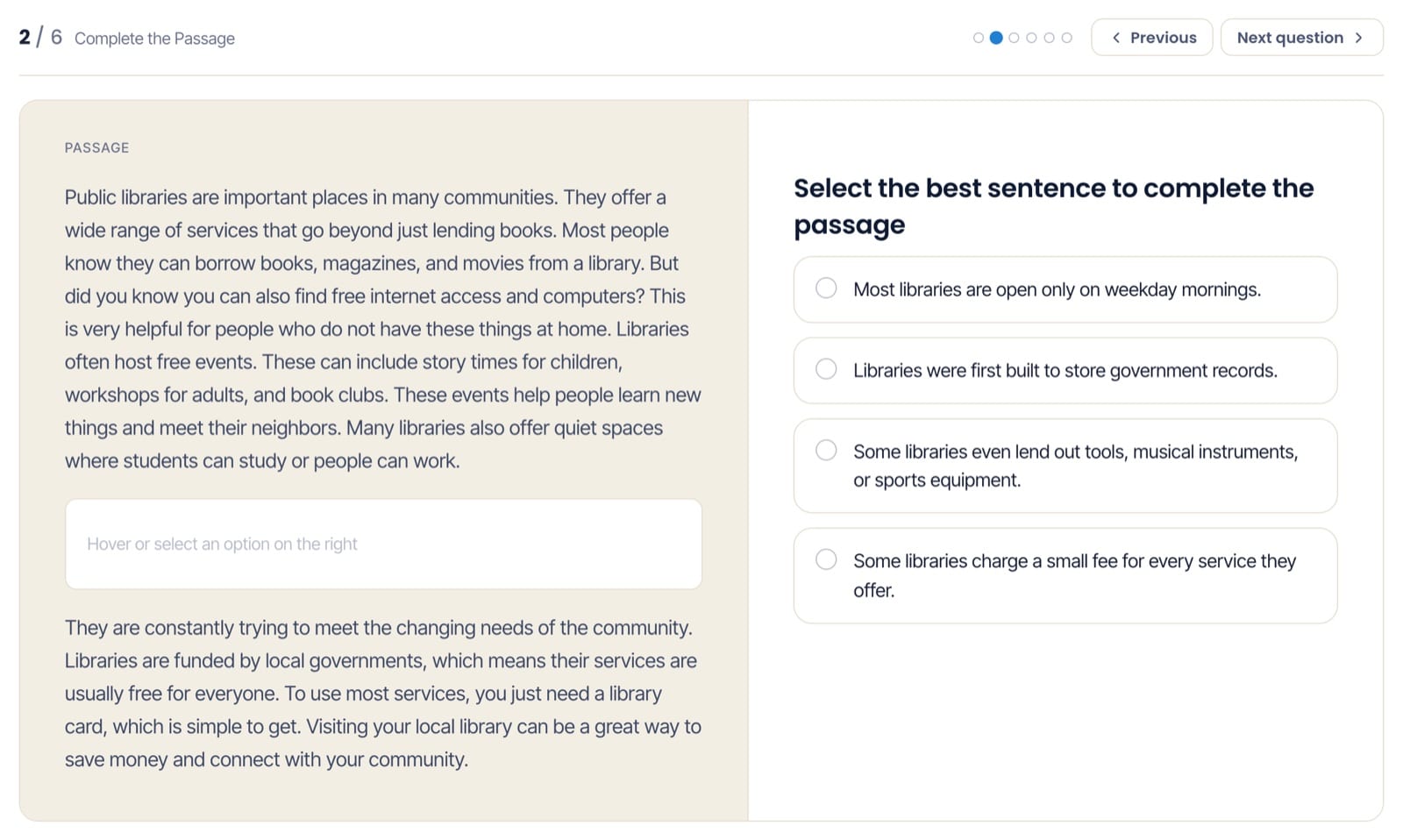
- The first half comes back with the blanks filled in, and this time the second half is revealed.
- One sentence is missing between the two parts. You choose, from four options, the sentence that joins them most naturally.
- When you pick an option, you can see it sitting in the blank. Read from the sentence before to the sentence after in one go, and if it breaks awkwardly, try the next option.
- You have already read the first half, so spend your time reading the new second half carefully.
Hold on to the sentence right before and right after the blank
The missing sentence picks up the flow of the sentence before it, and the sentence after it takes that idea and moves on. If the next sentence starts with a pointing word like This, These or They, the missing sentence has to contain what that word points to.
sentence before → missing sentence → sentence after
Many libraries also offer quiet spaces where students can study or people can work. Most libraries are open only on weekday mornings.
The list of free services suddenly stops.
Many libraries also offer quiet spaces where students can study or people can work. Some libraries even lend out tools, musical instruments, or sports equipment. They are constantly trying to meet the changing needs of the community.
It continues the list of services, and They in the next sentence wraps it up.
Wrong options come in about three kinds
① A sentence that goes against the direction of the text around it ② A sentence stating something the passage never says ③ A sentence that repeats something the passage already said elsewhere. Type ③ is the trickiest. Nothing in it is false, so students pick it often.
① Some libraries charge a small fee for every service they offer.
① Goes against the flow. The passage keeps saying "free".
② Libraries were first built to store government records.
② The passage never says this.
③ Libraries often host free events.
③ (example) Already said earlier. Not wrong, just redundant here.
3. Highlight the Answer: mark the sentence with the answer (2 questions)
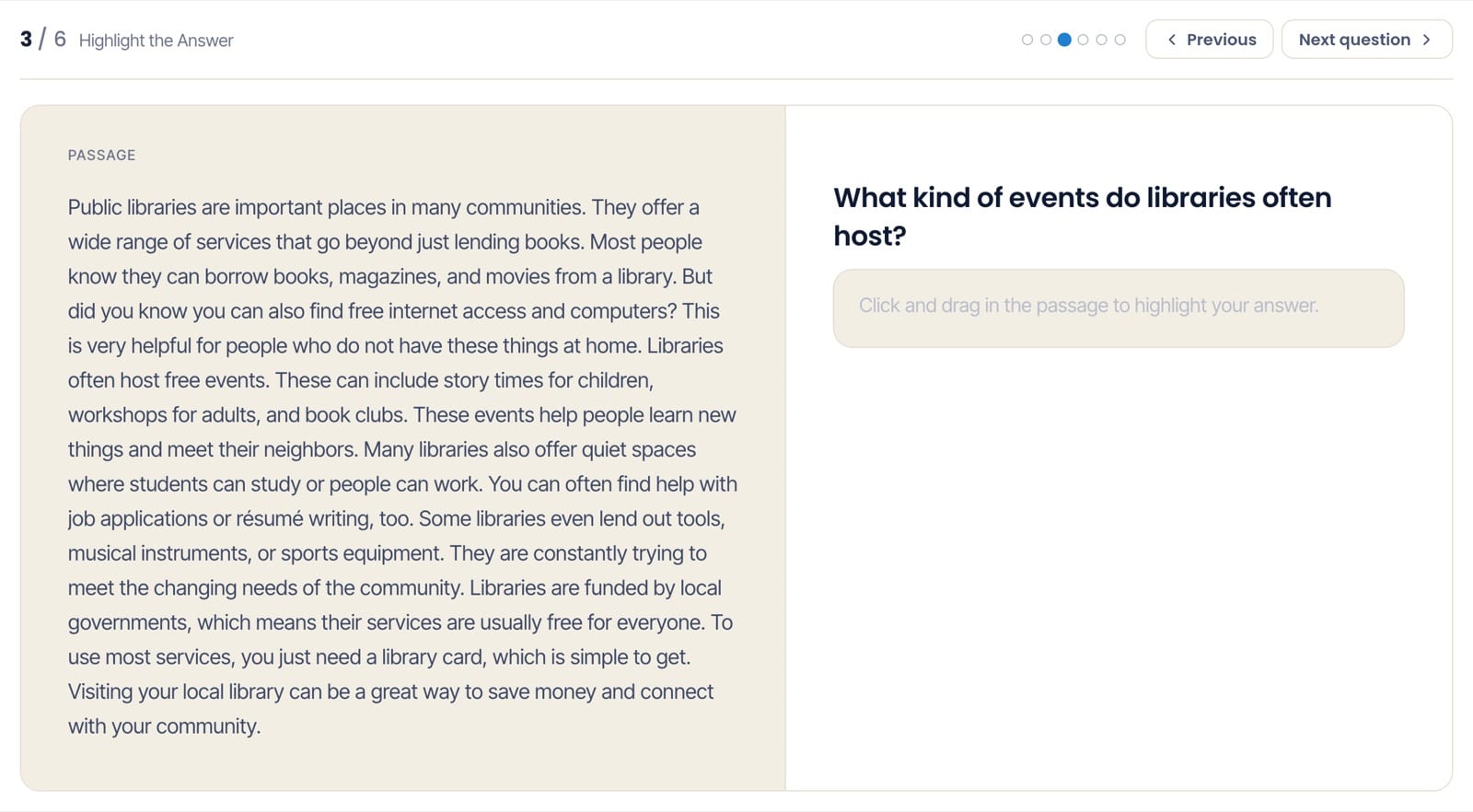
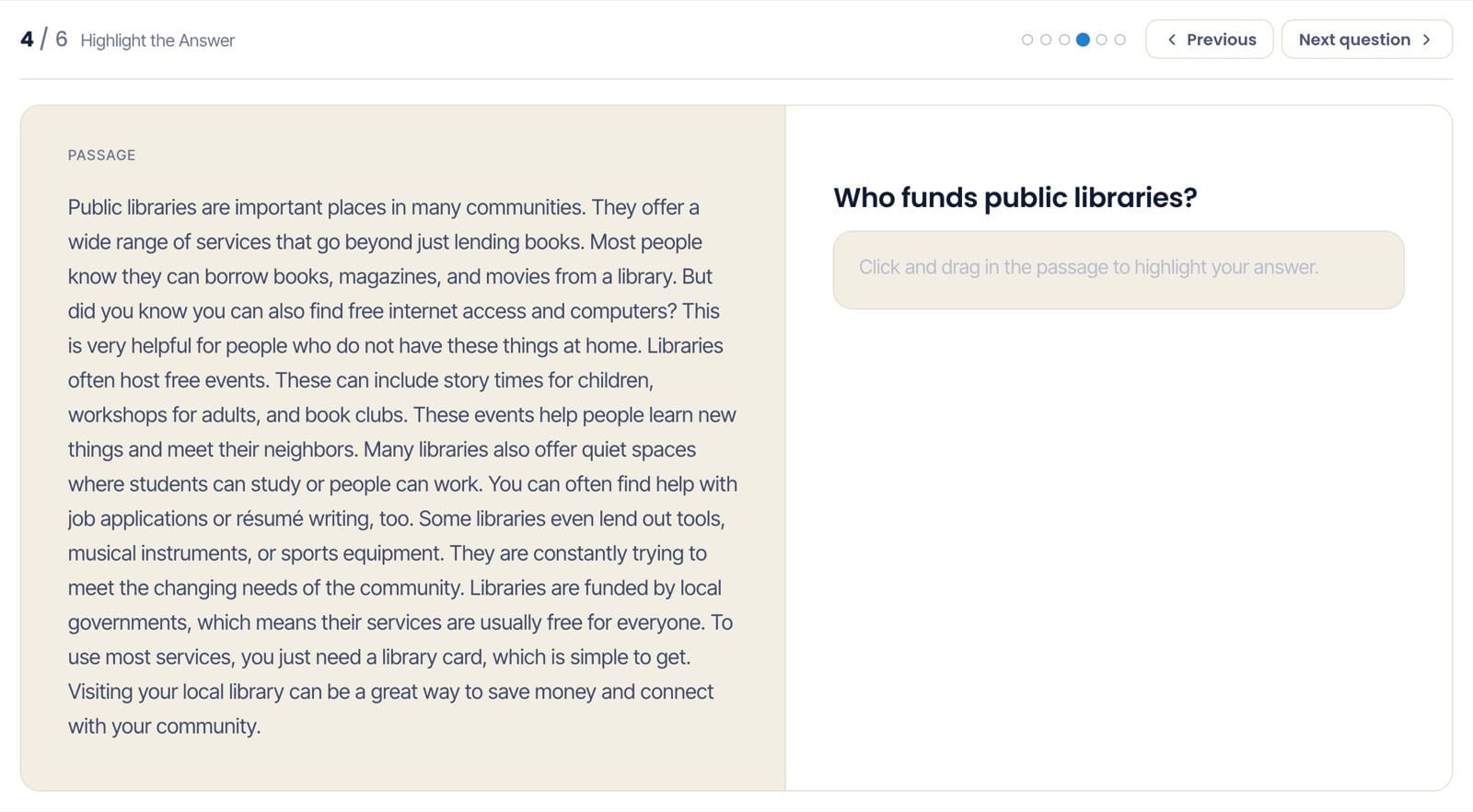
- The full passage, with the missing sentence now in place, appears with a question on the right. There are no options.
- You click and drag over the part of the passage that answers the question. The same passage comes twice with a different question.
- The answer is always written in the passage. The two answers are usually in different places, so for the second question, scan somewhere other than where you highlighted the first time.
Find the question's key word in the passage
The key word from the question often appears in the passage in a slightly different form. The question word is a signal too. For Why, look near because, so or which means. For How, look near by + -ing. For Who, look at the person or group after by.
question word → same word, different form, in the passage
Who funds public libraries?
question
Libraries are funded by local governments, which means their services are usually free for everyone.
funds becomes funded. A Who question sends you to what follows by.
Highlight only the one sentence that holds the answer
What you highlight is exactly one sentence: the one that contains the answer. Don't stretch the highlight across several sentences just to be safe. Once you find the sentence with the question's key word, highlight from its first word to its period and stop.
Question: Who funds public libraries?
Libraries are funded by local governments, which means their services are usually free for everyone. To use most services, you just need a library card, which is simple to get.
No multiple sentences. The second one has nothing to do with the question.
Libraries are funded by local governments, which means their services are usually free for everyone. To use most services, you just need a library card, which is simple to get.
The one sentence with the answer. Stop at the period.
4. Identify the Idea: choose the main idea
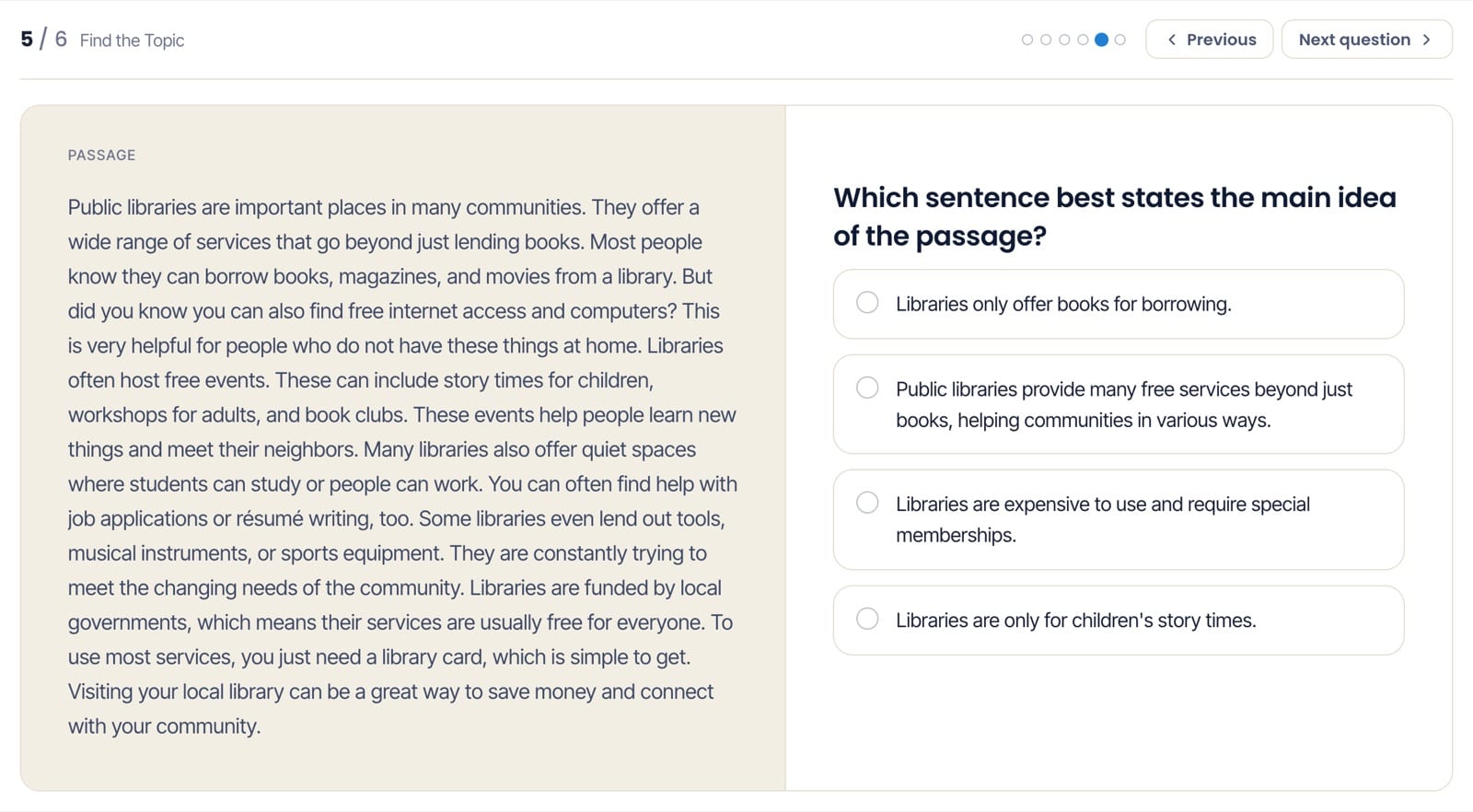
- You look at the whole passage again and choose the option that states what the entire text is about.
- On our practice screen this question is labeled "Find the Topic".
Say the main idea to yourself before reading the options
By this point you have read the passage four times. Finish the sentence "This text is about ___" in your head first, then look at the options. You won't get pulled in by the plausible wrong ones.
Cross out absolute options, partial options and opposite options
Absolute words like only, always and never often turn an option into the opposite of the passage. The most tempting wrong answer is one that is true for just one part of the text. Of what's left, the answer is the option that covers every part of the passage.
Libraries only offer books for borrowing.
One word, only, flips it into the opposite of the passage.
Libraries are only for children's story times.
True for one sentence only. A partial truth.
Libraries are expensive to use and require special memberships.
The passage says they're free. Opposite.
Public libraries provide many free services beyond just books, helping communities in various ways.
Covers every part of the passage.
5. Title the Passage: choose the best title
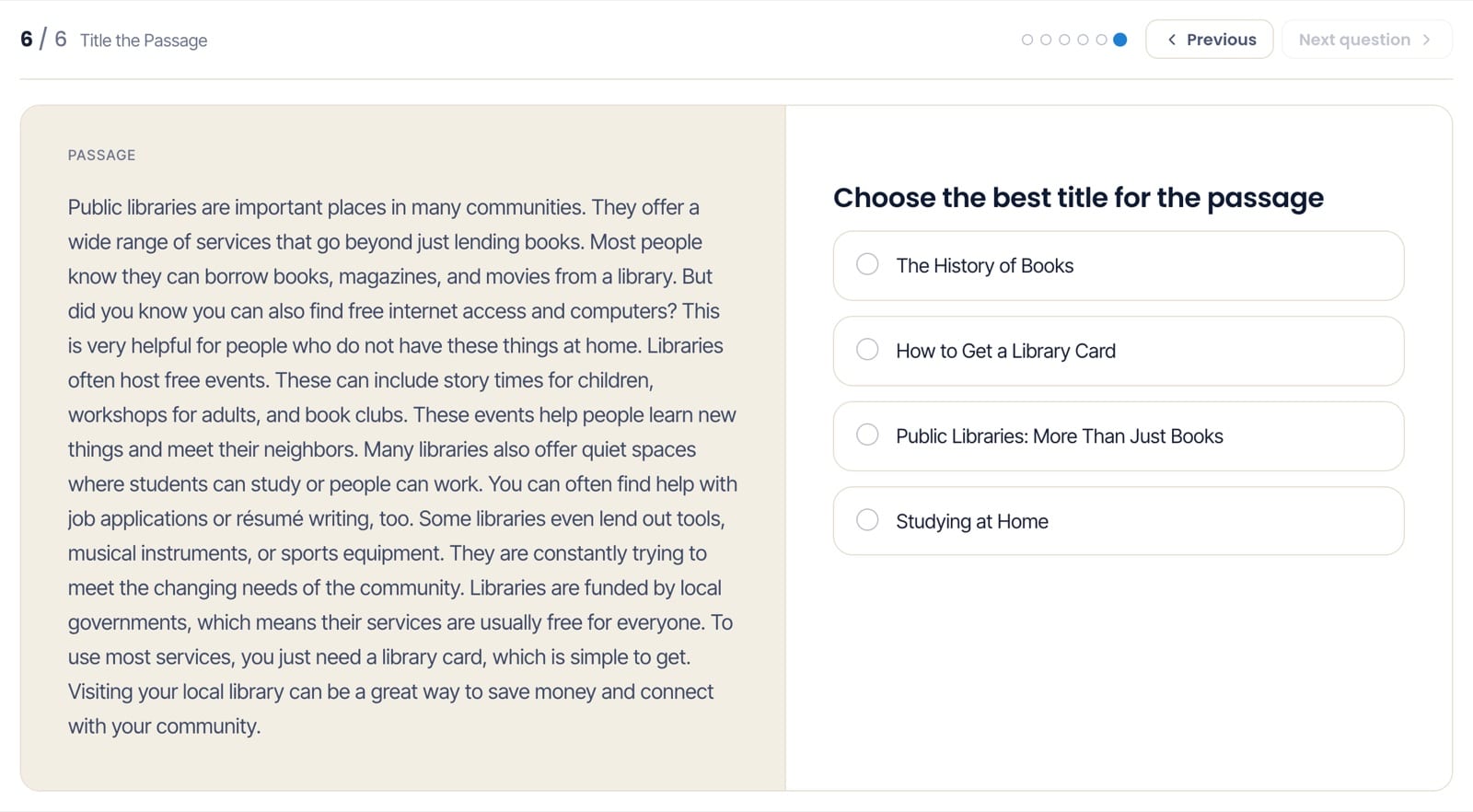
- This is the last question in the set. You choose the title that fits the whole passage best.
- Coming last, it is easy to feel rushed here. But if you already have the main idea, it is the fastest question to answer.
Shrink the main idea you just chose into a title
A title is the main idea made short. Start with the title that contains the key words of your main idea sentence.
main idea (the Identify the Idea answer) → title
Public libraries provide many free services beyond just books, helping communities in various ways.
main idea
Public Libraries: More Than Just Books
The main idea, made short.
Cross out titles that are too narrow or too broad
A title that matches only one sentence of the passage is too narrow. A title that reaches beyond what the passage covers is too broad.
How to Get a Library Card
One sentence of the passage. Too narrow.
The History of Books
Beyond what the passage covers. Too broad.
Studying at Home
Not in the passage at all.
How to split your time
Give the first two questions more time
Six questions in 7 to 8 minutes works out to roughly a minute each, going by the official guide. In practice the time doesn't split evenly. Complete the Sentences, where you read the passage for the first time, and Complete the Passage, where you read the new second half, take longer. After that you already know the text, so things speed up. Reading the passage properly in the first two questions is what saves time overall.
Wrapping up
Interactive Reading looks hard because it has six questions, but really it checks six times how well you understood one passage. What you figure out in the early questions becomes your tool for the later ones.
Start practicing like it's the real test. testpracticelab has free Interactive Reading practice sets in the real exam format, from easy to hard. Try the library passage set used for the screens in this article first, and if you want to practice other question types too, keep going in the full Duolingo question bank.