Duolingo Read and Select: Judge Part of Speech by Suffix in 3 Seconds
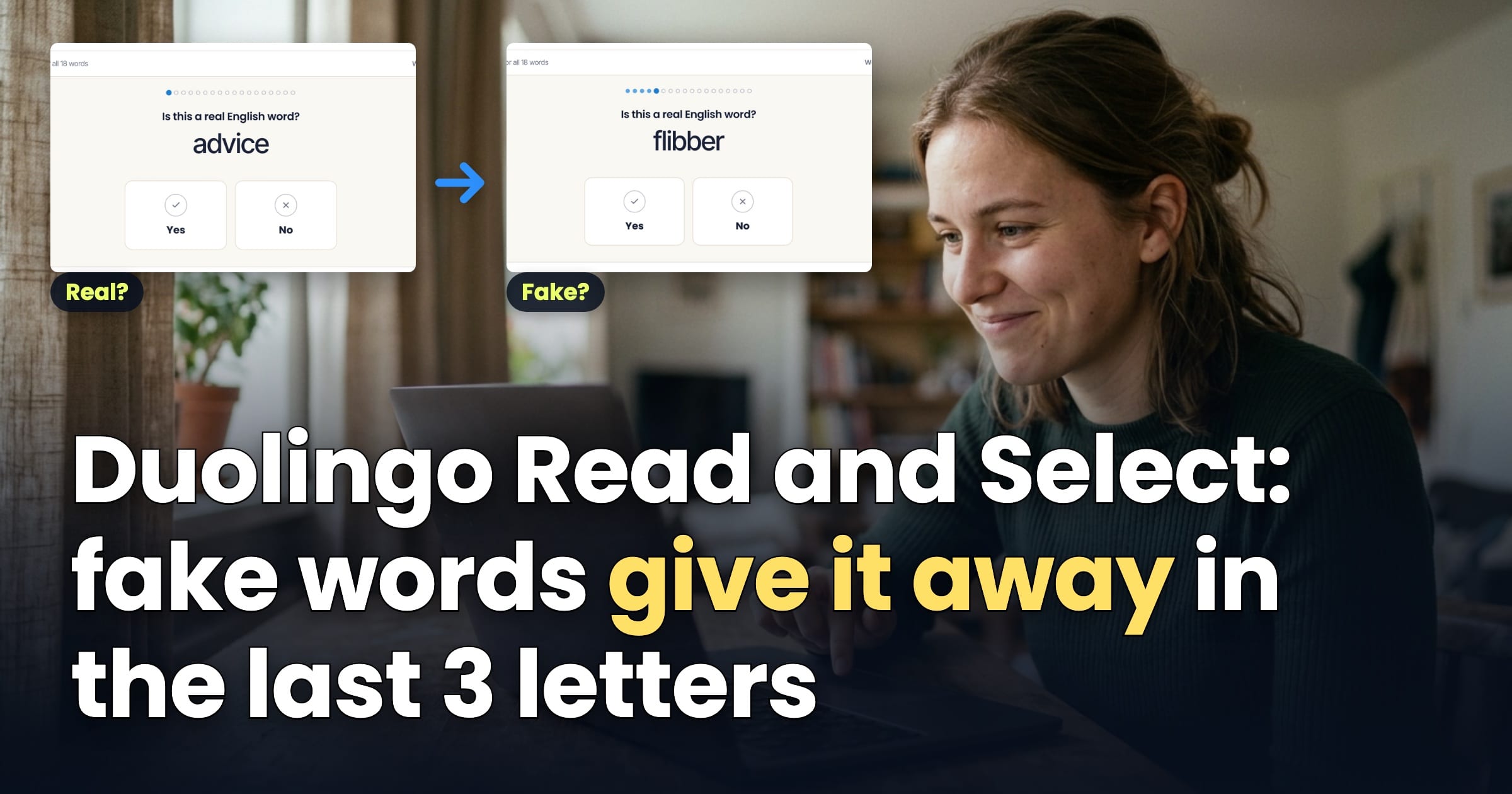
On the Duolingo English Test (DET), Read and Select shows one word at a time and asks whether it is a real English word or a made-up one. In our practice sets you get 1 minute 30 seconds for 18 words, so each word gets only a few seconds. It is hard to raise your score on this type by studying for it. Your score follows your core English, especially how many words you already know and how well you can read a word's ending to tell its part of speech.
At a glance
- Time: Our practice sets give 1 minute 30 seconds for 18 words (5 seconds a word). In the real test, aim to answer within 3 seconds a word.
- Count: 18 words
- Format: One word appears at a time. You choose Yes (real word) or No (fake word).
(Time and word count follow the testpracticelab practice sets.)
The screens below are captured from testpracticelab's actual practice sets. The key thing to see: how does the word ending (suffix) look? Compare it to the table as you read.
1. What Really Matters: Core Vocabulary + Fast Suffix Recognition
- The truth is, you can't study your way to a high score on this question type.
- Instead, two things determine your score:
- ① Core English vocabulary: how many words you already know
- ② Speed at spotting the part-of-speech ending (suffix): when you see -tion, -ness, -able, or -ly, can you instantly say "that's a noun / adjective / adverb"?
The Core Suffix Table (11 Patterns)
Fake words almost always mess with this ending part. If the suffix is wrong, the word is probably fake.
| Ending | Part of speech | Real word examples | Fake word examples |
|---|---|---|---|
| -tion, -sion | noun | nation, solution | nationel, solutio |
| -ness | noun | happiness, sadness | happyness, sadnes |
| -ment | noun | development, agreement | developmant, agreemant |
| -ity | noun | ability, quality | abilty, qualita |
| -ful | adjective | beautiful, helpful | beautifull, helpfull |
| -less | adjective | helpless, homeless | helplass, homeles |
| -able, -ible | adjective | possible, reliable | possibel, reliabel |
| -ous | adjective | dangerous, obvious | dangerus, obvius |
| -ly | adverb | quickly, suddenly | quickely, suddely |
| -er, -or | noun (person) | teacher, actor | techer, actur |
| -ing | noun / verb | running, building | runnin, buildin |
2. Real Word Screen
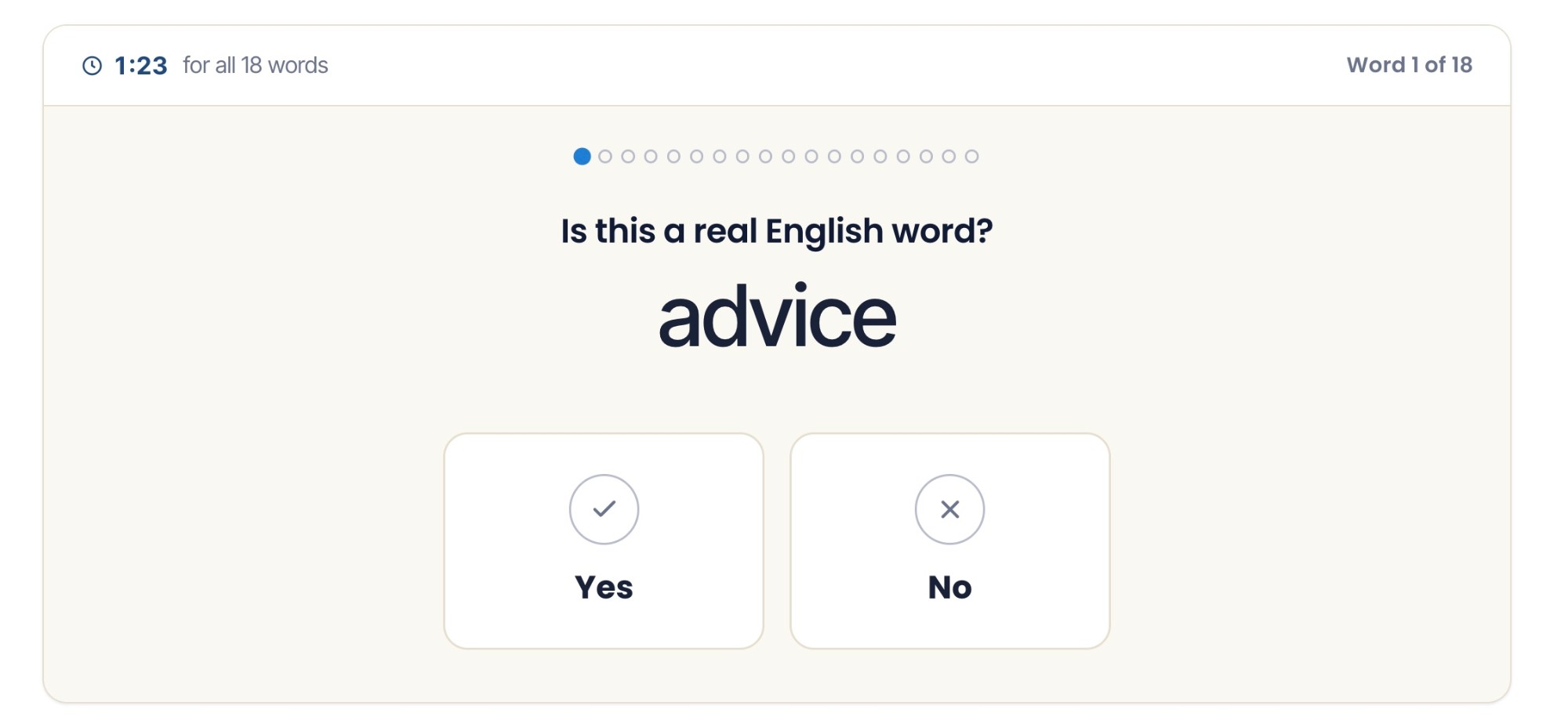
- This word is in the English dictionary.
- It has a natural ending (-ce here) and clear pronunciation.
Tip 1. Read the ending first, then check the part before it
When a word appears, look at the last 2 or 3 letters first. If you know whether the ending marks a noun, an adjective, or an adverb, you know the part of speech. But a real-looking ending is not enough: the part before it has to fit. In the explanation of our practice set, spovly has a genuine -ly ending, but -ly needs an adjective in front of it, and spov is not one, so it is fake.
Tip 2. If You Are Unsure, Say It Out Loud
The ending looks right but something feels off? Say the word out loud. Fake words almost always sound weird. Real words fit the way native speakers pronounce them; made-up words don't.
3. Fake Word Screen
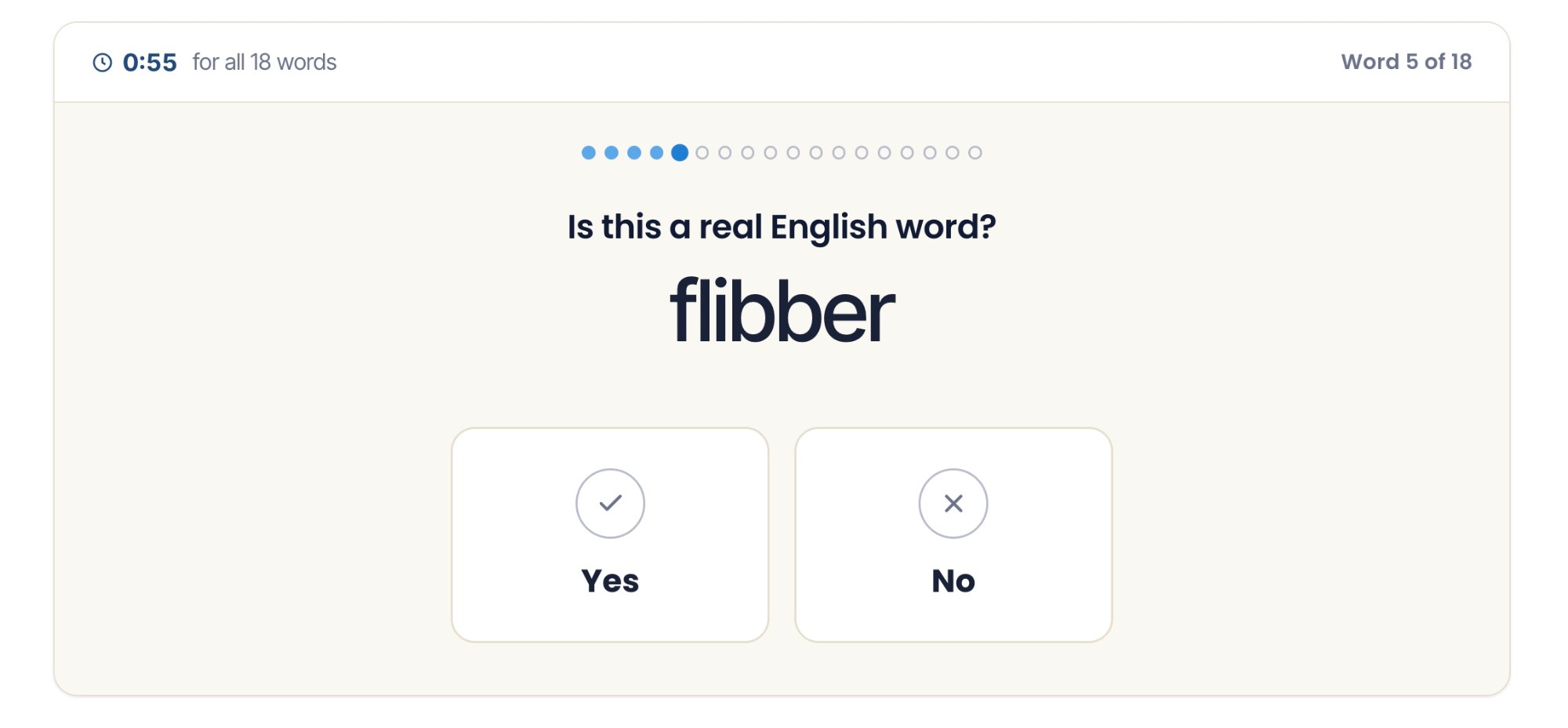
- This is a word made on purpose to look like a real one.
- It reads like English but is not in the dictionary.
- The answer page explains why it is fake.
Trap 1. The ending goes missing or gets attached wrongly
Examples: profession → profes (ending deleted), quickly → quicklying (-ing added by mistake). These are made-up examples to show the idea.
What to do: Don't try to memorize the table. Solve sets again and again until your eyes catch it.
Trap 2. One Vowel Swapped
Real: believe → Fake: beleive
Real: receive → Fake: recieve
What to do: These are easy to miss because the change is small. You don't have time to read the whole word anyway. Look at the first letter and the ending only. Skip the middle.
Trap 3. One Consonant Added or Dropped
Real: different (one t) → Fake: differrent (extra r)
Real: beginning (one n) → Fake: begining (missing n)
What to do: This shows up often too. You can't count every letter in 3 seconds. Judge the word's rough shape: does the length look about right? Do the first and last parts match? Let the details in the middle go.
4. Time Strategy and Final Tips
Tip 3. Don't deliberate: answer within 3 seconds
Spending a lot of time is not a good strategy. This type runs on the words you know and your feel for endings, and staring longer does not create vocabulary you don't have. Go with your gut, about 3 seconds a word, and move on.
Tip 4. If you don't know the word, decide by the ending and move on
Don't stall on an unknown word. If the ending looks natural, pick Yes. If it looks off, pick No. Then go to the next word.
Tip 5. Only Practice Makes You Faster
You can't boost your score by learning grammar rules. Instead, solve the same type of problem again and again to train your eyes to spot the pattern and build speed.
- First 2–3 rounds: slow down and look for suffixes on purpose
- Next 3–4 rounds: try to hit 3 seconds per word
- Later rounds: the pattern should jump out at you automatically
As you go through this, you will also find words you don't know. Write down their meaning afterward and build your vocabulary at the same time.
Wrap-up: Learn From the Answer Screen
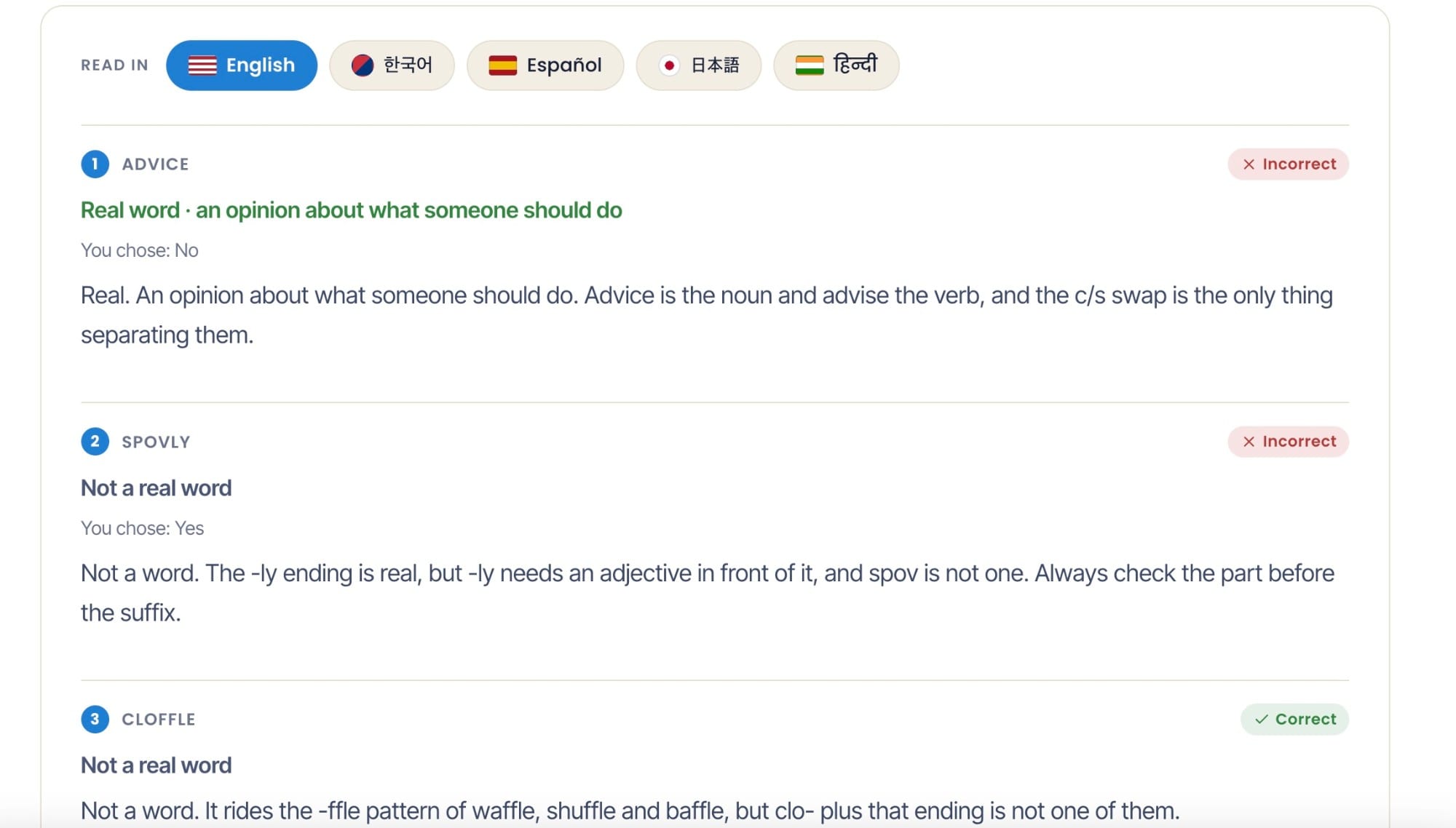
The best learning happens after you solve a problem and look at the answer. Each Read and Select set on testpracticelab shows you an answer page after you finish that explains whether each word is real or fake, and why.
Like the third screen below, you'll see that "advice" is a noun, "spovly" has a -ly ending that doesn't fit the pattern, and "cloffle" has a -ffle pattern that is not in real words like waffle, shuffle, and baffle. When you see these breakdowns again and again, you start to feel the endings the way a native speaker does.
Start with the Read and Select practice sets right now and find which patterns trip you up. Then come back to the suffix table and the three-trap section above and ask, "What did I miss?" By the next set, you will see the difference.