Duolingo Interactive Listening: Following One Official Conversation From Start to Finish
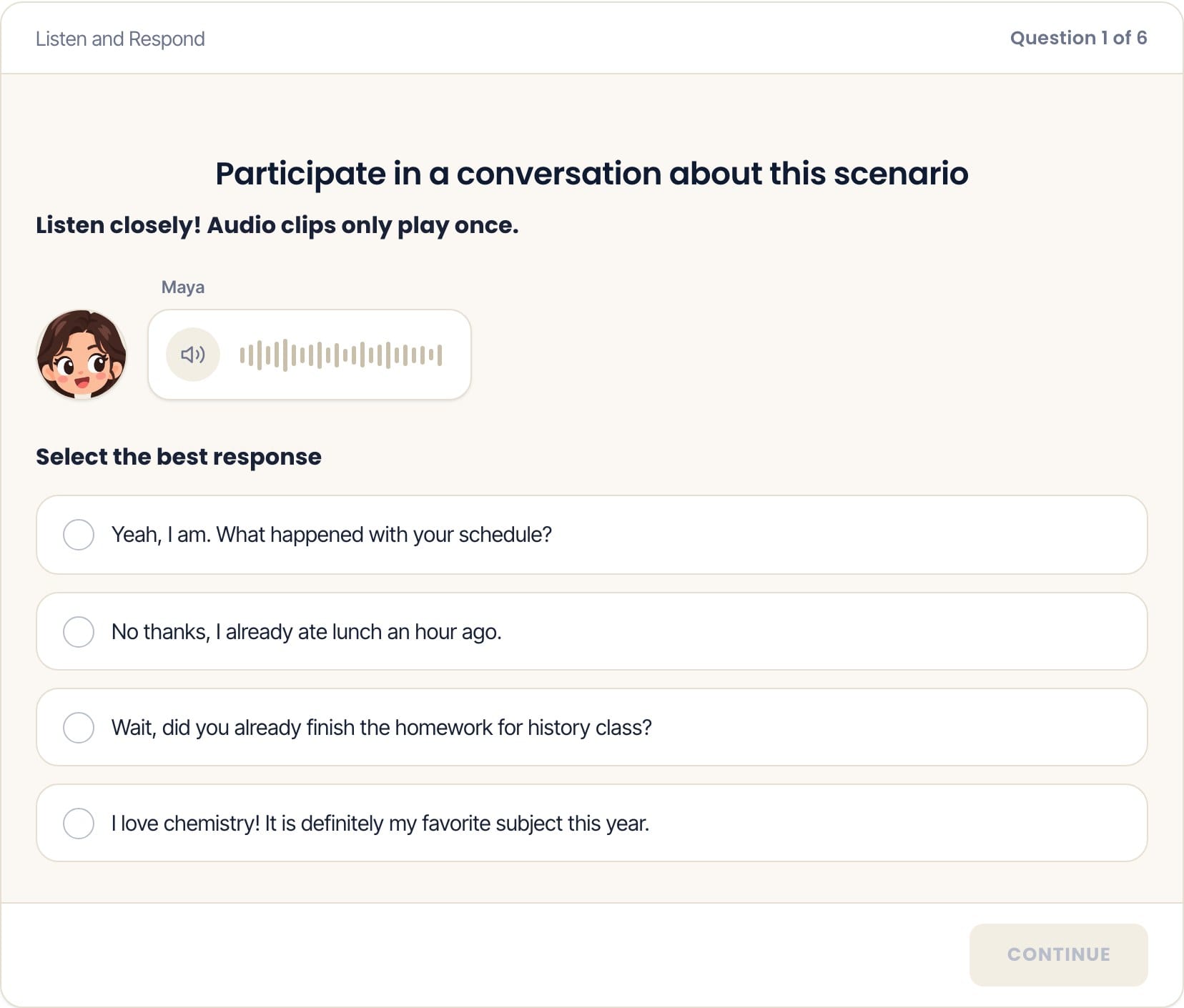
It's easy to assume the wrong replies in Interactive Listening are random nonsense. Follow an official sample conversation one turn at a time and that idea falls apart. Many wrong replies use the same topic words as the conversation and still don't fit what the other person just said. Here we follow one official conversation from start to finish and look for exactly that mismatch.
At a glance (official sources)
- Structure: One situation, three tasks in order: 1) Listen and Complete (fill in blanks) → 2) Listen and Respond (choose replies) → 3) Summarize the Conversation (write a summary).
- How many: 2 to 3 sets per test, with at least one student-to-student conversation and one student-to-professor conversation.
- Time: Parts 1 and 2 share 6 minutes 30 seconds. Part 3 has 75 seconds.
- Scoring: Part 1 gives partial credit the closer you get, part 2 is right or wrong per turn, and part 3 is scored on content, coherence, grammar, and vocabulary. It counts toward Writing and also affects Listening.
- Audio: You can replay the situation in part 1 as often as you like. Each conversation clip in part 2 plays only once.
(Sources: DET Question Guide 2026, official Sample Questions booklet)
What 39 official conversations show
| Item | 39 official sample conversations |
|---|---|
| You start the conversation | 26 (the other person starts 13) |
| Conversations with a professor | 19 |
| Your turns | 5 to 6 per conversation (average 5.1) |
| Options per turn | 4.5 on average (4 to 5) |
| Length of official sample summaries | 49 to 73 words (10 checked) |
(Count: testpracticelab went through the 39 Interactive Listening conversations and full answer transcripts in the official Sample Questions booklet)
The first row matters most. In two out of three conversations, you open. There's no line to react to, so you pick your first words from the situation description alone. Skim the situation and you can miss the very first turn.
Why wrong replies are wrong
The official guide lists five reasons a reply is wrong: it doesn't fit the situation, doesn't match what the other person said, uses the wrong words or pronouns, is too formal or informal, or adds or leaves out information. We sorted the 58 wrong replies in official conversations 1 to 3 into those five.
| Reason (official guide) | Count |
|---|---|
| Doesn't match what the other person just said | 24 |
| Doesn't fit the situation | 14 |
| Adds information or leaves out what's needed | 11 |
| Wrong word or pronoun | 8 |
| Wrong tone | 1 |
(Sorting: testpracticelab judged each of the 58 wrong replies in conversations 1 to 3 of the official booklet against the guide's reasons. This is our judgment, not an official classification)
The most common type is a reply that doesn't fit what you just heard. The topic is right. The words come from the conversation. It just isn't an answer to what the other person said.
Following official conversation 1
Situation: You and a classmate are writing a research paper for your History of the English Language class. It's due this week, so you're meeting to plan how to finish.
First turn (you open)
I can't believe we only have a week left to complete our research paper.
Correct. It matches "this week" in the situation.
This project is due in two weeks and we've barely started.
The situation says this week, not two weeks.
Not too bad. I'm just a little stressed about our research paper.
Nobody asked how you are, so Not too bad has nothing to answer.
Match the numbers and deadlines in the situation first. When you open, options starting with Not too bad or I know need something to react to, so they're often wrong.
Fourth turn: Your classmate says I'll write the introduction and the literature review if you write the methods and results sections.
Okay. Then we can write the conclusion together.
Correct. It accepts the split and offers to share the conclusion.
Okay, let's start with the literature review then.
Your classmate just said the literature review is theirs.
Because literature review appears in both, it looks right. But it's the opposite of the split your classmate just proposed. This is the most common shape of an official wrong reply.
Last turn: Your classmate says That sounds like a good plan. Let's try it and see how it goes!
Alright great, let's get to work.
Correct. It accepts the plan and closes the conversation.
Wednesday works for me. See you then!
No meeting day was ever mentioned.
Yeah, yeah. I'll hurry up, then.
It sounds rude, even to a friend.
How to choose
- Recall only the other person's last sentence. If it's a question, answer it. If it's a suggestion, accept or decline it. If it's a worry, respond to it. First check whether the option is a reply to that sentence.
- Cross out anything new. Options that bring in facts nobody mentioned, like a day of the week, another class, or a new plan, are usually wrong.
- Check who he, it, and they refer to. In our 58, about one wrong reply in seven failed on a word or pronoun.
- If you get one wrong, read the right answer. The correct reply appears after a wrong turn, and the official guide says reading it helps you choose the next one.
Listen and Complete doesn't grade spelling
The first task has you listen to the situation and type the missing parts of 3 to 4 sentences. The official guide says spelling isn't important as long as the idea is right, and not to write too much or too little. You can replay the audio as often as you want. But this time is shared with the next task, so spending it all here rushes your replies. What you hear here is the background for the conversation, so take in the situation as you fill the blanks.
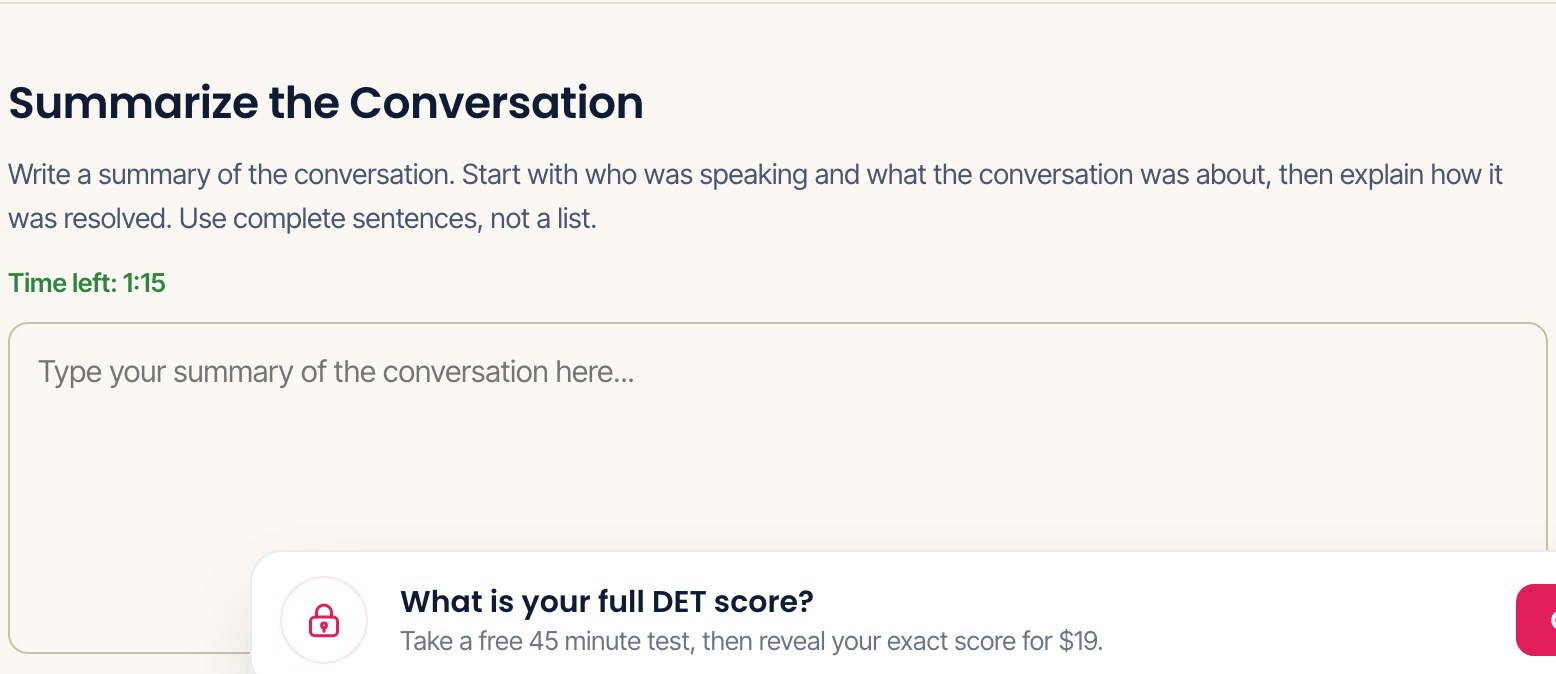
A three-sentence summary frame
The official guide says to explain the situation, the main ideas, and how it ended. With only 75 seconds, it helps to have the frame ready.
- Who and what about: My classmate and I talked about our research paper, which is due this week.
- What was discussed: We decided to split the sections: I will write the methods and results, and my classmate will write the introduction and literature review.
- How it ended: We agreed to write the conclusion together and start right away.
The official sample summaries ran about 50 to 70 words. The guide says it's fine to reuse words from the conversation, so don't spend time paraphrasing. Write full sentences, not bullet points.
What our practice page trains
To be upfront: our Interactive Listening practice sets train choosing replies and writing the summary. They don't include Listen and Complete. In every set, the other person also speaks first. In the real test you open two times out of three, so practice opening lines with the official samples above. Our sets have 4 options per turn, sometimes one fewer than the official 4 to 5.
How I'd practice this in class
If I were teaching this task, I'd have students use one set three different ways rather than racing through many.
1. After you choose, label the three you rejected. Don't stop at the right answer. Give each leftover option one of the five names from the table above: "just said," "situation," "new info," "word," or "tone." If you can't name one, you're still choosing by feel. After about ten sets, the label comes to mind as you read each option.
2. Listen again with the roles swapped. Reopen the same set. This time, right after you pick your reply, say out loud what you think the other person will say next, then play the audio and check. Once you can sense where a conversation is heading, options that break the flow stand out.
3. Draft the summary's first sentence before the conversation starts. The situation already tells you who met and why: My classmate and I met to plan our research paper for History of the English Language, which is due this week. You could write that before hearing a word. In the test the summary box opens after the conversation, but with that sentence ready in your head, you can spend most of your 75 seconds on what was discussed and how it ended.
Start practicing today
The most common wrong reply in Interactive Listening isn't nonsense. It's a reply that doesn't fit what you just heard. Check first whether an option answers the other person's last sentence, and cross out anything that wasn't in the conversation. Write the summary in three sentences, with the first one drafted from the situation.
Practice it like the real test, starting today. You can try the widget from this article in Interactive Listening set 003, and more sets at every level are on our Interactive Listening practice page. For the dictation task in the same Listening section, see how to handle Listen and Type.