TOEFL 2026 Speaking Practice — Level Hard (for score 100+) #07
Listen & Repeat · Take an Interview — full speaking practice with model answers at two score levels.
Listen & Repeat
Listen to each sentence and repeat it out loud. Try to match the speaker’s pronunciation, rhythm, and speed.
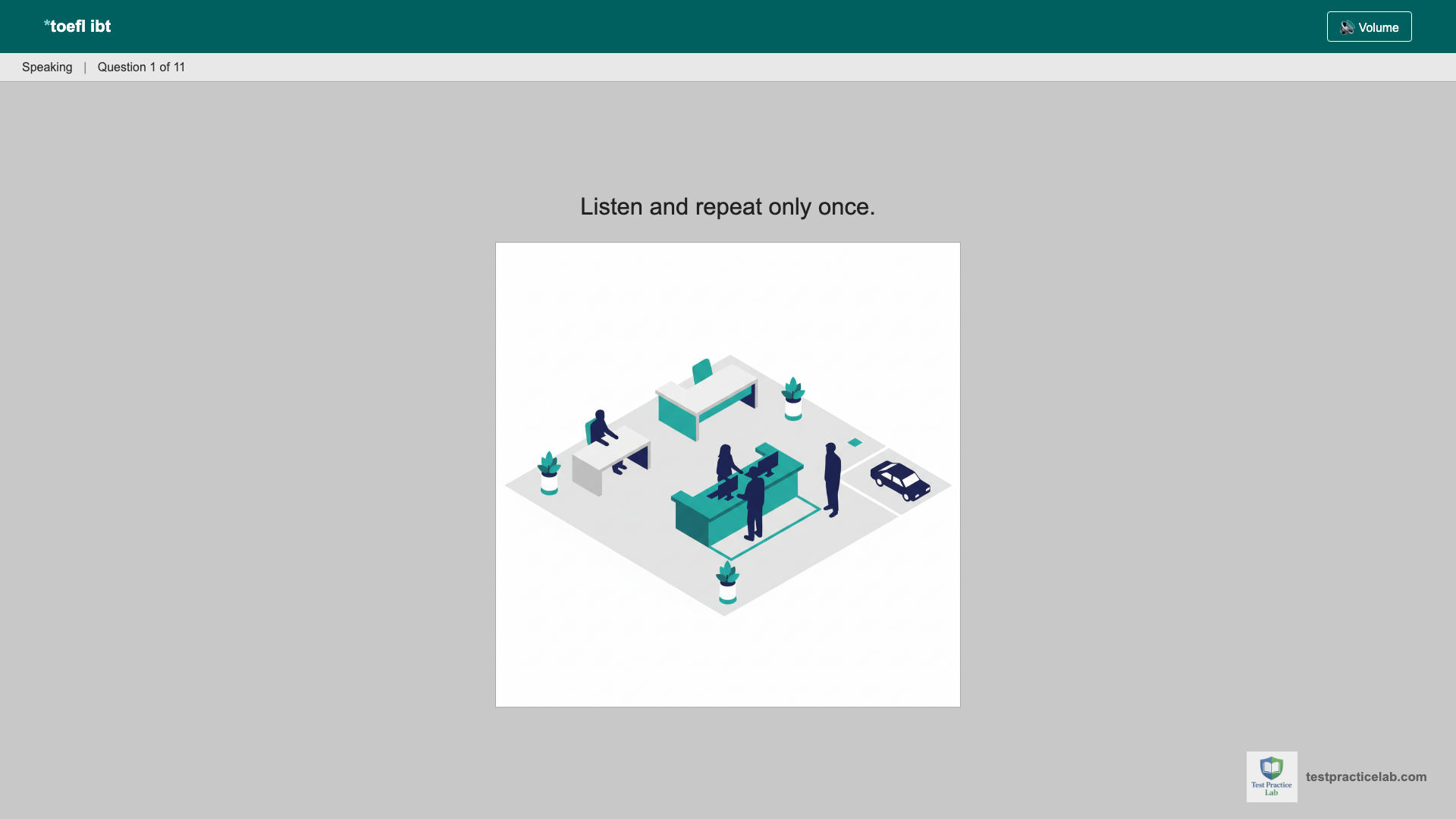
You are a university staff member explaining the parking permit registration process to a new student.
Show Answer
Welcome to the campus parking office.
Show Answer
Please begin your permit registration online.
Show Answer
You must provide your current vehicle license plate number.
Show Answer
Select the correct zone based on your daily class schedule.
Show Answer
Payment can be processed through your secure student account.
Show Answer
After you finalize the payment, remember to print a temporary pass to display on your dashboard.
Show Answer
If you encounter any technical issues, please contact our support desk before you leave the building.
Take an Interview
Listen to each question and give a spoken response. You have 45 seconds for each answer, and there is no preparation time.
You have agreed to participate in an interview about the role of biotechnology and genetic science in our modern society.
Thank you for joining me for this discussion. Please think back to the first time you learned about a genetic breakthrough in the news—such as CRISPR gene editing, genetically modified crops, or medical gene therapy. What specifically caught your attention, and how did you feel about the potential consequences of that discovery?
Start withI vividly remember when I…
Perfect answerScore 100
I vividly remember when I first read about CRISPR technology in a science magazine back in college. It was honestly mind-blowing. What really caught my attention was how researchers could, like, meticulously edit DNA sequences almost as if they were fixing typos in a document. At the time, I felt pretty optimistic about it because of the potential to eradicate hereditary diseases, which is huge, right? But, I mean, it also felt kind of unsettling. The ethical implications were immediately apparent to me; I started worrying about the prospect of ‘designer babies’ and the systemic inequality it might cause if only the wealthy could access these enhancements. It was a really nuanced realization that scientific progress isn’t inherently good or bad—it’s just powerful. That shift in my perspective pretty much defined how I view bioethics today.
Good answerScore 80
I vividly remember when I first heard about CRISPR gene editing on the news a few years ago. It really caught my attention because the scientists were talking about how it could fix genetic diseases, which sounded like something out of a movie. At first, I felt pretty excited about the potential to help people, but then I started to worry a bit. I mean, it’s a powerful tool, so I wondered if people might use it for the wrong reasons, like changing how babies look or things like that. It made me feel like science is moving really fast, and we need to be careful about where we draw the line.
People have very different levels of comfort with genetic technology. Some people actively follow new research and embrace these changes, while others prefer to avoid them or remain cautious. How do you usually stay informed about developments in genetic engineering, and why do you think you prefer that level of involvement?
Start withIn my case, I tend to…
Perfect answerScore 100
In my case, I tend to keep a pretty close watch on genetic engineering developments, mainly through science podcasts like ‘Radiolab’. I’d say I’m inherently fascinated by the field, so I make it a point to stay updated on things like CRISPR and gene editing. I think my preference for this level of involvement comes from a need to understand the potential, as well as the risks. I mean, it’s not just about the science; it’s about the ethical implications, right? For instance, last month I read a compelling article about designer babies, and it really forced me to reflect on the moral boundaries we’re pushing. Because of this, I feel much more prepared to engage in these discussions. Ultimately, I prefer being informed because it helps me navigate the nuanced reality of these advancements rather than just fearing the unknown.
Good answerScore 80
In my case, I tend to stay pretty updated on genetic engineering by reading science articles online or watching documentaries. I guess I’m just curious because it’s a field that’s changing so fast. I don’t really go deep into the research papers, but I like knowing about new things like gene editing or medical breakthroughs. I think I prefer this level of involvement because it’s important to know how these technologies might affect our future lives. It’s not just about science; it’s about understanding the world around us. So, I don’t want to be completely out of the loop, but I also don’t feel the need to be an expert on all the details.
Now I’d like your opinion. Some people argue that we should use genetic engineering to eliminate hereditary diseases and improve human longevity, regardless of the risks. Others believe that altering human DNA is fundamentally crossing an ethical line. Do you believe the potential medical benefits outweigh the ethical risks? Why or why not?
Start withIn my opinion, I believe…
Perfect answerScore 100
In my opinion, I believe that the potential medical benefits of genetic engineering definitely outweigh the ethical risks, provided we move forward with caution. I mean, think about conditions like Huntington’s disease—it’s a devastating, hereditary condition that essentially destroys a person’s quality of life. If we have the technology to identify and edit those specific genes, it seems almost immoral not to use it. For instance, recent advancements in CRISPR technology have shown us that we can potentially rectify these genetic errors at the source. It’s a profound shift in how we approach medicine, moving from just treating symptoms to fundamentally curing the root cause. Of course, we need strict regulations to prevent misuse, but the ability to alleviate systemic suffering is just too significant to ignore. So, I’m convinced that responsible genetic modification is a necessary step for our future.
Good answerScore 80
In my opinion, I believe that the potential medical benefits actually outweigh the ethical risks, but it’s a really tough issue. If we can use genetic engineering to stop kids from having serious hereditary diseases, I think we have a responsibility to do that. Like, it just seems wrong to let someone suffer if we have the technology to fix it, right? Of course, we need to be careful about where we draw the line, so we don’t end up just designing babies for looks or intelligence. But overall, I think the chance to save lives and make people healthier is more important than our fears about technology. It’s just a great way to improve human life.
One last question. Do you think governments should establish strict international laws to limit how far scientists can go with genetic modification, such as banning ‘designer babies’ or permanent changes to the human germline? Why do you think such regulations are, or are not, necessary for society?
Start withI believe that society should…
Perfect answerScore 100
I believe that society should absolutely implement rigorous international regulations on genetic engineering. It’s not just about scientific progress; it’s about the ethical implications of tampering with our DNA. If we allow for ‘designer babies,’ we’re essentially creating a society where wealth dictates biological traits, which I think is inherently problematic. For instance, think about the CRISPR experiments in China a few years ago—they caused a massive global outcry for a reason. Because of this, I’d say we need a unified, global framework to prevent labs from going rogue. Without these boundaries, we might inadvertently create systemic health disparities that could last for generations. So, while I’m all for medical innovation, I’m convinced that setting strict legal limits on germline modification is a pivotal step toward protecting our shared human future.
Good answerScore 80
I believe that society should definitely have strict international laws about genetic modification. I mean, it’s such a powerful technology, so we really need some clear boundaries. If we don’t have rules, I think people might start creating ‘designer babies’ just to get better traits, and that would be really unfair because only rich people could afford it. It could create a huge divide in society, right? Also, changing the human germline is a permanent thing, so if something goes wrong, it affects all future generations. We don’t really know the long-term consequences yet, so it’s just safer to have these regulations in place to keep everyone protected.
Every answer graded, for less than one tutoring lesson.
You heard the model answers. Record all 11 in a full TOEFL test and each one gets a band from 1 to 6 and a line by line note, like this sample.
I think it is important because hobbies makesmake people more creative inat work, and they come back more freshfresher.
That was one answer. Your full test has 11. Every one gets this.