TOEFL 2026 Speaking Practice — Level Medium (for score 90+) #23
Listen & Repeat · Take an Interview — full speaking practice with model answers at two score levels.
Watch & speak along
Play the video and answer out loud before you open the model answers.
Listen & Repeat
Listen to each sentence and repeat it out loud. Try to match the speaker’s pronunciation, rhythm, and speed.
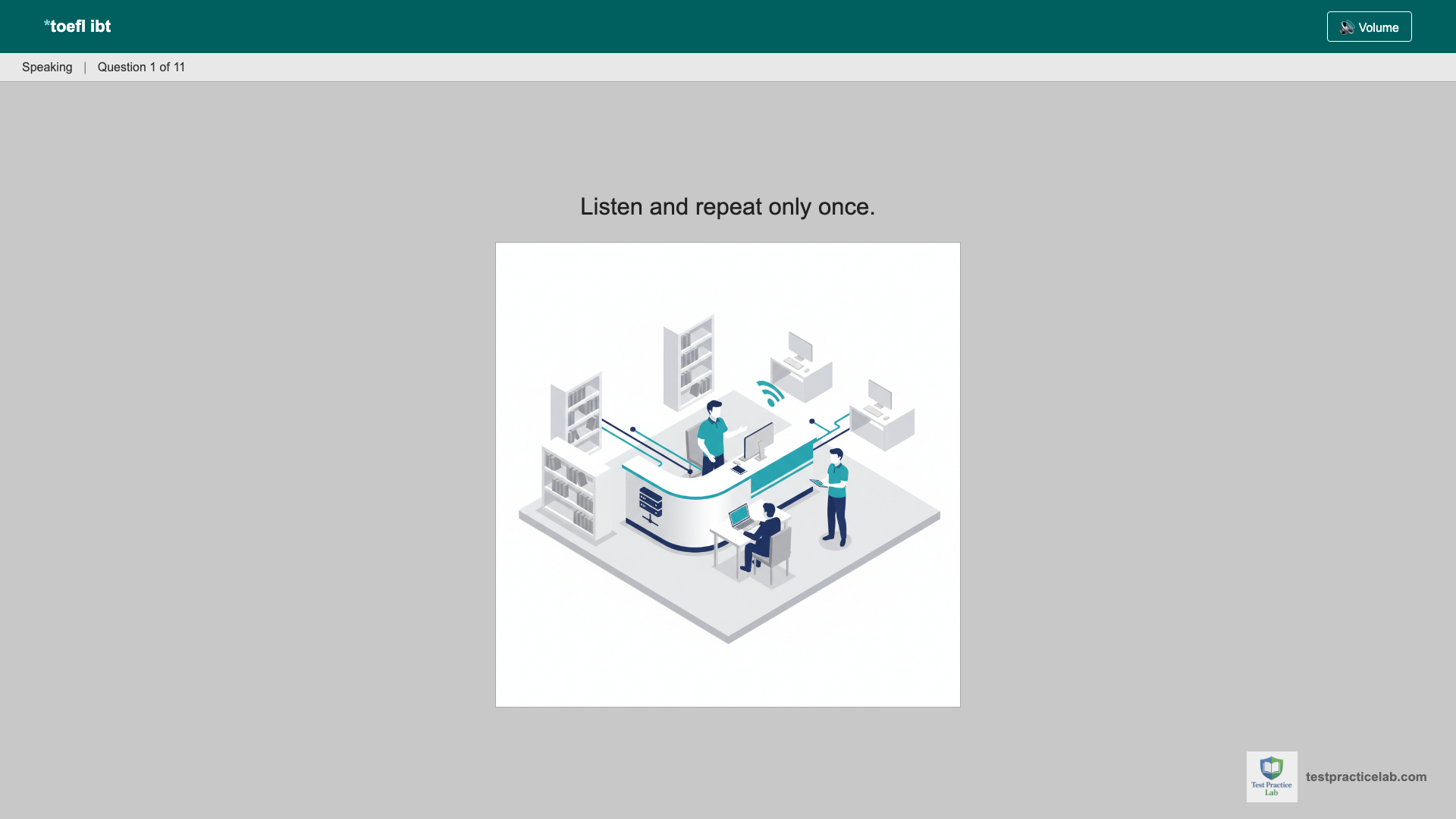
You are a student assistant training to help visitors at the campus IT support desk.
Show Answer
Welcome to the campus tech support office.
Show Answer
Please sign your name on the digital screen.
Show Answer
You should show your student ID card to the technician.
Show Answer
Please explain the problem with your laptop or device.
Show Answer
Wait in the lobby until your ticket number is called.
Show Answer
If you need to leave your device for repairs, remember to take your power cable home with you.
Show Answer
Check your email for status updates, and we will notify you as soon as your computer is ready.
Take an Interview
Listen to each question and give a spoken response. You have 45 seconds for each answer, and there is no preparation time.
You are participating in an interview about your personal experiences and perspectives regarding language acquisition.
Thank you for joining me today. Please think back to a specific time when you used a foreign language to communicate—such as asking for directions while traveling, ordering food at a restaurant, or helping someone who didn’t speak your native language. What was the situation, and how did you feel during that interaction?
Start withI remember a time when…
Perfect answerScore 100
I remember a time when I was traveling in Berlin last summer, and I honestly got completely turned around trying to find my hostel. I mean, I had a map, but the street names were just confusing. I finally gathered my courage and asked a local for help in my broken German. It was a bit nerve-wracking, but he was actually incredibly patient. He didn’t just point; he walked me three blocks to the correct corner. Looking back, that interaction was pivotal for my confidence. Before that trip, I was terrified of making mistakes, but that conversation made me realize that people usually appreciate the effort. It’s so much more rewarding than just using a translation app. Because of this, I now feel like I can navigate almost any situation, even if my language skills aren’t perfect yet.
Good answerScore 80
I remember a time when I was traveling in Italy last summer. I went into a small cafe to order some coffee and a sandwich, but the menu was only in Italian. I tried to order in English, but the waiter didn’t really understand me, so I had to use the few Italian phrases I knew. It was kind of stressful because I was worried about saying the wrong thing, but the waiter was actually really patient with me. In the end, I got my food and it tasted great. It was a pretty cool experience because it showed me that even if you aren’t fluent, you can still communicate and get what you need.
People have very different ways of studying languages; some prefer immersive methods like watching movies or talking to native speakers, while others prefer structured methods like using textbooks or taking formal classes. How do you usually go about learning or practicing a language? Why do you think you prefer that approach?
Start withIn my case, I usually…
Perfect answerScore 100
In my case, I usually prefer a more structured approach when I’m learning a language, like following a textbook or taking a formal class. I’d say I’m the kind of person who needs a clear roadmap to stay focused. For instance, last year I enrolled in a Spanish course at a local community center, and having a set curriculum was just so helpful for me. While some people might find movies or conversation practice more exhilarating, I actually find that those methods can be a bit overwhelming without a solid foundation. By using textbooks, I can meticulously study the grammar rules before trying to apply them in real-life conversations. So, for me, this structured path is definitely the most effective way to build my confidence and ensure I’m actually making progress.
Good answerScore 80
In my case, I usually prefer using textbooks and taking formal classes to learn a language. I know a lot of people like watching movies or talking to native speakers, but for me, that’s just too overwhelming. I feel like I need a solid structure to really understand how the language works. With a textbook, I can go at my own pace and practice the grammar rules over and over again. It’s also easier for me to track my progress that way because I can see exactly what I’ve learned each week. So, yeah, I think a formal class is just better for me because I need that clear guidance to stay focused.
Now I’d like your opinion. Some people argue that it is best to start learning a second language as early as possible in childhood, while others believe it is more effective to wait until someone is older and more motivated. Which approach do you prefer, and what are your reasons?
Start withPersonally, I believe that…
Perfect answerScore 100
Personally, I believe that starting to learn a language as a child is far more effective. When you’re young, your brain is just inherently better at picking up new sounds and grammar patterns without even trying. I remember my younger brother, Min-jun; when he was only six, he started attending an English immersion program, and within a year, his pronunciation was almost native-like. In contrast, I didn’t start learning until high school, and I’ve always struggled with my accent. It’s like, for kids, it’s a natural process, whereas for adults, it feels more like a chore. Because of this, I think early exposure is pivotal for true fluency. Not only that, but it also builds confidence early on. So, yeah, I’d definitely argue that the younger you start, the better the outcome.
Good answerScore 80
Personally, I believe that it’s much better to start learning a second language when you’re a child. I mean, kids are just like sponges, right? They pick up new sounds and words so easily, and they don’t really worry about making mistakes. When you’re older, it’s actually pretty hard to get the pronunciation right because you’re already so used to your first language. So, even though adults might have more motivation, I think the natural ability of a child is way more important. It’s just a much more effective way to become fluent, and it saves you a lot of time and effort later on in life.
One last question. Do you think schools or governments should make learning a second language mandatory for everyone, regardless of their career goals? For instance, should students be required to reach a certain level of fluency before they can graduate? Why or why not?
Start withI think it is…
Perfect answerScore 100
I think it is a bit too much to make a second language mandatory for everyone. While I honestly believe learning a new language is beneficial, forcing students to reach a high level of fluency seems counterintuitive, especially if they have no interest in it. For instance, my cousin Min-jun really struggled with English in high school; he was so stressed about passing his exams that he actually started to hate the subject. I mean, instead of fostering a love for learning, it just created a lot of unnecessary pressure. I’d say schools should offer languages as an elective rather than a requirement. That way, students who are genuinely interested can focus on it, while others can prioritize their own career goals. So, I don’t think it should be mandatory for graduation at all.
Good answerScore 80
I think it is a pretty good idea to make learning a second language mandatory in school. Even if students don’t use it for their jobs, it’s just really helpful to learn how other people think. Like, when you study a new language, you also learn about a different culture, so it makes you more open-minded. Some people might say it’s too much pressure, but I think it’s worth it because it connects us to the rest of the world. It’s better than only knowing your own language, right? So, I definitely support the idea of requiring it for graduation because it helps students become better citizens and things like that.
Every answer graded, for less than one tutoring lesson.
You heard the model answers. Record all 11 in a full TOEFL test and each one gets a band from 1 to 6 and a line by line note, like this sample.
I think it is important because hobbies makesmake people more creative inat work, and they come back more freshfresher.
That was one answer. Your full test has 11. Every one gets this.