TOEFL 2026 Speaking Practice — Level Medium (for score 90+) #18
Listen & Repeat · Take an Interview — full speaking practice with model answers at two score levels.
Watch & speak along
Play the video and answer out loud before you open the model answers.
Listen & Repeat
Listen to each sentence and repeat it out loud. Try to match the speaker’s pronunciation, rhythm, and speed.
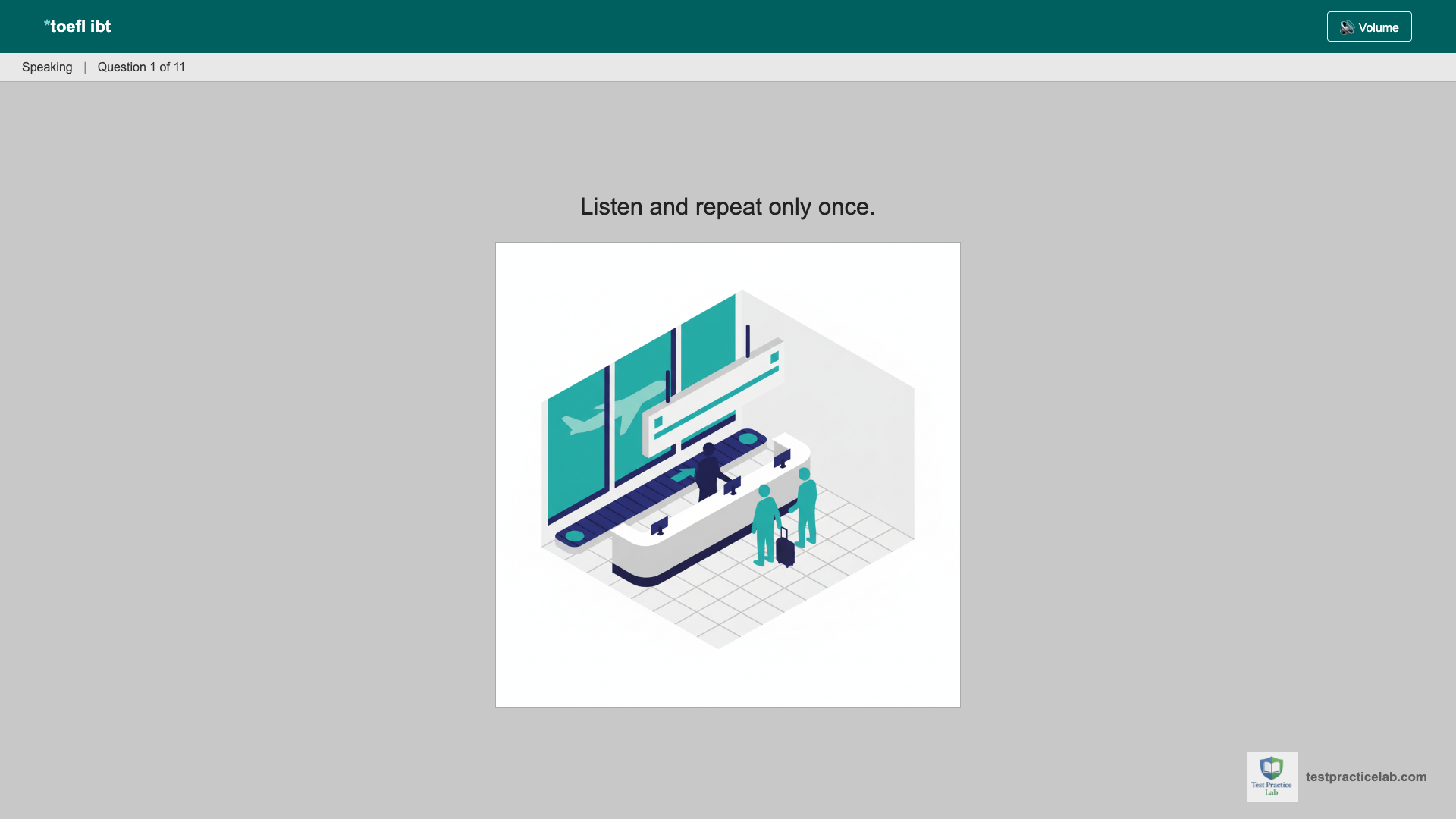
You are learning how to assist passengers at an airport check-in counter.
Show Answer
Welcome to our airline check-in desk.
Show Answer
Please have your passport ready for us.
Show Answer
You may place your heavy luggage on the scale for weighing.
Show Answer
Please confirm that your bag does not contain any forbidden items.
Show Answer
If you need a window seat, I can check the availability now.
Show Answer
Once you finish checking in, please head directly to the security checkpoint for your flight.
Show Answer
Be sure to monitor the digital departure screens for any updates regarding your boarding gate location.
Take an Interview
Listen to each question and give a spoken response. You have 45 seconds for each answer, and there is no preparation time.
You have been asked to share your perspectives for a research project on how different generations interact with modern technology.

Thank you for participating in this study. Please think back to a time when you helped an older or younger person use a piece of technology, such as setting up a new app, using a smart home device, or troubleshooting a computer issue. What specific challenges did you face, and how did you feel while teaching them?
Start withI remember a time when I…
Perfect answerScore 100
I remember a time when I helped my grandfather set up a video calling app on his tablet. He’s pretty old-school, so he was honestly quite intimidated by the interface. The main challenge was that he kept accidentally closing the app because he didn’t realize he needed to swipe instead of just tapping. It was definitely a bit frustrating for both of us, but I tried to stay patient. I eventually wrote down a step-by-step guide with large, clear font, which was a pivotal moment because it gave him the confidence to try it on his own. Once he finally saw my face on the screen, his reaction was just priceless. Helping him bridge that digital divide felt really rewarding; it made me realize how vital it is to be patient when teaching technology to older generations.
Good answerScore 80
I remember a time when I helped my grandfather set up a video calling app on his new tablet. He really wanted to talk to my cousins who live abroad, but he found the interface pretty confusing. The biggest challenge was that he kept accidentally closing the app because he didn’t know how to navigate the touch screen properly. It was kind of frustrating for both of us at first, but I stayed patient and explained the steps slowly. Once he finally made his first call, he was so happy and excited to see their faces. I felt really proud because I helped him connect with our family, even though the technology was new to him.
Some people find that they adapt to new technology as quickly as their peers, while others feel they are much slower or faster than those in other age groups. How do you usually approach learning new technology compared to people from different generations? Why do you think you have this tendency?
Start withIn my case, I tend to…
Perfect answerScore 100
In my case, I tend to adapt to new technology a bit faster than the older generation, but I’m definitely slower than my younger cousins. I think this difference is pretty much due to how we grew up. For instance, my dad always asks me for help setting up his smart TV, which is actually kind of funny because he’s usually a pro at everything else. I think the reason is that I’ve had to be **meticulously** careful with software updates since I was a teenager. My younger cousins, though, just intuitively grasp new apps without even reading the instructions. It’s a **pivotal** difference in our mindset, I guess. While I look for manuals, they just jump right in. So, I’m somewhere in the middle, balancing caution with a genuine curiosity for new gadgets.
Good answerScore 80
In my case, I tend to pick up new technology pretty quickly, but I’ve noticed that my parents struggle a bit more with it. For example, when I got my new tablet, I figured out all the settings in just a few minutes, while my dad spent hours trying to understand how to even turn it on. I think I’m faster because I grew up using computers and smartphones every single day, so it’s just second nature to me. My parents didn’t have that, so they feel a bit overwhelmed when things change. It’s definitely a big difference, but I try to be patient and help them out whenever they get stuck with their phones.
Now I would like your opinion. Some people believe that older generations are unfairly criticized for their technology habits, while others argue that younger generations are too dependent on digital tools. Which perspective do you agree with, and why?
Start withPersonally, I feel that…
Perfect answerScore 100
Personally, I feel that the criticism directed at older generations regarding technology is often quite unfair. You know, people tend to assume that seniors are just tech-illiterate, but that’s not really the case. Take my grandfather, for example; he’s seventy-five, and he actually taught himself how to use complex video editing software just to organize our family archives. It’s a **profoundly** different way of engaging with tech, but it’s still very impressive. In contrast, while younger people are definitely more fluent with gadgets, we are often too dependent on them for basic tasks like navigation or even simple math. It’s almost like we’ve lost the ability to function without a screen. So, rather than judging older folks, I think we should appreciate their efforts, as it’s a **nuanced** issue that goes beyond just age.
Good answerScore 80
Personally, I feel that the criticism against younger generations is a bit unfair because we just grew up in a different world. Like, for us, using digital tools is just second nature, right? We use them for everything, like studying, working, and keeping in touch with friends. Older people might see this as being too dependent, but I think it’s just how we adapt to modern life. I mean, it’s not really about being lazy; it’s just about being efficient. So, I don’t think it’s right to judge us for that. It’s just a different way of doing things compared to how it used to be back in the day, you know?
One last question. Do you think schools or workplaces should offer mandatory technology training programs that mix employees or students of all ages to bridge the generational gap? For example, should they pair younger and older individuals to learn from one another? Why or why not?
Start withI think this would be…
Perfect answerScore 100
I think this would be a fantastic idea, actually. I mean, there’s often this huge divide in how different generations approach tech, right? So, having a mandatory program where, for instance, a twenty-year-old intern is paired with a veteran manager could be incredibly beneficial. It’s not just about the younger person showing the older one how to use a new app; it’s about a two-way exchange. The older employee has this nuanced perspective on communication that the younger one might lack, while the younger one can teach them the latest digital tools. I once saw this happen at my dad’s office during a software transition, and it was pretty cool to see them collaborating instead of just being frustrated. Ultimately, fostering this kind of interaction is a pivotal step toward building a more cohesive and efficient environment for everyone.
Good answerScore 80
I think this would be a really great idea. You know, in most workplaces, older people and younger people don’t really talk that much, so they kind of stay in their own groups. If they had to work together on tech skills, it would help them understand each other better. For example, a younger person could teach an older person how to use new apps, but the older person could also share their experience with work. It’s basically a win-win situation because everyone learns something new. I think it would also make the office environment much more friendly and connected, so it’s definitely something companies should try to do.
Every answer graded, for less than one tutoring lesson.
You heard the model answers. Record all 11 in a full TOEFL test and each one gets a band from 1 to 6 and a line by line note, like this sample.
I think it is important because hobbies makesmake people more creative inat work, and they come back more freshfresher.
That was one answer. Your full test has 11. Every one gets this.