TOEFL 2026 Speaking Practice — Level Medium (for score 90+) #17
Listen & Repeat · Take an Interview — full speaking practice with model answers at two score levels.
Watch & speak along
Play the video and answer out loud before you open the model answers.
Listen & Repeat
Listen to each sentence and repeat it out loud. Try to match the speaker’s pronunciation, rhythm, and speed.
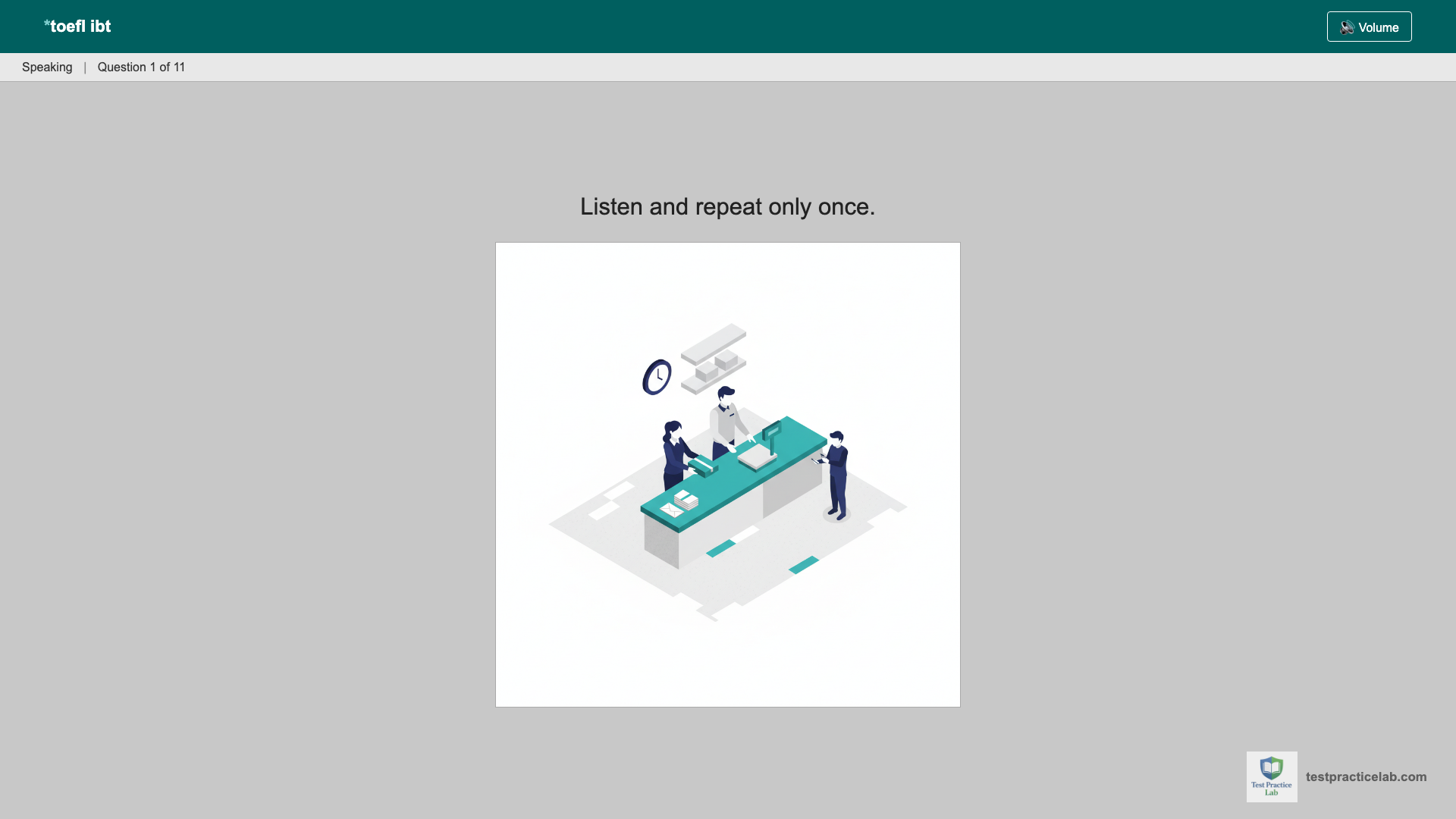
You are a postal worker guiding a customer through the process of shipping a package.
Show Answer
Welcome to our local post office.
Show Answer
Please bring your box to this counter.
Show Answer
You should fill out this form with your address and the recipient’s name.
Show Answer
Make sure that the package is sealed tightly before you place it on the scale.
Show Answer
If the items are fragile, please let me know so I can mark it as breakable.
Show Answer
Once the label is printed, you can pay for the shipping costs using a credit card or cash.
Show Answer
Keep your receipt in a safe place until you receive the tracking number for your delivered package.
Take an Interview
Listen to each question and give a spoken response. You have 45 seconds for each answer, and there is no preparation time.
You have agreed to participate in an interview about how cultural background shapes personal identity and values.
Thank you for joining me today. Please think back to a specific moment when you felt strongly connected to your cultural background—perhaps during a traditional holiday celebration, a family gathering, or while visiting a heritage site. What happened during that moment, and why did it feel meaningful to you?
Start withI vividly remember a time when…
Perfect answerScore 100
I vividly remember a time when I was celebrating Chuseok at my grandmother’s house back in Busan. It was a really busy day, right? We were all gathered in the kitchen, and my mom was teaching me how to make songpyeon, those traditional rice cakes. At first, I was kind of struggling because my folding technique was honestly pretty messy. But as we sat there together, laughing and sharing stories about our ancestors, I felt this profound sense of belonging. It wasn’t just about the food; it was about honoring our roots. This moment was pivotal for me because it helped me realize that my cultural identity is something I carry with me every day, not just during the holidays. Because of this, I feel much more connected to my heritage whenever I practice these traditions.
Good answerScore 80
I vividly remember a time when I was helping my grandmother make kimchi for the holidays. It was a really long process, and we spent the whole day in the kitchen together. Um, honestly, I used to think it was just a chore, but that day it felt different. We were talking about our family history while we worked, and it really helped me understand my roots better. It was meaningful because it connected me to my heritage in a way that school books just can’t. It also showed me how important family traditions are for keeping our identity alive. So, yeah, it was a pretty special experience that I still think about a lot.
People express their cultural identity in different ways; some people make it a priority to participate in traditional rituals, while others focus more on integrating their values into their modern, everyday lifestyle. How do you usually express your cultural identity in your daily life, and why do you choose that approach?
Start withIn my daily life, I typically…
Perfect answerScore 100
In my daily life, I typically express my cultural identity by blending traditional Korean values into my modern routines rather than just focusing on formal rituals. I mean, for me, it’s really about how I treat others. For instance, I always make sure to use honorifics when I’m talking to elders at my office, which is a small but pivotal part of my heritage. Some might argue that traditional ceremonies are more significant, but I find that incorporating these values into my everyday interactions is more meaningful. It’s kind of a way to keep my roots alive without feeling like I’m stuck in the past. This approach has profoundly shaped my character because it helps me stay connected to my identity while navigating a fast-paced, globalized world. So, yeah, that’s how I keep my culture present.
Good answerScore 80
In my daily life, I typically express my cultural identity by cooking traditional Korean meals for my friends. I think food is a really good way to share my background with other people. You know, instead of just following old rituals, I like to bring my culture into my modern life because it feels more natural for me. I mean, it’s not that I don’t like traditions, but sharing a meal is just more fun and social. I also try to explain the meaning behind the ingredients when I’m cooking, so my friends can learn about my heritage too. It’s a simple way to stay connected to my roots while I’m living in a busy, modern city.
Now I’d like your opinion. Some people believe that it is essential for individuals to strictly follow the traditions of their culture to maintain their identity, while others believe it is better to adapt and evolve those traditions to fit modern society. Which perspective do you prefer, and why?
Start withPersonally, I am inclined to believe…
Perfect answerScore 100
Personally, I am inclined to believe that adapting traditions to fit modern life is actually more important for keeping a culture alive. If we just stick to old ways without changing anything, traditions can become kind of stagnant, right? For instance, in my family, we have this tradition of preparing a massive feast for Chuseok. My grandmother used to spend three days in the kitchen, but that’s just not feasible for my generation anymore. So, we’ve shifted to a more collaborative, smaller-scale approach. It’s a nuanced change, but it means we still value the gathering without the unnecessary stress. I mean, evolving our customs allows them to remain relevant rather than just feeling like a chore. Because of this, I think adaptation is the best way to honor our roots while moving forward.
Good answerScore 80
Personally, I am inclined to believe that it’s better to adapt traditions instead of following them strictly. I mean, culture isn’t just about the past, right? It’s something that should grow with us. For example, my family has these traditional holiday meals, but we’ve changed them over the years because some of us are vegetarians now. If we stayed exactly the same, it wouldn’t really fit our lives anymore. So, I think it’s important to keep the core values of our culture, but we should also be flexible. It’s better to evolve, because if traditions don’t change, they might just disappear, and that would be a real shame.
One last question. Do you think schools and workplaces should actively promote cultural diversity by requiring employees or students to share their unique traditions and values? For instance, should they set aside time for cultural exchange sessions or celebration events? Why or why not?
Start withI think it would be beneficial…
Perfect answerScore 100
I think it would be beneficial for schools and workplaces to promote cultural diversity, though it should definitely be voluntary. I mean, forcing people to share their personal traditions can sometimes feel a bit intrusive, right? But if it’s done in a supportive way, it’s actually a really powerful tool. For instance, back when I was in university, we had this monthly ‘Global Kitchen’ event where students brought dishes from their home countries. It was a pivotal experience for me because I got to learn about the nuanced differences in how people celebrate holidays, which I never would have known otherwise. As a result, our group became much more cohesive. Unlike a formal lecture, these sessions allow for genuine connection. So, I’d say that creating these spaces is a great way to foster mutual respect and understanding among diverse groups.
Good answerScore 80
I think it would be beneficial for schools and workplaces to have cultural exchange sessions because it helps people understand each other better. You know, when we share our own traditions, it makes everyone feel more comfortable and connected. In my school, we had a day where we brought snacks from our home countries, and it was actually really cool to learn about where my friends came from. It’s much better than just working in a place where everyone is the same, right? So, I think these events are a great idea because they stop people from judging others. It’s just a simple way to make sure everyone feels welcome and respected in the group.
Every answer graded, for less than one tutoring lesson.
You heard the model answers. Record all 11 in a full TOEFL test and each one gets a band from 1 to 6 and a line by line note, like this sample.
I think it is important because hobbies makesmake people more creative inat work, and they come back more freshfresher.
That was one answer. Your full test has 11. Every one gets this.