TOEFL 2026 Speaking Practice — Level Medium (for score 90+) #12
Listen & Repeat · Take an Interview — full speaking practice with model answers at two score levels.
Watch & speak along
Play the video and answer out loud before you open the model answers.
Listen & Repeat
Listen to each sentence and repeat it out loud. Try to match the speaker’s pronunciation, rhythm, and speed.
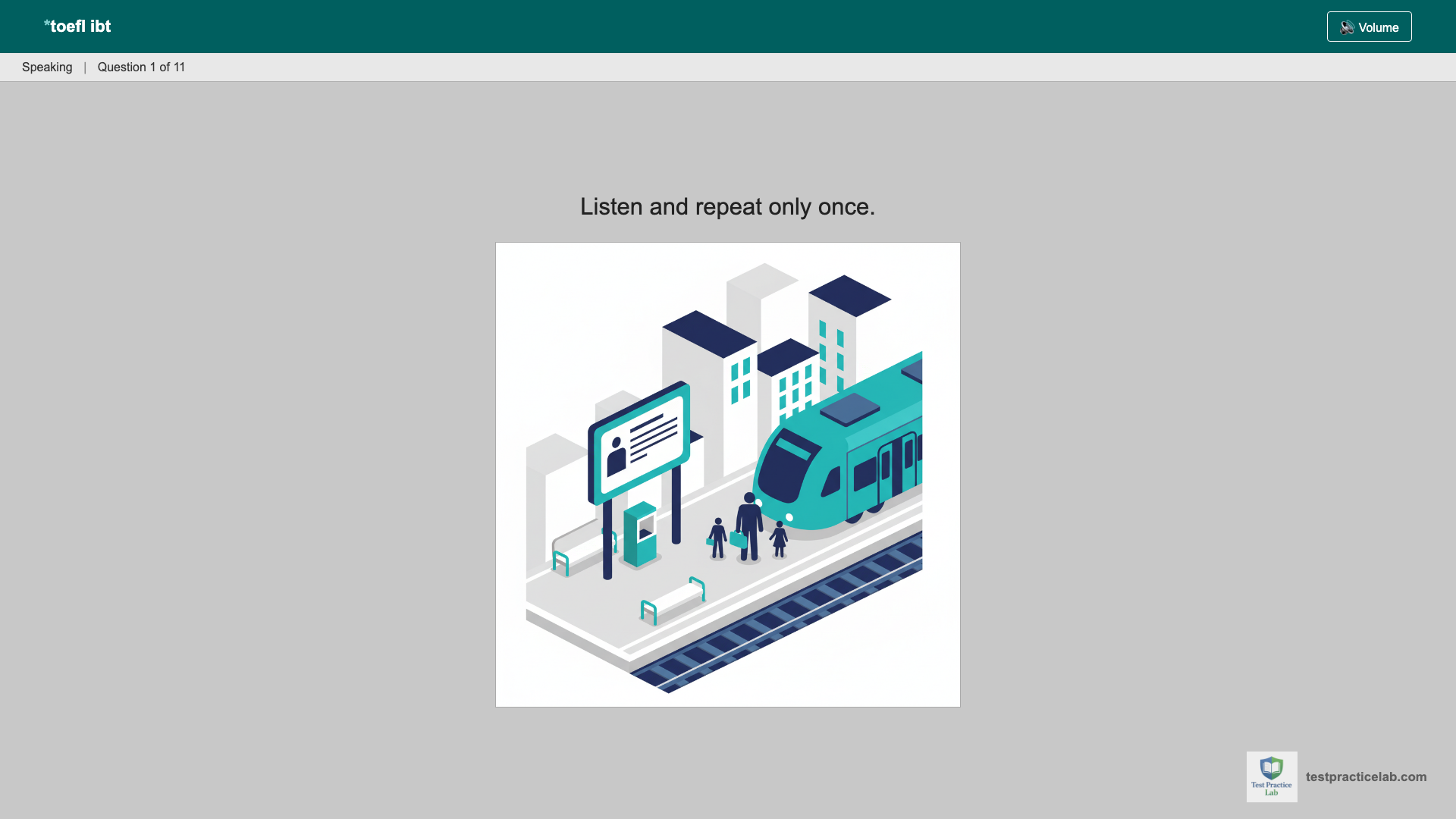
You are a station attendant explaining platform safety and boarding procedures to passengers.
Show Answer
Welcome to the central train station.
Show Answer
Please stand behind the yellow safety line.
Show Answer
Check the digital screens for your train departure time.
Show Answer
Always keep your personal belongings close to your body.
Show Answer
Wait for all arriving passengers to exit the train first.
Show Answer
If you need assistance with your luggage, please speak with an agent at the information desk.
Show Answer
Once you have boarded the train, ensure that your ticket is ready for the conductor to inspect.
Take an Interview
Listen to each question and give a spoken response. You have 45 seconds for each answer, and there is no preparation time.
You are participating in a brief interview about personal organization strategies and how people manage their responsibilities.
Thank you for joining me today. Please think back to a time when you had to complete a very challenging project or meet a tight deadline—perhaps for a school assignment, a work task, or a personal goal. How did you manage your time during that period, and what did you learn about your ability to stay productive?
Start withI remember a time when…
Perfect answerScore 100
I remember a time when I had to finish a massive research paper for my history class during my sophomore year. It was honestly overwhelming because I had only four days to write twenty pages. At first, I was just spinning my wheels, but then I decided to get organized. I meticulously broke the project into small, manageable chunks, like dedicating specific hours just to finding sources and others to drafting. It was a huge contrast to my usual habit of procrastinating until the night before. I mean, by focusing on one section at a time, I felt way less anxious. As a result, I actually finished ahead of schedule. That experience was pivotal for me because it taught me that I’m capable of staying productive under pressure as long as I have a clear, structured plan.
Good answerScore 80
I remember a time when I had to finish a huge group project for my marketing class in just three days. It was really stressful because we had so much work to do and the deadline was coming up fast. So, I decided to break the project into small parts and assigned each person a specific section. This helped us stay organized and focused because we weren’t just working randomly. Before that, I used to procrastinate a lot, but this experience taught me that planning ahead is much better. I realized that I’m actually pretty good at finishing tasks when I have a clear plan, and that really helped me feel more confident.
People have very different approaches to getting things done. Some people thrive on strict schedules and to-do lists, while others prefer a more flexible, spontaneous approach to their work. How do you usually handle your daily tasks, and why do you think you prefer that particular method?
Start withIn my daily life, I…
Perfect answerScore 100
In my daily life, I’m definitely the type of person who swears by strict schedules and to-do lists. I mean, I find that I’m just way more productive when I have a clear roadmap for my day. For instance, every Sunday night, I meticulously map out my tasks for the entire week using a digital planner. It sounds a bit intense, but it keeps me from feeling overwhelmed. Honestly, I’ve tried the more spontaneous approach before, but I found it pretty ineffective because I’d just end up procrastinating. By having a structured plan, I can actually prioritize my most important work. It’s definitely a more disciplined way to live, but for me, it’s the only way to stay on top of everything. I guess that’s why I’ll always prefer structure over flexibility.
Good answerScore 80
In my daily life, I usually prefer using a strict to-do list because it helps me stay on track. If I don’t write down all my tasks for the day, I just feel kind of lost and I end up wasting a lot of time. Um, I mean, I try to list everything I need to do in the morning, and then I check things off as I go. Some of my friends like being more spontaneous and flexible, but that approach just doesn’t work for me at all. I think having a plan is better because it keeps me focused, so I don’t feel stressed about forgetting important things like that.
Now I’d like your opinion. Some people argue that using digital productivity tools, like time-tracking apps or online calendars, is the best way to stay efficient. Others believe that traditional methods, like pen-and-paper planners, are more effective for focus. Which do you prefer, and why?
Start withPersonally, I strongly prefer…
Perfect answerScore 100
Personally, I strongly prefer using a traditional paper planner over any digital app. I mean, don’t get me wrong, technology is great, but there’s something about physically writing things down that helps me remember them better. For instance, last semester, I tried using a popular time-tracking app to manage my assignments, but I found the constant notifications to be quite distracting. Instead of staying focused, I’d end up checking social media every time my phone buzzed. By contrast, using a simple notebook allows me to meticulously organize my daily goals without any digital interference. It’s a much more tactile experience, and it keeps me grounded. Because of this, I feel way more productive when I’m not staring at a screen all day. For me, the classic pen-and-paper method is definitely the superior way to stay on track.
Good answerScore 80
Personally, I strongly prefer using a pen-and-paper planner because it helps me focus much better. I mean, when I use digital apps, I get distracted by notifications or other things on my phone, so I end up wasting time. But with a paper planner, I just write down my tasks and look at them whenever I need to. It feels more personal to me, and I can remember my schedule better because writing things down by hand really helps. Digital tools are okay for some people, but for me, they are just too much. I think sticking to a simple notebook is the best way to stay organized and get my work done.
One last question. Do you think schools or workplaces should mandate specific productivity training for everyone? For example, should an office require all employees to follow a specific time-management system, such as the Pomodoro technique, to ensure consistency? Why or why not?
Start withI think that such policies…
Perfect answerScore 100
I think that such policies would actually be pretty counterproductive if they were forced on everyone. I mean, people have completely different ways of working, right? For instance, last year at my internship, my manager tried to make our whole team use a strict time-tracking app to log every single task. It was honestly a nightmare because it disrupted my flow and felt like micromanagement. I think productivity is inherently personal; some people thrive on rigid schedules, while others, like me, work better with more flexibility. If a company forces a one-size-fits-all system, they might inadvertently kill the creativity of their employees. So, instead of mandating a specific technique, I’d say workplaces should provide resources but let people choose what works for them. That way, everyone can actually stay motivated and reach their goals.
Good answerScore 80
I think that such policies are not really a good idea, honestly. If a company forces everyone to use the same time-management system, it might actually hurt people more than help them. See, everyone works in different ways. Some people like to focus for a long time, but others prefer to take frequent breaks, so a one-size-fits-all approach just doesn’t make sense. If I’m forced to follow a strict method that doesn’t fit my style, I think I’d just get stressed out and feel less productive. I mean, it’s better to let employees choose what works for them because everyone is different, and forcing a system on them is just not the right way to manage a team.
Every answer graded, for less than one tutoring lesson.
You heard the model answers. Record all 11 in a full TOEFL test and each one gets a band from 1 to 6 and a line by line note, like this sample.
I think it is important because hobbies makesmake people more creative inat work, and they come back more freshfresher.
That was one answer. Your full test has 11. Every one gets this.