TOEFL 2026 Speaking Practice — Level Medium (for score 90+) #11
Listen & Repeat · Take an Interview — full speaking practice with model answers at two score levels.
Watch & speak along
Play the video and answer out loud before you open the model answers.
Listen & Repeat
Listen to each sentence and repeat it out loud. Try to match the speaker’s pronunciation, rhythm, and speed.
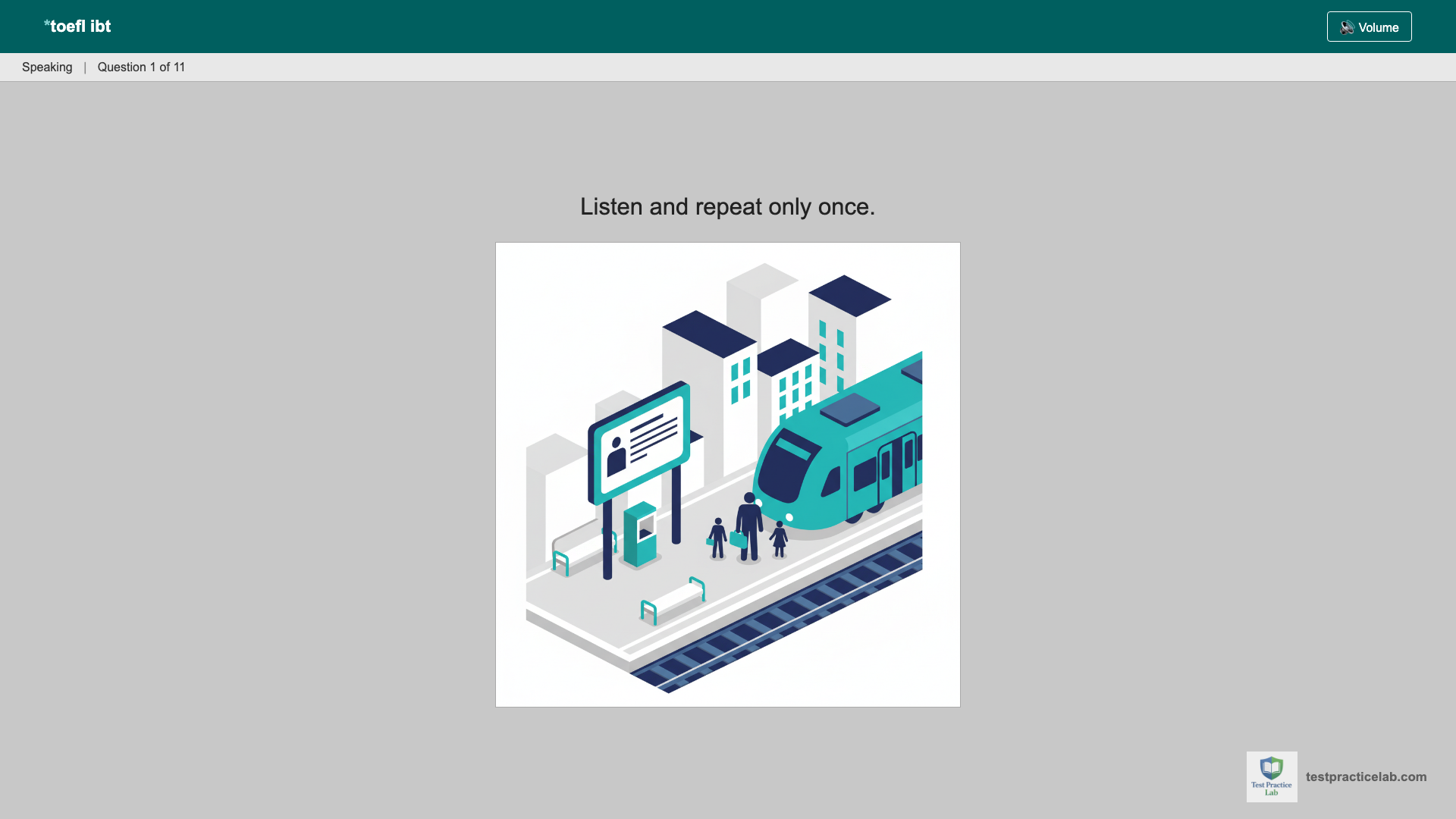
You are acting as a transit official guiding passengers waiting on a train station platform.
Show Answer
Welcome to the central platform.
Show Answer
Please wait behind the yellow line.
Show Answer
Check the digital monitors for the latest schedule updates.
Show Answer
If you have a large suitcase, keep it close to your side.
Show Answer
Make sure your valid travel ticket is ready for the scan.
Show Answer
When the train arrives at the station, please allow all passengers to exit before you board.
Show Answer
Once you have reached your final destination, remember to collect all of your personal belongings.
Take an Interview
Listen to each question and give a spoken response. You have 45 seconds for each answer, and there is no preparation time.
You are participating in a brief interview about how personal environmental awareness influences your daily habits and opinions.
Thank you for joining me. Please think back to a time when you made a specific change to your daily routine for environmental reasons, such as switching to reusable bags, reducing your plastic use, or choosing public transportation instead of driving. What was the change, and how did that experience make you feel about your impact on the environment?
Start withI remember a time when I…
Perfect answerScore 100
I remember a time when I decided to stop using plastic water bottles entirely, which was actually a pretty big shift for me. I used to go through maybe three or four bottles a day while studying at the campus library. I mean, it was just so convenient, right? But then I saw this documentary about ocean pollution, and it really resonated with me. So, I bought a high-quality metal canteen instead. At first, it was kind of a hassle to carry it around, but I eventually got used to it. The impact felt **profoundly** positive because I wasn’t just reducing waste; I was also saving a lot of money. It’s funny, but that one small change made me realize that individual choices are **pivotal** to environmental health, and now, I’m much more conscious about my daily footprint.
Good answerScore 80
I remember a time when I decided to stop buying plastic water bottles every single day. Before that, I was just grabbing a new bottle whenever I was thirsty because it was super convenient, right? But then I started to feel guilty about all the waste I was creating, so I bought a nice metal reusable bottle instead. It was actually a pretty simple change, but it really made me think about my daily habits. Carrying that bottle everywhere made me feel like I was finally doing my part to help the planet. It’s not a huge change, but it made me realize that even small, consistent actions can have a positive impact on the environment.
People approach environmental habits differently; some people are very strict about recycling and energy saving, while others prefer to focus on convenience and simplicity. How do you usually handle these choices in your daily life? Why do you think you tend to approach it that way?
Start withIn my daily life, I…
Perfect answerScore 100
In my daily life, I try to be pretty conscious about my environmental footprint, though I wouldn’t call myself a perfectionist. I’m definitely more on the side of being strict about things like recycling and energy use. For instance, I’ve made it a rule to carry my own reusable tumbler everywhere I go, so I’m not constantly grabbing plastic cups at my local cafe, Coffee Bean. I’d say this habit is **profoundly** important to me because I’ve seen how much waste just one person can generate in a single week. While some of my friends prioritize pure convenience, I find that taking that extra minute to sort my trash is a **pivotal** step in living more sustainably. It’s not always easy, but it’s just become part of my routine, and that’s how I balance my lifestyle.
Good answerScore 80
In my daily life, I try to be pretty eco-friendly, but I also value convenience, so I guess I’m somewhere in the middle. Like, I always make sure to separate my trash and recycle everything I can because it’s honestly not that hard to do. But, when it comes to things like using plastic bags at the grocery store, I sometimes forget my reusable one. It’s just, well, sometimes you’re in a rush, right? I think I approach it this way because I want to help the environment, but I also have a really busy schedule. So, I do what I can without making my life too complicated, you know? It’s just about finding a balance.
Now I would like your opinion. Some people believe that an individual’s small, daily choices are the most important factor in protecting the environment, while others believe that individual actions are too small to make a real difference. Which perspective do you agree with, and why?
Start withPersonally, I strongly believe that…
Perfect answerScore 100
Personally, I strongly believe that individual choices are actually the most important factor in environmental protection. I mean, while it’s easy to think that one person doesn’t matter, I think that’s a pretty counterintuitive way to look at it. For instance, I started bringing my own reusable cup to this coffee shop near my office, ‘Bean Scene,’ about six months ago. By doing this every single day, I’ve saved over a hundred plastic cups from ending up in a landfill. It’s a small change, but when you multiply that by thousands of people, it has a profound impact on waste reduction. Not only that, but these habits often influence our friends and family to do the same. So, even though systemic change is necessary, our daily actions are really the foundation for a greener future.
Good answerScore 80
Personally, I strongly believe that individual choices are actually the most important factor in protecting the environment. Um, I mean, some people think their actions are too small to matter, but I disagree. When everyone decides to use less plastic or recycle their trash, it adds up to a huge change. For example, if I bring my own coffee cup every day, that’s hundreds of cups I keep out of the landfill each year. It’s definitely not just a drop in the bucket because these small habits create a real culture of sustainability. So, I think individual actions are really the key to helping the planet, and we shouldn’t underestimate how much we can do.
One last question. Do you think schools and workplaces should implement strict policies to enforce eco-friendly behaviors, such as banning all single-use plastics or requiring mandatory composting for everyone? Why or why not?
Start withI think it would be…
Perfect answerScore 100
I think it would be a bit too much to enforce these rules strictly, honestly. While I totally support the goal, making things mandatory can actually lead to a lot of resistance. For instance, at my university last year, they tried to ban all plastic cups in the cafeteria overnight, and it was kind of a disaster. Students were just frustrated because there weren’t enough reusable options available, so it felt like a systemic issue that wasn’t properly addressed. I’d say it’s much better to encourage eco-friendly habits through incentives rather than strict bans. If schools or offices provided discounts for using your own mug, it would be a more compelling way to change behavior. In short, I think voluntary participation is way more effective than top-down policies that just frustrate people.
Good answerScore 80
I think it would be a bit too much to have strict policies like that. I mean, I agree that we need to be more eco-friendly, but forcing people to compost or banning everything might not work. For example, at my office, people are already pretty busy, so if the company made composting mandatory, everyone would just get annoyed and maybe stop caring about the environment altogether. It’s better to encourage people to change their habits on their own instead of just making rules. If you force these things, people don’t really learn, right? So, I think education is better than strict rules because it helps people choose to be green because they actually want to.
Every answer graded, for less than one tutoring lesson.
You heard the model answers. Record all 11 in a full TOEFL test and each one gets a band from 1 to 6 and a line by line note, like this sample.
I think it is important because hobbies makesmake people more creative inat work, and they come back more freshfresher.
That was one answer. Your full test has 11. Every one gets this.