TOEFL 2026 Speaking Practice — Level Medium (for score 90+) #09
Listen & Repeat · Take an Interview — full speaking practice with model answers at two score levels.
Watch & speak along
Play the video and answer out loud before you open the model answers.
Listen & Repeat
Listen to each sentence and repeat it out loud. Try to match the speaker’s pronunciation, rhythm, and speed.
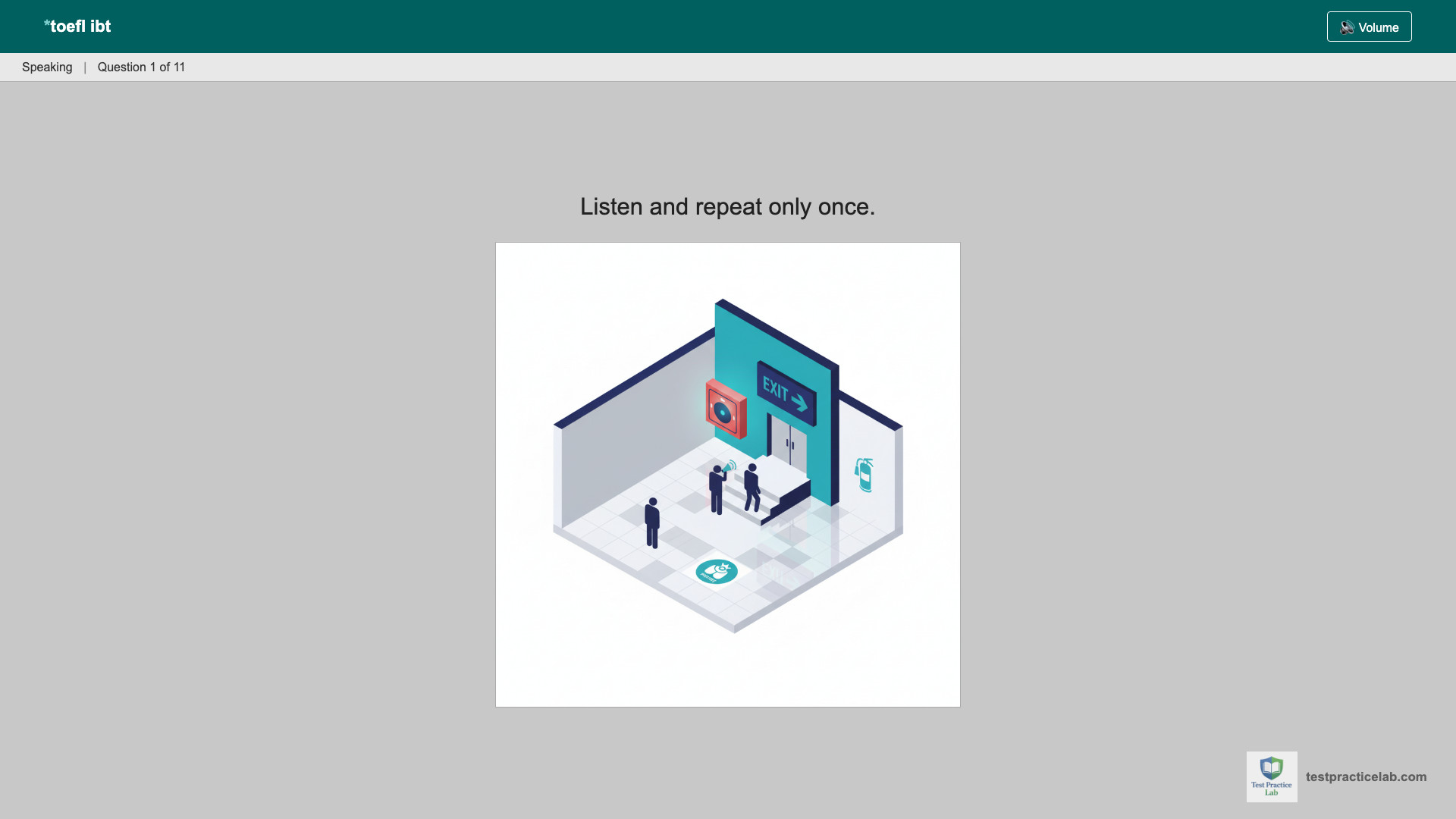
You are a floor monitor explaining the proper procedures for an upcoming fire safety drill.
Show Answer
Please listen to these safety instructions.
Show Answer
We are starting our fire drill today.
Show Answer
When you hear the alarm, please leave your desk immediately.
Show Answer
Walk calmly toward the nearest exit sign on your floor.
Show Answer
Do not use the elevators while the alarm is sounding.
Show Answer
Once you reach the outside parking lot, please check in with your supervisor to confirm you are safe.
Show Answer
You must wait in the designated assembly area until the staff gives you permission to return inside.
Take an Interview
Listen to each question and give a spoken response. You have 45 seconds for each answer, and there is no preparation time.
You have agreed to participate in an interview about how people stay informed and interact with information in the modern world.
Thank you for joining me today. Please think back to the last time you read or watched a news story that really caught your attention, such as a major global event, a local incident, or a scientific discovery. What was the story about, and what made you want to pay close attention to it at that time?
Start withI vividly remember when I…
Perfect answerScore 100
I vividly remember when I first read about the discovery of water on the moon last year. It was a headline on a major science website, and honestly, it just completely grabbed my attention. I mean, I’ve always been fascinated by space, but this felt like a pivotal moment for future exploration. What made me pay such close attention was the way the article broke down the technical findings into something actually understandable. It wasn’t just a dry scientific report; it explained how this resource could potentially sustain long-term lunar bases. In contrast to the usual negative news I see on social media, this story felt incredibly hopeful. Because of this, I ended up spending hours looking into the mission details. It’s pretty rare to find a story that’s so compelling, and it really reignited my interest in astronomy.
Good answerScore 80
I vividly remember when I saw a news report about a new space mission to Mars. It was on the news last month, and I honestly found it super interesting. I’ve always been curious about space, so I watched the whole video online. The story explained how they were going to search for signs of life on the planet. I wanted to pay attention because it felt like such a huge scientific discovery, and it was pretty cool to see the new technology they were using. I usually just check headlines on my phone, but this story was different because it made me feel really excited about the future of space travel.
People have very different ways of staying informed. Some people prefer to check news updates constantly throughout the day, while others prefer to set aside one specific time to catch up. How do you usually keep up with the news in your daily life, and why do you think you have developed that particular habit?
Start withIn my daily life, I…
Perfect answerScore 100
In my daily life, I actually prefer to catch up on the news just once, usually right after I finish dinner in the evening. Honestly, I’ve developed this habit because checking my phone constantly throughout the day was making me feel pretty anxious. I mean, there’s such a disproportionate amount of negative news out there that it was starting to affect my focus at work. For instance, last month I tried keeping notifications on for a breaking news app, but I ended up distracted every ten minutes. As a result, I decided to switch to a more deliberate approach. I find that reading a summary in the evening gives me a much more nuanced understanding of the day’s events without the stress. So yeah, setting aside that specific time really helps me stay informed while keeping my peace of mind.
Good answerScore 80
In my daily life, I actually prefer to catch up on the news just once, usually in the evening. I know some people like to check updates all day long, but that just feels way too overwhelming for me. If I’m constantly looking at my phone for headlines, I feel like I can’t focus on my studies or anything else. So, I wait until I’m finished with my work, and then I spend about twenty minutes reading a few articles online. It’s a much better way for me to stay informed without getting distracted. I guess I just developed this habit because I really value having some quiet time to myself after a long day.
Now I would like your opinion. Some people prefer to read news articles to get deep details, while others prefer watching short video summaries on social media for speed. Which do you personally prefer, and what are the main reasons for your preference?
Start withPersonally, I definitely prefer…
Perfect answerScore 100
Personally, I definitely prefer reading news articles over watching short video clips. I mean, for me, it’s all about the depth of information. When I read a piece in a publication like the New York Times, I feel like I get a much more nuanced understanding of complex global issues. You know, social media videos are often just quick soundbites, and they can be pretty superficial. For instance, last week I was trying to learn about the new economic policy in my country, and a thirty-second TikTok video just didn’t cut it. I ended up reading a full article instead, which provided the context I needed. So, while videos are fast, they often lack the substance I’m looking for. I’d say reading is just a more reliable way to stay informed about what’s actually happening in the world.
Good answerScore 80
Personally, I definitely prefer reading news articles instead of watching short video clips. I find that articles give me much more detail, which is important because social media videos are often too brief. When I read an article, I can really focus and understand the whole story, but with videos, I feel like I’m only getting the surface-level stuff. It’s also easier for me to go back and re-read a specific part if I don’t understand it the first time. So, yeah, I just feel like reading is a better way to stay informed about what is happening in the world, you know, because it provides a much more complete picture.
One last question. Do you think schools or workplaces should provide training on how to identify reliable news sources, such as teaching people how to spot misinformation or verify facts? Why or why not?
Start withI think it is important…
Perfect answerScore 100
I think it is important for schools and workplaces to provide training on identifying reliable news, because honestly, the amount of misinformation online is just overwhelming. I mean, we’re constantly bombarded with headlines, and it’s become really difficult to distinguish between facts and pure fiction. For instance, last year, a friend of mine shared a fake article about a local policy change that went viral on social media, and it caused a huge, unnecessary panic in our neighborhood. If people had the skills to verify sources, that whole mess could’ve been avoided. Providing this kind of training is a pivotal step toward creating a more informed society. It’s not just about being smart; it’s about being responsible. So yeah, I’m convinced that media literacy should be a standard part of our daily education.
Good answerScore 80
I think it is important for schools and workplaces to provide training on how to find reliable news. Nowadays, there is just so much fake information online, and it is pretty easy to get confused. If students or employees don’t know how to verify facts, they might believe things that aren’t true and share them with others. I mean, it is really easy to fall for clickbait these days. So, if we had workshops or training sessions, people could learn how to check sources and be more careful. It would help everyone make better decisions, and it is a good way to stop misinformation from spreading. It’s definitely a necessary skill for everyone.
Every answer graded, for less than one tutoring lesson.
You heard the model answers. Record all 11 in a full TOEFL test and each one gets a band from 1 to 6 and a line by line note, like this sample.
I think it is important because hobbies makesmake people more creative inat work, and they come back more freshfresher.
That was one answer. Your full test has 11. Every one gets this.