TOEFL 2026 Speaking Practice — Level Hard (for score 100+) #21
Listen & Repeat · Take an Interview — full speaking practice with model answers at two score levels.
Listen & Repeat
Listen to each sentence and repeat it out loud. Try to match the speaker’s pronunciation, rhythm, and speed.
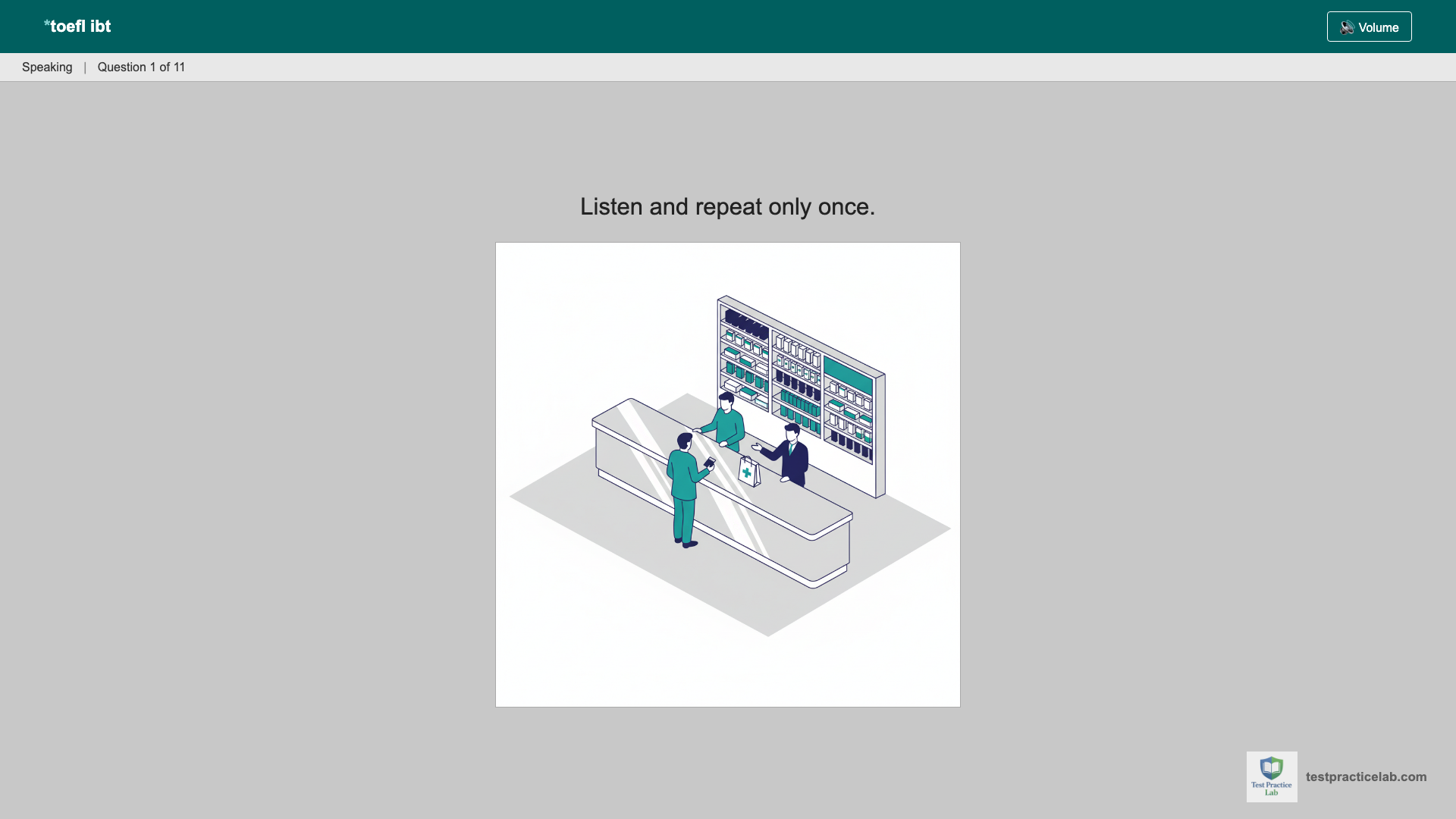
You are a pharmacy technician guiding a patient through the prescription pickup process.
Show Answer
Welcome to our local pharmacy.
Show Answer
Please approach the pickup window now.
Show Answer
Kindly present your photo identification for our records.
Show Answer
The pharmacist will explain how to take your new medication.
Show Answer
You may pay for your items at this register before leaving.
Show Answer
If you have any further questions about these pills, please consult the printed guide located inside your bag.
Show Answer
Once you have signed the confirmation form, you are free to head home and begin your treatment plan today.
Take an Interview
Listen to each question and give a spoken response. You have 45 seconds for each answer, and there is no preparation time.
You are participating in a research interview about the evolving balance between individual privacy and collective security in the digital age.
Thank you for joining me. Please think back to a time when you encountered a situation involving digital security or privacy—such as receiving a security alert, deciding whether to share your location with an app, or hearing a news report about government surveillance. What happened during that moment, and how did it affect your feelings about your personal data?
Start withI remember a time when…
Perfect answerScore 100
I remember a time when I was setting up a new banking app on my phone and it prompted me to grant it full, persistent access to my location. Honestly, it felt kind of intrusive because I didn’t see why a simple finance app needed to track my movements 24/7. I actually ended up denying that permission, but then the app wouldn’t even let me log in. It made me realize how we’re often forced into a **disproportionate** trade-off between convenience and our own privacy. It was a pretty frustrating moment, but it made me hyper-aware of how much data we surrender daily. Since then, I’ve been way more cautious about what I share, because I think it’s **profoundly** important to maintain some boundaries between our digital footprint and our personal lives.
Good answerScore 80
I remember a time when I was downloading a new fitness app, and it asked for access to my location and my contacts. I just clicked ‘allow’ without thinking because I wanted to start using it right away. But then, I read a news report later that day about how some apps sell that kind of data to other companies. It made me feel really uncomfortable and a bit worried because I realized I had given away my private information too easily. So, now I’m much more careful about what I share. I always check the settings before I click yes because I don’t want my personal data being used in ways I don’t know about.
People have very different approaches to digital safety. Some people are extremely cautious and limit their online presence, while others prioritize convenience and are less concerned about data collection. How do you usually manage your digital privacy in your daily life, and why do you think you have adopted that specific approach?
Start withIn my daily life, I…
Perfect answerScore 100
In my daily life, I’d say I’m somewhere in the middle, though I definitely lean toward being quite cautious. I mean, I’m not exactly a digital recluse, but I’m definitely not reckless with my information either. For instance, last month, I started using a dedicated password manager after I realized I was reusing the same weak password for everything—which, honestly, was a pretty systemic failure on my part. I’ve also become much more selective about which apps I grant location access to. I think I’ve adopted this approach because the potential for data breaches is just so pervasive these days. It’s a bit of a balancing act, right? You want the convenience of modern tech, but you can’t ignore the risks. So, keeping my digital footprint minimal is just my way of staying safe.
Good answerScore 80
In my daily life, I’m actually pretty careful about my digital privacy because I’m worried about my personal data. I don’t really post much on social media, and I also try to avoid clicking on suspicious links or pop-up ads. I feel like it’s important to be cautious because there are so many scams and hackers out there today. Even though it might be more convenient to just save all my passwords on my browser, I prefer to keep things private and secure. It’s just better to be safe than sorry, you know? I think I’ve adopted this approach because I’ve heard too many stories about people losing their information online.
Now I would like to hear your opinion on a common debate. Some people believe that governments should have full access to private digital communications if it helps prevent crime or terrorism. Do you agree that national security should always take precedence over individual privacy, or do you believe privacy is a fundamental right that should never be compromised? Why?
Start withPersonally, I strongly believe that…
Perfect answerScore 100
Personally, I strongly believe that individual privacy is a fundamental right that shouldn’t be compromised, even in the name of national security. I mean, once you start letting the government monitor everyone’s personal messages, it’s a slippery slope toward systemic surveillance. For instance, consider the controversy surrounding the Snowden leaks back in 2013; that situation really highlighted how easily state power can be overextended. I’d argue that the potential for abuse is just too high. While I understand that preventing terrorism is critical, the cost to our personal freedom is disproportionate. Actually, I think there are smarter ways to catch criminals without infringing on the digital lives of millions of innocent people. At the end of the day, I’m convinced that a secure society shouldn’t have to sacrifice the very privacy that defines a free democracy.
Good answerScore 80
Personally, I strongly believe that privacy is a fundamental right that shouldn’t be compromised, even for national security. Well, I mean, if the government has full access to our private messages, it feels like they’re watching us all the time. That really scares me because it could lead to people being afraid to speak their minds or share their ideas freely. I think that once you give up your privacy, it’s really hard to get it back. So, even though I know security is important, I just don’t think it’s right for the government to look at our personal stuff like that. It’s just too much power for them to have, you know?
One last question. Do you think that technology companies should be required by law to build ‘backdoors’ into their encrypted products so that law enforcement can access data during investigations? Do you think this would make society safer, or would it create more risks for the general public? Why or why not?
Start withI think it would be…
Perfect answerScore 100
I think it would be a huge mistake to mandate backdoors in encrypted products. I mean, while the goal of assisting law enforcement sounds noble, it’s inherently dangerous because you can’t build a door that only the ‘good guys’ can enter. If a government agency has a key, hackers or malicious actors will eventually find a way to exploit that same vulnerability. For instance, look at the 2017 WannaCry ransomware attack; that massive global crisis was actually caused by a leaked tool from the NSA. By weakening encryption, we’d be creating a systemic risk to everyone’s digital security. I’d argue that the potential for widespread data breaches far outweighs the investigative benefits. So, ultimately, forcing companies to compromise their security would leave the general public much more vulnerable, not safer.
Good answerScore 80
I think it would be a huge mistake to force companies to create backdoors. I mean, I understand that law enforcement wants to catch criminals, but building a backdoor creates a massive security risk for everyone. If there is a way for the police to get in, hackers will eventually find that same way too. It’s like leaving a spare key under the mat; eventually, the wrong person is going to find it. So, while the goal is to keep us safe, I think it would actually make our personal data much less secure because our private information would be vulnerable to cyberattacks. It just seems like a really dangerous idea for society.
Every answer graded, for less than one tutoring lesson.
You heard the model answers. Record all 11 in a full TOEFL test and each one gets a band from 1 to 6 and a line by line note, like this sample.
I think it is important because hobbies makesmake people more creative inat work, and they come back more freshfresher.
That was one answer. Your full test has 11. Every one gets this.