TOEFL 2026 Speaking Practice — Level Hard (for score 100+) #19
Listen & Repeat · Take an Interview — full speaking practice with model answers at two score levels.
Listen & Repeat
Listen to each sentence and repeat it out loud. Try to match the speaker’s pronunciation, rhythm, and speed.
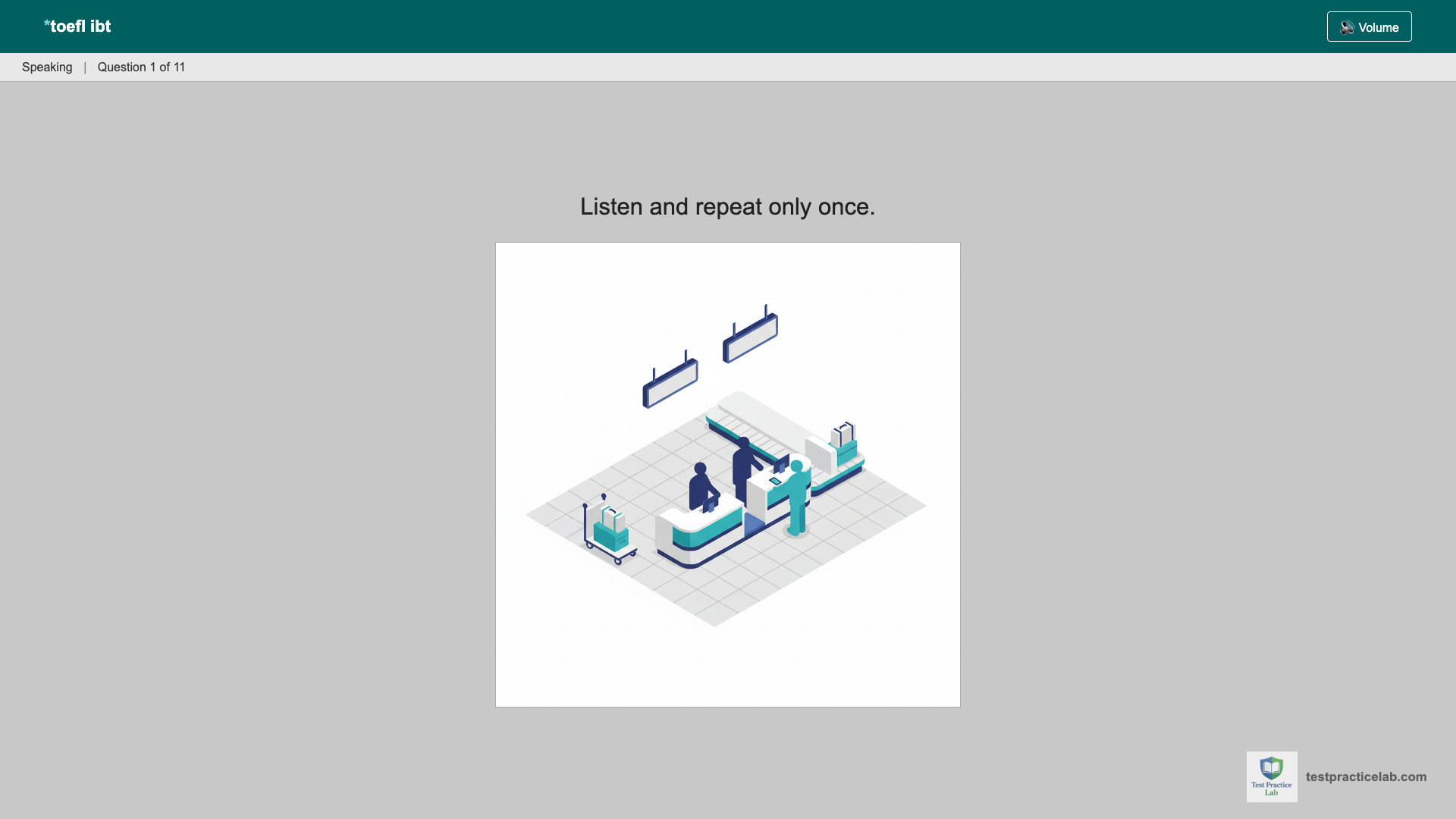
You are a customer service representative assisting a traveler at the airport check-in counter.
Show Answer
Welcome to the check-in counter.
Show Answer
Please place your luggage on the scale.
Show Answer
You may now provide your identification for us to verify your flight details.
Show Answer
Please ensure that your carry-on bag meets our current size and weight limits.
Show Answer
We ask that you remove any restricted items from your baggage before we process it.
Show Answer
Your boarding pass will be issued momentarily, so please wait a few seconds while the system prints it for you.
Show Answer
Once you have received your documents, please proceed directly through the security checkpoint located down the hall.
Take an Interview
Listen to each question and give a spoken response. You have 45 seconds for each answer, and there is no preparation time.
You are participating in an interview regarding your perspectives on workplace culture and gender equity.
Thank you for joining me today. Please think back to a time when you witnessed or experienced a situation related to gender in a professional or academic setting—such as a team project, a meeting, or a job interview. What happened during that moment, and how did it influence your perception of fairness?
Start withI recall a specific time when…
Perfect answerScore 100
I recall a specific time when I was working on a marketing project back in university. Our team lead, who happened to be male, kept interrupting our female team member whenever she tried to share her insights during our brainstorming sessions. It was actually quite frustrating to watch, I mean, it felt like her contributions were being systematically overlooked. Eventually, I decided to step in and explicitly ask her to finish her point, which shifted the dynamic of the meeting immediately. Because of this, she ended up providing the core strategy that ultimately led us to an A-plus on the project. That experience was pretty eye-opening for me, as it highlighted how even subtle biases can create a disproportionate impact on team success. It really shaped my belief that true fairness requires active, intentional inclusion.
Good answerScore 80
I recall a specific time when I was working on a group project during my sophomore year. We had to prepare a presentation, and I noticed that my male teammates kept interrupting the female members whenever they tried to share their ideas. It was really frustrating because the women had some great suggestions, but they just weren’t being heard. I mean, it felt like their contributions were being undervalued. So, I finally spoke up and asked everyone to let them finish. That experience really changed how I see fairness; it made me realize that systemic bias can be pretty subtle, and we all need to be more mindful about giving everyone an equal voice in the room.
People often have different approaches to how they interact with colleagues of different genders; some prioritize strictly formal communication, while others prefer building informal, personal connections. How do you usually approach building professional relationships, and why do you feel that style is most effective for you?
Start withIn my professional interactions, I usually…
Perfect answerScore 100
In my professional interactions, I usually favor a more informal, personal approach, regardless of gender. I mean, I’ve found that building genuine rapport is just more effective than staying strictly formal. For instance, when I was interning at a marketing firm in Seoul last summer, my team lead was this incredibly reserved woman, and at first, our communication felt pretty stiff. But once I started asking about her weekend or hobbies, the atmosphere shifted. It made our collaboration feel less like a transaction and more like a partnership. I’d say this is because establishing that human connection helps dismantle the systemic barriers that often make cross-gender communication feel awkward. As a result, we were able to share ideas much more openly. Honestly, prioritizing those personal connections is just a more authentic way to foster trust in the workplace.
Good answerScore 80
In my professional interactions, I usually prefer building informal, personal connections with my colleagues, regardless of their gender. I feel like it’s much easier to collaborate when you actually know the person behind the job title. Like, if I’m working on a project with someone, having a friendly chat about our hobbies or weekend plans makes the atmosphere way more comfortable. Um, it just feels more natural that way. Because we feel more relaxed, we end up sharing ideas more openly and honestly. I think this approach is really effective for me because it builds trust, and honestly, it makes the daily office routine feel a lot less stressful and more enjoyable for everyone involved.
Now I would like your opinion. Some people argue that companies should implement mandatory gender-neutral hiring processes, like anonymizing resumes to remove names and gender markers. Do you believe this is a necessary step for achieving equality, or do you prefer a more traditional approach? Why?
Start withPersonally, I am of the opinion…
Perfect answerScore 100
Personally, I am of the opinion that mandatory gender-neutral hiring is an absolutely essential step for modern companies. I mean, despite our best intentions, unconscious bias is still so prevalent in recruitment. When a hiring manager sees a name or a gender marker, it’s almost impossible for them not to form a quick, often biased, judgment. For instance, I have a friend who works at a major tech firm in Seoul, and after they started anonymizing resumes, the proportion of female candidates moving to the interview stage actually jumped by nearly twenty percent. It’s pretty clear that this systemic change helps level the playing field. By stripping away these identifiers, companies ensure that talent—not stereotypes—remains the focus. So yeah, I’m convinced that this approach is a pivotal move toward true workplace equality.
Good answerScore 80
Personally, I am of the opinion that companies should definitely use anonymous resumes. I think it’s a really good way to make hiring fair because it helps people focus on skills instead of just looking at names or gender. You know, sometimes managers might have unconscious biases without even realizing it, so removing those details is a smart move. If a company hides names and genders, they are forced to look at the actual work experience, which is what really matters. I believe this makes the whole process a lot more objective. It’s just a better way to ensure that everyone gets an equal chance to get the job based on their hard work and talent.
One last question. Do you think governments should mandate that all large organizations publicly disclose their salary data by gender to ensure transparency? For instance, should companies be required to publish average pay gaps for equal roles? Why or why not?
Start withI believe that such a policy…
Perfect answerScore 100
I believe that such a policy is absolutely vital for fostering fairness in the professional world. You know, systemic pay inequality is still a persistent issue, and without transparency, it’s just too easy for companies to sweep those discrepancies under the rug. For instance, I read a report about Iceland’s equal pay certification law, which essentially forces firms to prove they’re paying fairly, and it’s been incredibly effective at closing the gap. When organizations have to disclose their data, it creates a kind of social accountability that’s hard to ignore. It’s not just about shaming companies; it’s about nudging them toward better practices. So, I’d say that mandatory disclosure is a pivotal step toward ensuring that someone’s gender doesn’t inadvertently dictate their earning potential. Ultimately, transparency is the best tool we have to guarantee genuine equity.
Good answerScore 80
I believe that such a policy is a good idea. Honestly, I think companies should be required to show their salary data because it helps make things fair. If everyone can see the pay gaps, then organizations might feel more pressure to fix them. It’s really about being open with employees. Um, I’ve seen that when there’s no transparency, it’s easy for inequality to hide in the background. So, if the government mandates this, it would definitely encourage businesses to pay people equally for the same work. It’s just a better way to make sure that gender doesn’t affect how much someone earns, and that’s important for fairness in the workplace, you know?
Every answer graded, for less than one tutoring lesson.
You heard the model answers. Record all 11 in a full TOEFL test and each one gets a band from 1 to 6 and a line by line note, like this sample.
I think it is important because hobbies makesmake people more creative inat work, and they come back more freshfresher.
That was one answer. Your full test has 11. Every one gets this.