TOEFL 2026 Speaking Practice — Level Hard (for score 100+) #17
Listen & Repeat · Take an Interview — full speaking practice with model answers at two score levels.
Listen & Repeat
Listen to each sentence and repeat it out loud. Try to match the speaker’s pronunciation, rhythm, and speed.
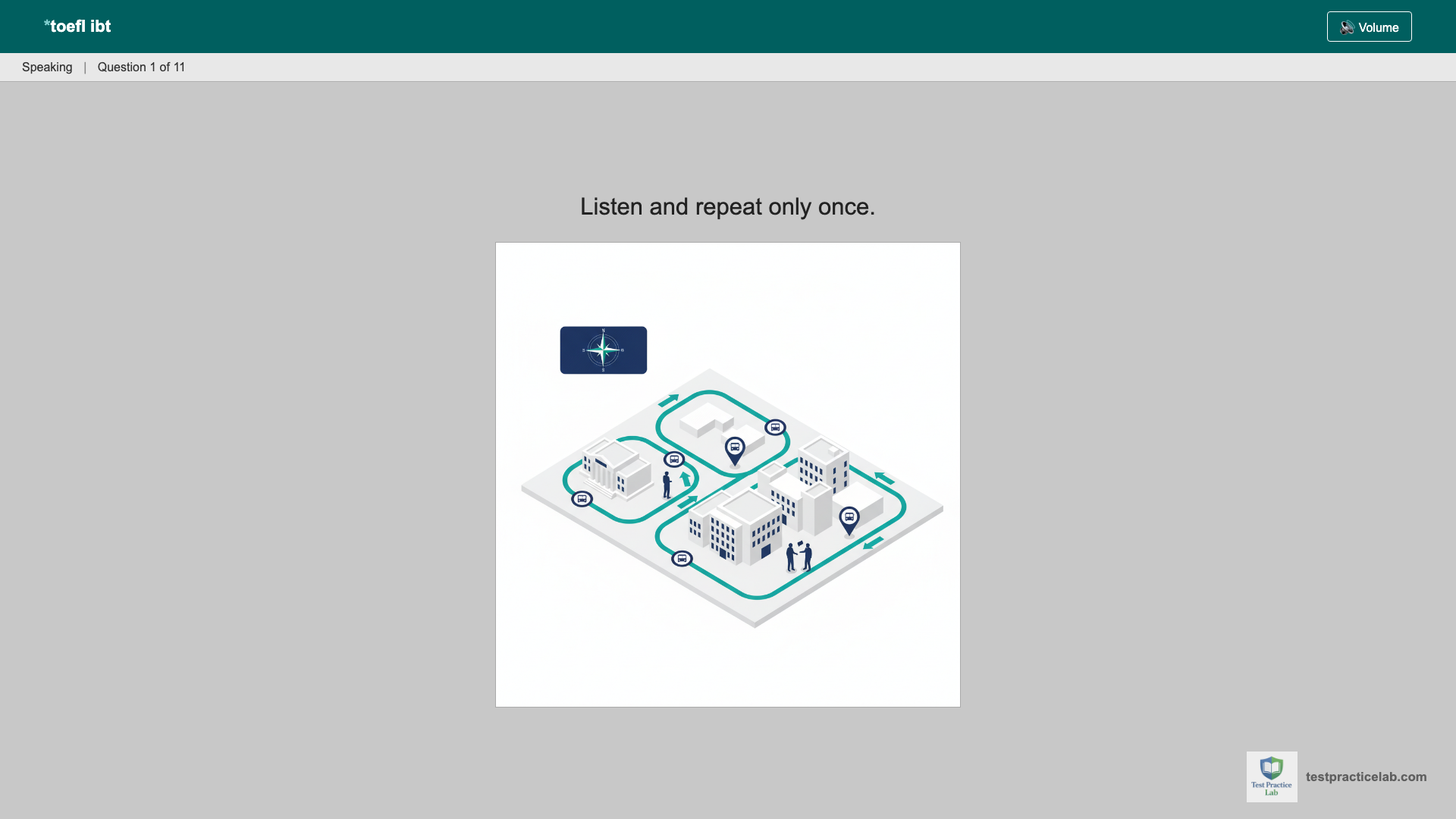
You are a transit assistant explaining the university bus system to new students.
Show Answer
Welcome to the campus bus station.
Show Answer
Please check the schedule for all routes.
Show Answer
Show your student identification card to the driver when boarding.
Show Answer
Wait behind the yellow safety line until the vehicle stops.
Show Answer
You may store your heavy luggage in the designated cargo area.
Show Answer
If you need to get off at a specific stop, please pull the cord before the bus reaches your destination.
Show Answer
Check your seat for personal belongings before you exit through the rear door to complete your journey.
Take an Interview
Listen to each question and give a spoken response. You have 45 seconds for each answer, and there is no preparation time.
You are participating in a research interview regarding the value and purpose of arts and humanities subjects within university curricula.
Thank you for joining me. Please think back to a specific moment in your education when you engaged with an arts or humanities subject—such as reading a powerful piece of literature, attending a history lecture, or participating in a creative project. What was the experience, and why did it leave such a lasting impression on you?
Start withI remember a time when…
Perfect answerScore 100
I remember a time when I was in my sophomore year of college, and I attended this lecture on existential literature. We were analyzing Camus’s ‘The Stranger,’ and honestly, it was a total turning point for me. Before that, I just viewed my studies as a means to an end, but hearing the professor dissect the protagonist’s alienation made me rethink my own perspective on society. It was profoundly moving, I mean, it forced me to confront these abstract questions about human existence that I’d previously ignored. As a result, I became much more critical in my thinking. It wasn’t just about reading a book; it shifted my entire academic focus toward philosophy. That experience really underscored for me why the humanities are so pivotal—they don’t just teach you facts, they fundamentally shape how you interpret the world.
Good answerScore 80
I remember a time when I took a history class during my sophomore year. We were studying the civil rights movement, and the professor assigned us a really intense book about the personal experiences of people during that era. It was just so different from the textbooks I usually read because it made the history feel real, you know? I mean, it wasn’t just dates and facts anymore; it was about actual people and their struggles. That experience really changed how I look at the world today because it helped me understand the importance of empathy. I think that’s why it left such a big impression on me, and I still remember those stories.
Students have different approaches to these subjects; some actively seek out humanities courses to broaden their perspectives, while others focus strictly on technical or scientific training to ensure career readiness. How do you usually approach your own learning or intellectual interests, and why do you think you have developed this tendency?
Start withIn my own experience, I…
Perfect answerScore 100
In my own experience, I’ve always tried to strike a balance between technical skills and the humanities, though it’s definitely a challenge. Honestly, I used to be entirely focused on computer science, thinking that was the only path to a good career. But then, I took this elective called ‘Philosophy of Technology’ during my sophomore year, and it was a total game-changer. It forced me to think about the ethical implications of the code I was writing, which was a pretty profound shift for me. I realized that technical expertise is actually quite hollow without a broader, more nuanced understanding of human values. Because of this, I’ve become much more intentional about interweaving literature or history into my studies. It’s made me a more well-rounded thinker, and I’m convinced that this multidisciplinary approach is essential for long-term success.
Good answerScore 80
In my own experience, I tend to focus mostly on technical training because I want to be ready for my future career. I study computer science, and it takes up so much of my time that I don’t really have room for other classes. I feel like I need to learn as much as I can about programming and data to get a good job later. Um, I guess I developed this habit because my parents always told me that practical skills are the most important thing for success. So, I just prioritize my technical courses and skip things like literature or history, even though I know they might be interesting, because I’m just too busy with my main studies.
Now I would like your opinion. Some people argue that higher education should prioritize practical, job-focused skills like technology and business, while others believe that a strong foundation in the arts and humanities is essential for a well-rounded individual. Where do you stand on this, and why?
Start withPersonally, I strongly believe that…
Perfect answerScore 100
Personally, I strongly believe that a solid foundation in the arts and humanities is absolutely pivotal for any university student, even in our tech-driven world. While technical skills are obviously important for landing that first job, I think the humanities provide something more enduring, like critical thinking and empathy. For instance, back when I was an undergraduate, I took a philosophy course on ethics that completely changed how I approach problem-solving; it forced me to analyze complex issues from multiple perspectives rather than just looking for a quick fix. Because of this, I’ve become a much more nuanced communicator in my professional life. Not only that, but these subjects help us navigate the human experience, which is something a coding boot camp just can’t teach. So, I’d say prioritizing the humanities is essential for developing a truly well-rounded individual.
Good answerScore 80
Personally, I strongly believe that arts and humanities are just as important as job-focused skills in college. Well, I think that studying things like literature or philosophy helps students become better thinkers. If we only focus on technology or business, we might miss out on learning how to really understand people and society. I mean, even if someone is a great engineer, they still need to communicate well and think about the ethics of their work. So, I feel that a well-rounded education is necessary because it prepares us for life, not just for a specific job. It helps us see the world in a broader way, and that’s a skill that is useful in any career.
One last question. Do you think governments or universities should mandate that all students, regardless of their major, complete a certain number of credits in arts and humanities? For instance, should an engineering student be required to take ethics or philosophy courses to graduate? Why or why not?
Start withI believe this policy would be…
Perfect answerScore 100
I believe this policy would be incredibly beneficial for students in every field. Honestly, I think we’re seeing a bit of a disproportionate focus on technical skills lately, but the arts and humanities are really what teach us how to think critically about our impact on society. Take my cousin, for instance; he’s an engineering major at Seoul National University, and he recently took a philosophy course on medical ethics. He told me it completely changed how he views his own research, because he started considering the moral consequences of the technology he’s building. Not only that, but these courses foster empathy and a more nuanced perspective on complex global issues. So, yeah, I’m convinced that requiring these credits is essential for creating well-rounded graduates who can actually navigate the real world.
Good answerScore 80
I believe this policy would be a really great idea for all students. I mean, even if someone is studying something technical like engineering, they still need to understand the world around them. If students only focus on their major, they might miss out on important stuff like ethics or how to think critically about society. So, requiring a few classes in arts or philosophy would help them become better people and better professionals too. It’s just important to have a well-rounded education because you need more than just technical skills to succeed in the real world. That’s why I think universities should definitely make these courses a requirement for everyone.
Every answer graded, for less than one tutoring lesson.
You heard the model answers. Record all 11 in a full TOEFL test and each one gets a band from 1 to 6 and a line by line note, like this sample.
I think it is important because hobbies makesmake people more creative inat work, and they come back more freshfresher.
That was one answer. Your full test has 11. Every one gets this.