TOEFL 2026 Speaking Practice — Level Hard (for score 100+) #16
Listen & Repeat · Take an Interview — full speaking practice with model answers at two score levels.
Listen & Repeat
Listen to each sentence and repeat it out loud. Try to match the speaker’s pronunciation, rhythm, and speed.
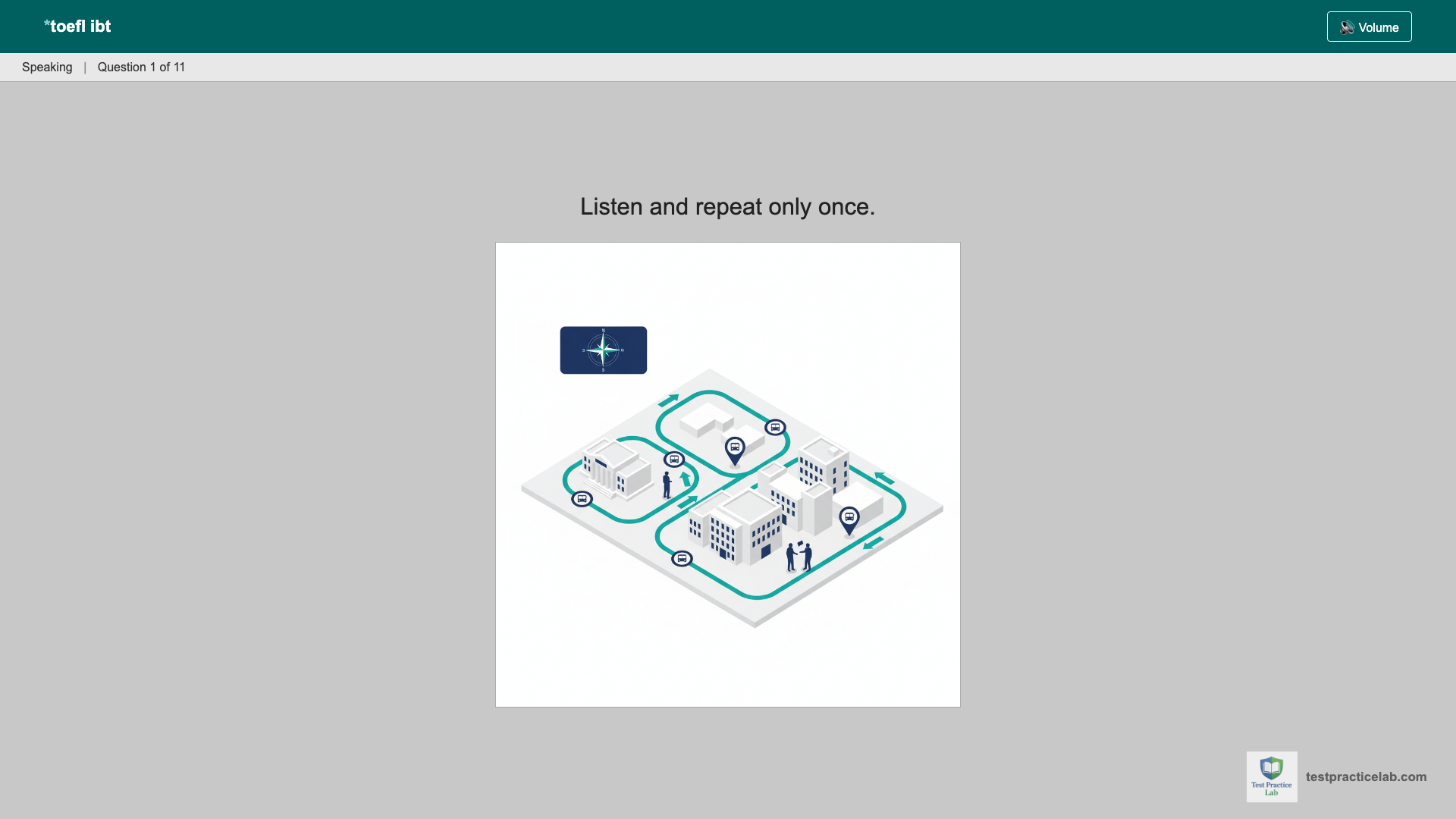
You are explaining the campus bus transit system to a new student.
Show Answer
Welcome to the campus bus station.
Show Answer
Please check the schedule for your route.
Show Answer
You must present your student identification card to the driver.
Show Answer
The express shuttle leaves from the main terminal every hour.
Show Answer
Please remain seated while the vehicle is in motion today.
Show Answer
If you need to get off at the library, simply press the yellow button near the window.
Show Answer
Remember to gather all of your personal belongings before you exit the bus at your stop.
Take an Interview
Listen to each question and give a spoken response. You have 45 seconds for each answer, and there is no preparation time.
You have agreed to participate in an interview about your perspectives on the role of government oversight regarding digital platforms.
Thank you for joining me. Think back to a time when you encountered a news story or a significant change on a social media site—such as a platform removing a viral post, a new warning label on content, or a government announcement about data privacy. What happened, and how did you feel about how the platform or the government handled the situation?
Start withI recall a time when…
Perfect answerScore 100
I recall a time when I was scrolling through Twitter—or X, I guess—and noticed these new, prominent labels appearing on posts about the 2022 election. It was kind of jarring at first. Basically, the platform started adding fact-check links to viral claims, and honestly, I felt pretty conflicted about it. On one hand, I understood the necessity of curbing misinformation, but on the other, it felt like a disproportionate level of interference from a private company. I mean, who gets to decide what’s truly ‘factual’? It’s a nuanced issue, right? Because of this, it made me really skeptical about how much power these platforms wield over public discourse. Ultimately, while I appreciate the effort to maintain integrity, I’m still uneasy about how these government-pressured regulations inadvertently stifle open debate.
Good answerScore 80
I recall a time when I saw a warning label on a post about a health trend on Instagram. It was basically a claim about a miracle diet, and the app put a link to official health websites right under it. At first, I was a bit surprised because I wasn’t used to seeing that, but then I felt it was a good move. I mean, there’s so much fake news online, and it’s easy for people to get confused by things like that. So, I think it’s important for platforms to step in and provide accurate info. It made me feel safer using the app because I knew they were trying to stop misinformation.
People have very different attitudes toward platform oversight; some people feel comforted when governments step in to regulate content, while others worry that regulation limits their personal freedom. How do you usually react when you hear about new government policies regarding social media, and why do you think you feel that way?
Start withIn my case, I tend to…
Perfect answerScore 100
In my case, I tend to feel pretty skeptical when I hear about new government policies on social media. I mean, while safety is obviously important, I worry that these regulations could inadvertently lead to overreach or censorship. For instance, I remember reading about a proposed law in my home country last year that aimed to curb misinformation, but it seemed so vague that it could easily be used to silence political dissent. Because of this, I’m always concerned that giving the government too much control over digital spaces is inherently dangerous for free speech. I’d say my reaction is mostly one of caution, as I believe the risks to our personal freedom often outweigh the potential benefits of such top-down oversight. Ultimately, I think we need a more nuanced approach than just blanket government intervention.
Good answerScore 80
In my case, I tend to feel pretty uneasy when I hear about new government policies for social media. I mean, it’s understandable that they want to stop harmful content, but I worry that regulation is a slippery slope. If the government starts deciding what we can or cannot see, it might limit our personal freedom in the long run. I think it’s important to have a space where people can share their thoughts freely, so I’m always concerned that these rules might be used to silence people. It’s hard to find a balance, but I definitely prefer having more freedom on these platforms instead of having the government control everything.
Now I would like your opinion. Some people argue that social media companies should be regulated by the government just like public utilities, while others believe these companies should remain entirely self-governed. Do you believe government regulation is necessary for social media platforms? Why or why not?
Start withPersonally, I strongly believe that…
Perfect answerScore 100
Personally, I strongly believe that government regulation of social media is absolutely essential these days. I mean, these platforms aren’t just websites anymore; they’ve become the primary public square where people get their news. Because of this, their influence on democracy is profound. For instance, look at the spread of misinformation during the last election cycle—it was honestly chaotic. I think when platforms prioritize engagement over accuracy, it inadvertently causes systemic harm to public discourse. If we treat them like utilities, like water or electricity, we can mandate more transparency regarding their algorithms. It’s not about suppressing free speech, but rather ensuring accountability. So, I’d say that some level of oversight is a necessary step to protect the integrity of our information ecosystem. Without it, these companies just have too much unchecked power.
Good answerScore 80
Personally, I strongly believe that government regulation of social media is really necessary. I mean, these platforms have become so powerful in our daily lives that they basically control the flow of information. If they’re left entirely self-governed, they might just prioritize profits over the public good, which leads to things like the spread of misinformation or even hate speech. It’s kind of like how we regulate electricity or water because they’re essential services, right? So, I think it’s important for the government to step in and set some rules. It’s the only way to make sure these companies stay accountable and don’t just do whatever they want with our personal data.
One last question. Do you think governments should pass strict laws requiring social media companies to verify the identity of every user to prevent misinformation and harassment? For example, should platforms be legally required to link accounts to official government identification? Why or why not?
Start withI believe that such a policy…
Perfect answerScore 100
I believe that such a policy would be a mistake, honestly. While the goal of curbing harassment is noble, mandating government ID verification would be inherently problematic for personal privacy. I mean, think about the massive data breaches we’ve seen lately—like the 2021 incident where hundreds of millions of Facebook users had their personal info leaked. If platforms were forced to link accounts to official IDs, a single hack could expose not just a username, but a person’s real identity to malicious actors. It’s a disproportionate risk, right? Plus, anonymity is often a vital shield for activists or whistleblowers in restrictive regimes. Instead of strict identity laws, I’d argue we should focus on better moderation algorithms. So, I’m convinced that sacrificing our digital anonymity is definitely not the right way to combat misinformation.
Good answerScore 80
I believe that such a policy would be a big mistake. I mean, I get that people want to stop online harassment and fake news, but requiring government IDs for social media is just too much. It would really hurt our privacy because, well, these companies would have all our sensitive data, and that could lead to serious security risks if there’s a data breach. Also, it would make it hard for people to speak up anonymously, which is important for things like political activism. So, I don’t think the government should get involved in that way because it creates more problems than it actually solves for users.
Every answer graded, for less than one tutoring lesson.
You heard the model answers. Record all 11 in a full TOEFL test and each one gets a band from 1 to 6 and a line by line note, like this sample.
I think it is important because hobbies makesmake people more creative inat work, and they come back more freshfresher.
That was one answer. Your full test has 11. Every one gets this.