TOEFL 2026 Speaking Practice — Level Hard (for score 100+) #14
Listen & Repeat · Take an Interview — full speaking practice with model answers at two score levels.
Listen & Repeat
Listen to each sentence and repeat it out loud. Try to match the speaker’s pronunciation, rhythm, and speed.
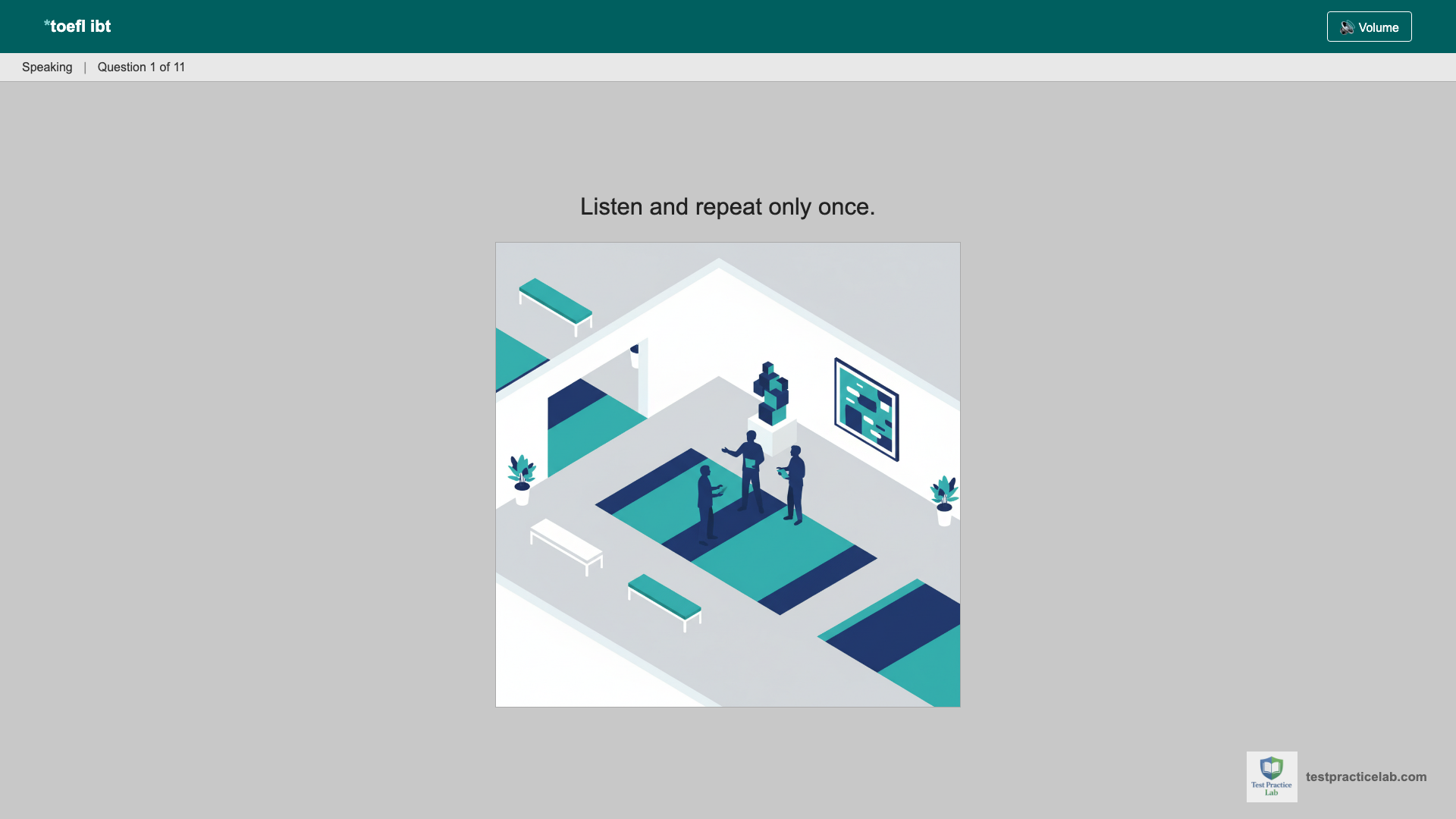
You are a student assistant giving instructions to visitors arriving at the campus art gallery.
Show Answer
Welcome to our university art gallery.
Show Answer
Please leave your large bags at the front desk.
Show Answer
You are welcome to view all the exhibits at your own pace.
Show Answer
Kindly refrain from touching any of the paintings on display.
Show Answer
Photography is permitted as long as you do not use a flash.
Show Answer
If you need any information about the artists, please feel free to ask our staff members for assistance.
Show Answer
Before you depart, remember to sign our guest book located near the main exit on your way out.
Take an Interview
Listen to each question and give a spoken response. You have 45 seconds for each answer, and there is no preparation time.
You are participating in a research interview about changing economic landscapes and social welfare policies.
Thank you for joining this discussion. Think back to a time when you first heard about the concept of universal basic income, perhaps through a news report, a social media debate, or a conversation with friends. What was your initial reaction to the idea, and why did you feel that way at the time?
Start withI first learned about this when…
Perfect answerScore 100
I first learned about this when I was scrolling through a news feed during my sophomore year of college, and honestly, my initial reaction was pretty skeptical. I remember reading about a pilot program in Finland, and my first thought was that it sounded completely unsustainable—like, how could a government just give out money without it causing massive inflation? It felt counterintuitive to everything I’d been taught about work and productivity. But as I kept reading, I started to see the nuance, specifically how it could act as a safety net for people in unstable jobs. I mean, it’s not just about free cash; it’s about systemic security. So, while I was initially dismissive, that article really shifted my perspective, making me realize it’s a much more complex policy than I’d first assumed.
Good answerScore 80
I first learned about this when I was watching a news segment online a few years ago. Honestly, my initial reaction was pretty skeptical because it sounded like such a radical change to our current economic system. I just didn’t see how a government could afford to give everyone money without causing some major problems, like inflation or maybe people just stopping their jobs. So, I was pretty worried that it might hurt the economy instead of helping it. It was a really strange concept to me at the time, and I remember talking to my friends about it, but we all just thought it sounded like a dream that couldn’t actually work in real life.
People have very different habits when it comes to keeping up with economic news. Some people actively follow policy discussions and financial trends, while others prefer to focus on their own work and avoid these complex topics. How do you usually stay informed about social and economic policies, and why do you think you have that approach?
Start withIn my case, I usually…
Perfect answerScore 100
In my case, I usually keep up with economic policies through a mix of news apps and podcasts, specifically the Economist’s daily briefings. I’d say I’ve adopted this habit because I find that understanding systemic changes—like the ongoing debates around universal basic income—is actually vital for navigating modern life. It’s not just about the numbers, right? It’s about how these policies influence our future. For instance, last month I read a compelling piece on how UBI might reshape the labor market, and it really shifted my perspective on automation. I mean, staying informed feels like a responsibility rather than a chore. As a result, I feel much more empowered to make long-term financial decisions. So, yeah, I prioritize this because keeping a pulse on the economy is just a fundamental part of being an engaged citizen.
Good answerScore 80
In my case, I usually don’t spend much time following economic news because it feels pretty overwhelming. I mean, I prefer to just focus on my own work and studies instead of worrying about complex social policies. Honestly, I’m already pretty busy with my daily schedule, so I don’t really have the energy to read about financial trends or things like that. I guess I just feel like those topics are a bit too far away from my life. So, I mostly just hear about major changes through my friends or maybe social media, but I don’t actively go out and search for that kind of information on my own.
Now I would like your opinion. Some people believe that a guaranteed income would empower individuals to pursue creative or educational goals, while others argue it might discourage people from seeking traditional employment. Which perspective do you find more convincing, and why?
Start withPersonally, I tend to believe…
Perfect answerScore 100
Personally, I tend to believe that a universal basic income would profoundly empower people to pursue more meaningful goals, rather than just making them lazy. I mean, the idea that people would simply stop working is kind of a cynical take, right? If you look at the pilot program they ran in Stockton, California, a few years back, the recipients actually ended up being more likely to find full-time employment, not less. Because of this, it’s clear that having a financial safety net removes that paralyzing anxiety about basic survival. It provides the freedom to invest in education or take a risk on a creative venture, which is inherently better for society in the long run. So, I’m convinced that providing that stability is a much more effective way to foster human potential.
Good answerScore 80
Personally, I tend to believe that a guaranteed income would really help people pursue their own goals. You know, if everyone had enough money for basic needs, they wouldn’t have to work just to survive. So, they could spend more time on things like education or maybe starting a creative business. I think it’s a good idea because it gives people more freedom to choose what they want to do with their lives. Some people say it might make people lazy, but I don’t really agree. Most people want to stay busy and productive, so they would probably still find work that they actually enjoy doing instead of just working for money.
One last question. Do you think governments should implement a universal basic income as a standard social policy to address poverty, perhaps by replacing existing welfare programs? Why or why not?
Start withI think this policy would…
Perfect answerScore 100
I think this policy would be a bit too risky to implement as a blanket solution. Honestly, the idea of replacing all existing welfare with a flat payment sounds appealing, but it’s inherently flawed because it ignores the disproportionate needs of different people. For instance, someone living in a high-cost city like San Francisco has vastly different expenses than someone in a rural area, so a one-size-fits-all check wouldn’t actually alleviate poverty effectively. I mean, if you scrap specialized programs like disability support or food assistance, you might inadvertently leave vulnerable groups with less than they had before. It’s a compelling theory, sure, but I’d say we should focus on refining current systems instead. So, replacing targeted aid with a universal payment just doesn’t seem like a sustainable way to address systemic inequality.
Good answerScore 80
I think this policy would be a really big mistake, honestly. I mean, if the government just gives everyone a set amount of money, it could actually cause some major problems. For one thing, I’m worried that it might discourage people from looking for work because they’d have that safety net, you know? And if you replace all the current welfare programs, the people who really need extra help, like those with disabilities, might end up with less support than they have now. So, it seems like a pretty risky idea to me. I think we should just focus on improving the existing systems instead of trying something so drastic and potentially harmful.
Every answer graded, for less than one tutoring lesson.
You heard the model answers. Record all 11 in a full TOEFL test and each one gets a band from 1 to 6 and a line by line note, like this sample.
I think it is important because hobbies makesmake people more creative inat work, and they come back more freshfresher.
That was one answer. Your full test has 11. Every one gets this.