TOEFL 2026 Speaking Practice — Level Hard (for score 100+) #12
Listen & Repeat · Take an Interview — full speaking practice with model answers at two score levels.
Listen & Repeat
Listen to each sentence and repeat it out loud. Try to match the speaker’s pronunciation, rhythm, and speed.
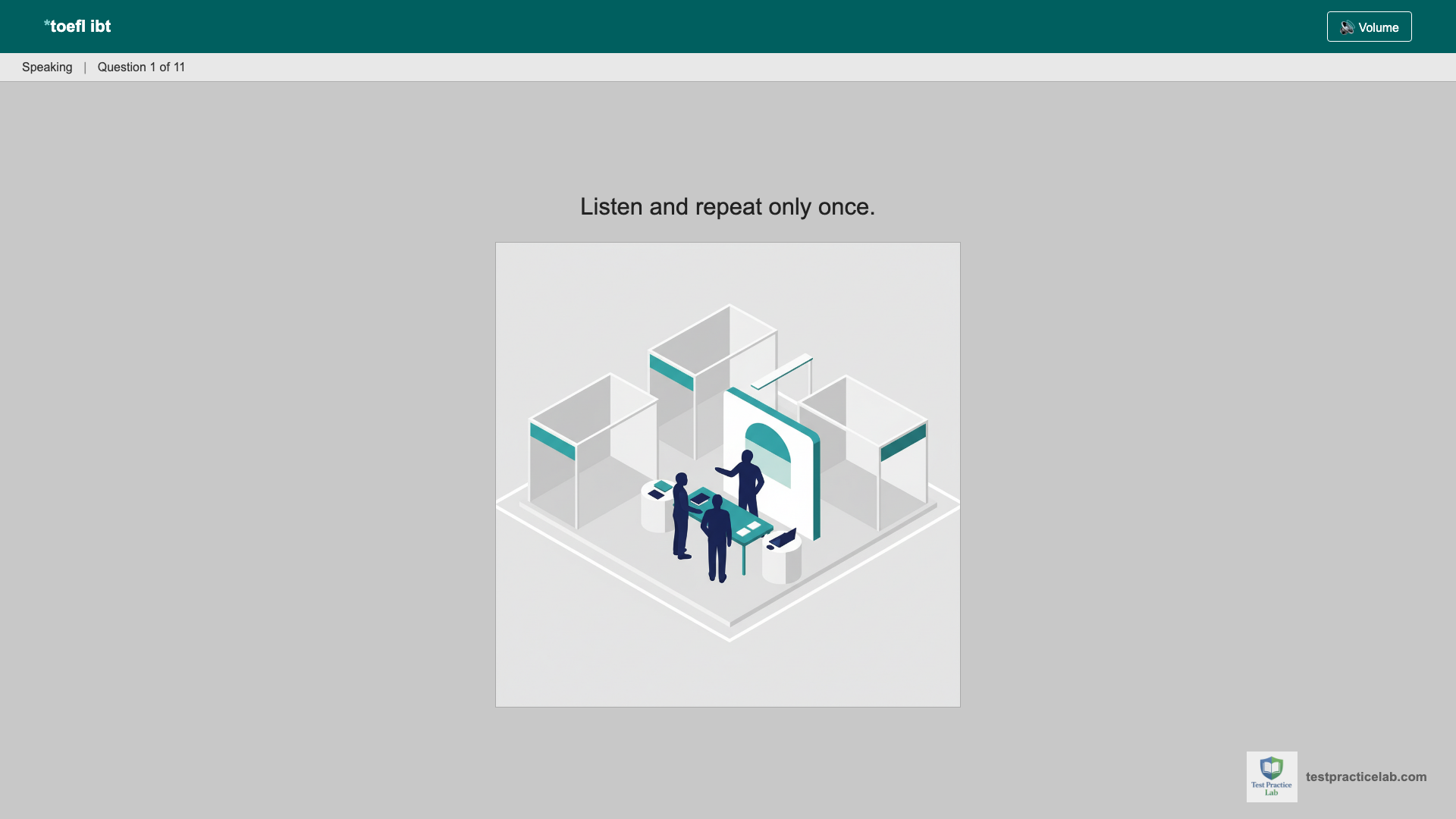
You are learning how to assist visitors at a professional job fair booth.
Show Answer
Welcome to our company booth today.
Show Answer
Please sign the guest book near the entrance.
Show Answer
Digital brochures are provided on these tablet screens.
Show Answer
You may ask our recruiters about current job openings.
Show Answer
Please keep the walkway clear for other interested guests.
Show Answer
If you wish to apply for a position, please submit your resume through our online portal before the event concludes.
Show Answer
Feel free to take a branded gift bag from the table, and we hope that you have a very productive afternoon.
Take an Interview
Listen to each question and give a spoken response. You have 45 seconds for each answer, and there is no preparation time.
You have been asked to participate in a research interview regarding the impact of emerging technologies on the professional landscape.
Thank you for joining this discussion. Please think back to a time when you encountered artificial intelligence in a work or academic setting—perhaps when you used a generative AI tool to complete a project, saw a task being automated, or received feedback from an algorithm. What specifically did you use it for, and how did that experience shape your initial impression of AI?
Start withI remember a time when…
Perfect answerScore 100
I remember a time when I was struggling to organize a massive dataset for my senior thesis project last semester. I had hundreds of survey responses, and frankly, I was drowning in raw data. I decided to use a generative AI tool to help me categorize the information and identify some initial patterns. It was actually pretty incredible; in a matter of seconds, it performed a complex analysis that would have taken me days to finish manually. Because of this, my initial skepticism about AI just kind of evaporated. I realized it wasn’t necessarily a threat to my work, but rather a **pivotal** tool for efficiency. It allowed me to focus on the higher-level interpretation instead of the tedious legwork, which fundamentally changed how I view AI’s role in future professional success.
Good answerScore 80
I remember a time when I used a generative AI tool for a big research project in my university class. I had so much data to summarize, and it was taking me forever to read through everything. So, I decided to use an AI tool to help me organize my notes and summarize the main points. It was actually super helpful because it saved me a lot of time and allowed me to focus on writing my paper instead. That experience gave me a really positive impression of AI. I felt like it was a great assistant for simple tasks, and it made me feel less stressed about my workload. It was just a really useful tool to have.
People have very different approaches to AI; some embrace it as an essential assistant for efficiency, while others are cautious and prefer to rely on traditional human-led methods. How do you usually incorporate AI tools into your own work or study habits? Why do you think you have developed this particular approach?
Start withIn my daily work, I…
Perfect answerScore 100
In my daily work, I actually use AI quite a bit, specifically for brainstorming and outlining my essays. When I’m staring at a blank page, it’s honestly pretty daunting, so I’ll use tools like ChatGPT to generate a few potential structures or to clarify complex concepts I’m struggling with. I’d say my approach is a blend of reliance and caution; I treat AI as a sounding board rather than an author. I’ve developed this habit because it’s inherently more efficient than staring at a screen for hours, yet I’m wary of losing my own voice. For instance, last week while writing a paper on environmental policy, I used AI to synthesize data, but I wrote every single paragraph myself to maintain a nuanced perspective. It’s a balanced strategy that keeps me productive without sacrificing my critical thinking skills.
Good answerScore 80
In my daily work, I use AI tools quite a lot, especially for things like drafting emails or organizing my research notes. I usually rely on them to quickly summarize long articles because it saves me so much time. I guess I developed this habit because I always feel like I have too much to do and not enough time to finish it all. So, using AI helps me stay on track and be more productive during the day. I know some people prefer doing everything by hand, but for me, it’s just a really helpful assistant that makes my life easier. I don’t think I could go back to the old way now.
Now I would like your opinion. Some people believe that AI will ultimately create more jobs than it destroys by opening up new industries, while others fear it will lead to widespread unemployment and the devaluation of human skills. Do you agree that AI will be a net positive for the future of employment? Why or why not?
Start withPersonally, I strongly believe that…
Perfect answerScore 100
Personally, I strongly believe that AI will ultimately be a net positive, even though it’s definitely going to be a bumpy transition. I mean, while it’s true that some repetitive roles might disappear, I think it’s actually going to spark a massive wave of innovation. For instance, look at what happened with my cousin, who’s a graphic designer in Seoul. A few years ago, he was terrified that AI tools would replace him, but now he uses them to handle all the tedious, technical parts of his work, which allows him to focus on more creative, high-level strategy. It’s profoundly changed his output. Because of this, I’m convinced that instead of just destroying jobs, AI will serve as a catalyst for new industries that we can’t even imagine yet. So, I’m optimistic about the future.
Good answerScore 80
Personally, I strongly believe that AI will actually be a net positive for the future of employment. You know, some people are really worried about machines taking over, but I think it’s more about our jobs just changing rather than disappearing. Like, throughout history, technology has always replaced old tasks, but then it creates totally new roles that we didn’t even imagine before. So, AI will handle the boring or repetitive stuff, which lets people focus on more creative and complex work. It’s like, it frees us up to do things that actually require a human touch. I mean, it’s definitely a big shift, but I think it’s going to make our work much more meaningful in the long run.
One last question. Do you think governments or corporations should implement specific policies to manage the rise of AI in the workplace? For example, should they mandate that companies retrain employees whose jobs are automated, or perhaps require clear labeling when a task is performed by an AI rather than a human? Why or why not?
Start withI think it would be…
Perfect answerScore 100
I think it would be absolutely essential for governments to step in and implement policies as AI evolves. I mean, we’re seeing such a rapid shift in the labor market that relying solely on corporations to regulate themselves feels a bit naive. For instance, consider the manufacturing sector in my hometown, where dozens of workers were laid off last year when a new automated assembly line was installed; those people were just left to fend for themselves. Because of this, I believe mandates for retraining programs are inherently necessary to prevent a systemic crisis. It’s not just about efficiency; it’s about social stability. If we don’t proactively manage this transition, we’re going to face a disproportionate amount of economic inequality. So, yeah, policy intervention is the only way to ensure AI benefits everyone, not just the tech giants.
Good answerScore 80
I think it would be really important for governments to step in and make policies about AI. I mean, because AI is changing everything so fast, many people are worried about losing their jobs to machines. So, I think it’s a good idea if companies are required to retrain their workers. If a person’s job gets automated, they shouldn’t just be fired, right? They should have the chance to learn new skills so they can keep working in other areas. Also, labeling AI work is helpful because it’s fair for customers to know who or what they are dealing with. It just feels like a necessary step to keep things fair and stable for everyone.
Every answer graded, for less than one tutoring lesson.
You heard the model answers. Record all 11 in a full TOEFL test and each one gets a band from 1 to 6 and a line by line note, like this sample.
I think it is important because hobbies makesmake people more creative inat work, and they come back more freshfresher.
That was one answer. Your full test has 11. Every one gets this.