TOEFL 2026 Speaking Practice — Level Hard (for score 100+) #09
Listen & Repeat · Take an Interview — full speaking practice with model answers at two score levels.
Listen & Repeat
Listen to each sentence and repeat it out loud. Try to match the speaker’s pronunciation, rhythm, and speed.
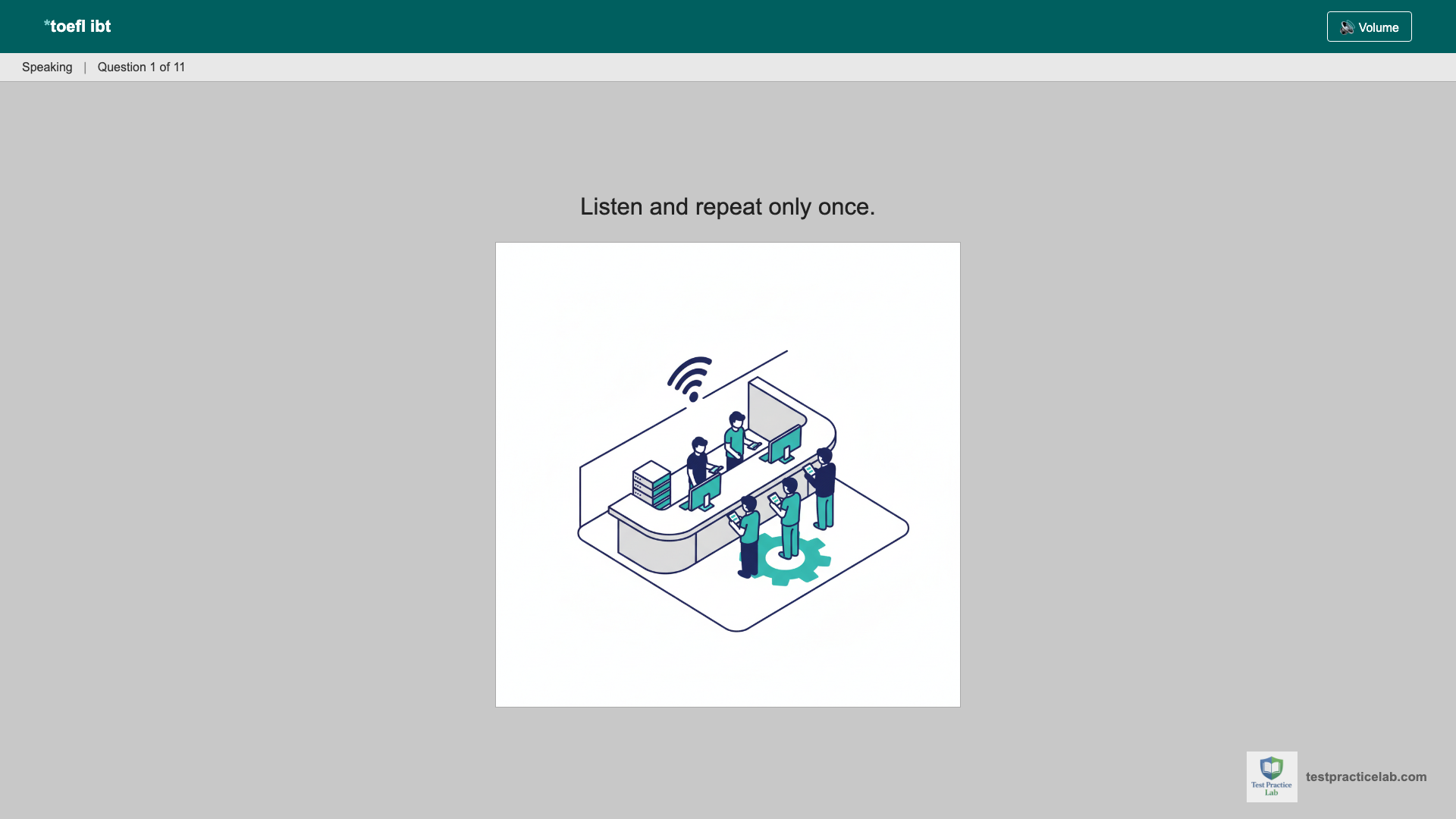
You are a student worker guiding a peer through the procedures at the campus IT help desk.
Show Answer
Welcome to the campus tech support center.
Show Answer
Please sign in at the front desk kiosk now.
Show Answer
You must present your student identification card to the technician.
Show Answer
Please describe the technical issues you are currently facing today.
Show Answer
Remember to save any important files before we begin the repairs.
Show Answer
If you need to leave your device here, please make sure you obtain a formal claim ticket from the staff.
Show Answer
Check your university email account later this afternoon for a confirmation regarding the status of your request.
Take an Interview
Listen to each question and give a spoken response. You have 45 seconds for each answer, and there is no preparation time.
You are participating in a panel discussion regarding the future of science and its impact on human ethics.
Thank you for joining our discussion today. Please think back to the first time you heard about a major scientific breakthrough in genetic engineering—such as gene-edited crops, CRISPR technology, or medical advancements. What specific news or documentary caught your attention, and what was your initial reaction to it?
Start withI vividly remember when I…
Perfect answerScore 100
I vividly remember when I first read about CRISPR technology in a science magazine back in college. Honestly, I was just completely floored by the potential of it. I mean, the idea that we could essentially edit the human genome with such precision—it felt like something straight out of a sci-fi movie. My initial reaction was actually kind of mixed; on one hand, it seemed like a miraculous solution for hereditary diseases, but at the same time, it raised these profound ethical questions about where we should draw the line. It’s inherently a bit unsettling to think about the long-term consequences of altering nature, right? But ever since that article, I’ve been fascinated by how we balance that technological promise with our bioethical boundaries. It’s definitely shaped how I view scientific progress today.
Good answerScore 80
I vividly remember when I first saw a documentary about CRISPR technology on TV. It was explaining how scientists could actually edit DNA to fix diseases, and I was just really surprised because I had never heard of anything like that before. At first, I thought it was amazing because it could help sick people, but then I started to feel a bit worried too. I mean, it’s kind of scary to think that humans can change the building blocks of life so easily. I kept wondering if people would use it for bad things later on. It was definitely a big moment for me because it made me think about the future.
People often react differently to new scientific developments; some stay informed and follow every update, while others prefer to avoid the topic due to moral or technical complexity. How do you usually keep up with or think about these developments in your daily life, and why do you approach it that way?
Start withIn my own experience, I…
Perfect answerScore 100
In my own experience, I tend to be pretty proactive about keeping up with scientific breakthroughs, especially regarding genetic engineering. Honestly, I find the whole field absolutely fascinating, though I recognize it’s inherently complex. I mean, I usually spend about twenty minutes every morning scrolling through science journals like Nature or listening to tech podcasts, just to stay in the loop. For instance, when I read about CRISPR gene editing, it wasn’t just interesting; it actually sparked a nuanced debate in my head about the ethical boundaries of altering human DNA. I think it’s crucial to stay informed because these advancements have such profound implications for our future. As a result, I don’t just passively consume information; I try to critically evaluate the moral weight behind each discovery, which I think is a much more responsible approach.
Good answerScore 80
In my own experience, I try to stay pretty informed about new scientific developments, especially things like genetic engineering. I usually read articles online because I think it’s important to know what’s happening in the world. Um, some of my friends avoid these topics because they feel like it’s too complicated or maybe a bit scary, but I feel like we should learn about it anyway. It’s definitely a complex issue, but I don’t want to just ignore it. I think if we don’t understand the science, we can’t really have an opinion on the ethics. So, I keep reading about it and talking to people about it because I want to be ready for the future.
Now I would like your opinion on medical applications. Some people believe that we should use genetic engineering to eliminate hereditary diseases at any cost, while others worry that this crosses an ethical line by ‘designing’ humans. Which position do you lean toward, and what are your main reasons?
Start withPersonally, I feel that we…
Perfect answerScore 100
Personally, I feel that we should pursue genetic engineering for medical purposes, though we definitely need some strict boundaries. I mean, if we have the technology to stop something like Huntington’s disease—which is just a devastating, soul-crushing condition—I think it’s almost immoral not to use it. You know, my cousin is actually a researcher in this field, and he’s shown me how CRISPR can potentially snip out faulty genes. It’s pretty profound stuff. Of course, I’m not saying we should be choosing eye colors or height, right? That’s where it becomes ethically murky. But for eradicating hereditary illnesses, I’d argue it’s a moral imperative. As a result, I think if we focus strictly on therapeutic applications rather than enhancement, we can navigate these bioethical concerns without losing our humanity.
Good answerScore 80
Personally, I feel that we should definitely use genetic engineering to stop hereditary diseases. I mean, it’s just so sad to see families suffer because of conditions that could be prevented, right? If we have the technology to fix these problems, it seems like we should use it because it can help people live much better lives. Some people are worried about designing humans, but I think that’s a different issue. We should just focus on curing illnesses first. It’s really about reducing suffering, and that’s the most important thing. So, I don’t think we should let those fears stop us from helping people who are sick or struggling with these health things.
One last question. Do you think governments should impose strict international regulations on all genetic research, even if it slows down potential medical cures? For instance, should there be a global ban on certain types of human gene editing? Why or why not?
Start withI believe that society should…
Perfect answerScore 100
I believe that society should absolutely implement rigorous international oversight for genetic research, even if it means some medical breakthroughs might be delayed. I mean, we’re talking about altering the fundamental building blocks of human life, right? It’s not just a technical challenge; it’s an ethical minefield. For instance, consider the CRISPR-baby scandal in China back in 2018; that situation was a wake-up call that proved how easily these tools can be misused without a global consensus. If we don’t have a uniform framework, researchers might just move to countries with lax rules to bypass safety standards. It’s inherently risky to play god with our biology. So, while I’m all for innovation, a cautious, unified approach is essential to ensure we don’t inadvertently create systemic problems that we can’t fix later.
Good answerScore 80
I believe that society should definitely have some strict rules on genetic research because it’s a really dangerous area. I mean, if we don’t have laws, some people might do things that are just wrong or hurt others, so we need a global ban on certain types of human gene editing. Even if it makes medical cures take longer to find, I think it’s better to be safe than sorry. We don’t want scientists changing human genes without thinking about the consequences, right? It’s just too risky to let everyone do whatever they want. So, yeah, I really think we need international regulations to keep things under control and safe for everyone.
Every answer graded, for less than one tutoring lesson.
You heard the model answers. Record all 11 in a full TOEFL test and each one gets a band from 1 to 6 and a line by line note, like this sample.
I think it is important because hobbies makesmake people more creative inat work, and they come back more freshfresher.
That was one answer. Your full test has 11. Every one gets this.