TOEFL 2026 Speaking Practice — Level Hard (for score 100+) #02
Listen & Repeat · Take an Interview — full speaking practice with model answers at two score levels.
Watch & speak along
Play the video and answer out loud before you open the model answers.
Listen & Repeat
Listen to each sentence and repeat it out loud. Try to match the speaker’s pronunciation, rhythm, and speed.
You are a bank representative guiding a new customer through the account opening process.
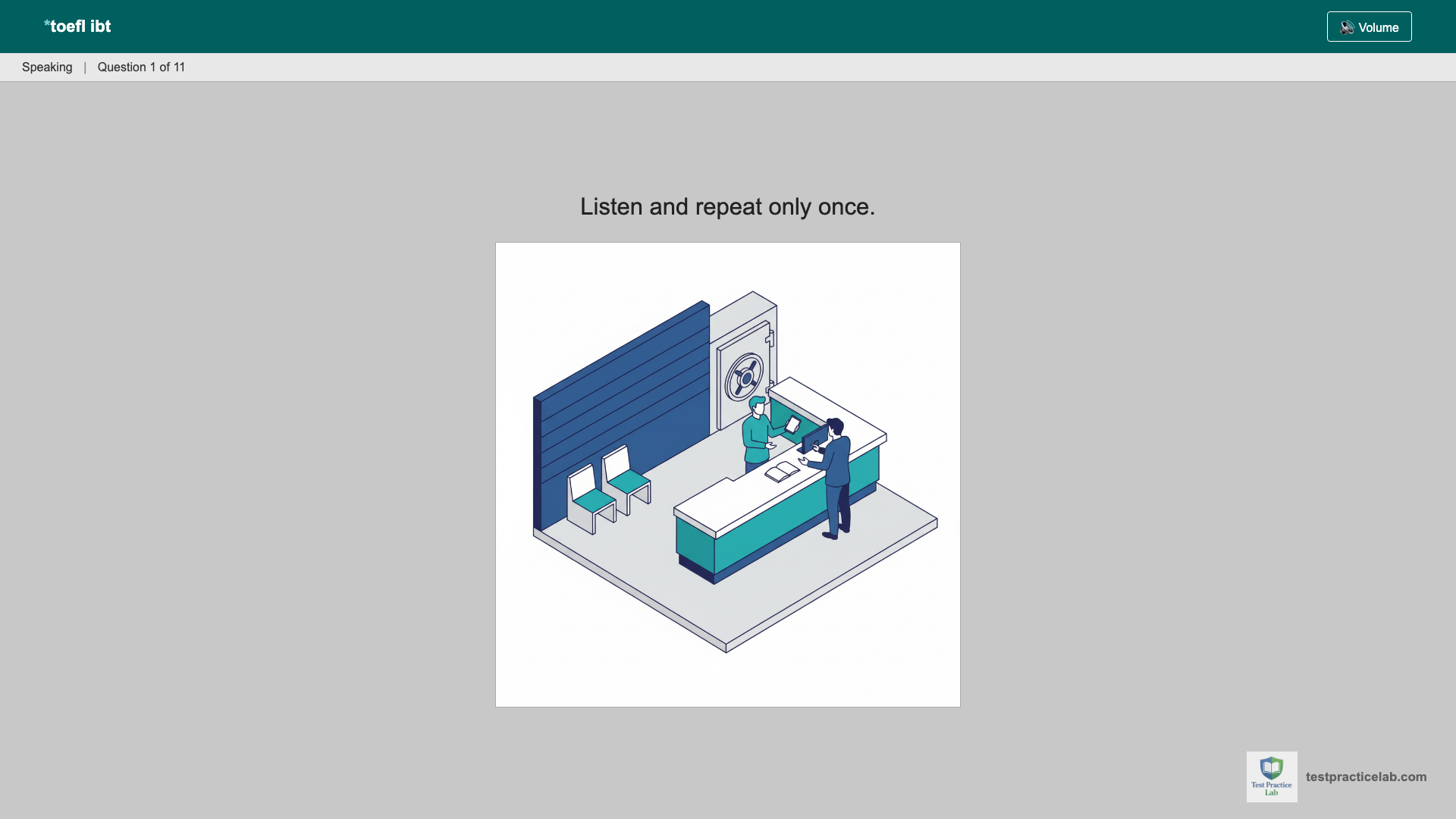
Show Answer
Welcome to our local branch today.
Show Answer
I can help you set up an account.
Show Answer
Please provide a valid form of identification to begin the process.
Show Answer
You will need to choose a secure password for your new debit card.
Show Answer
We require a small initial deposit to activate your savings account.
Show Answer
Before you leave, please review these documents and sign them at the bottom of every page.
Show Answer
If you have any further questions, feel free to contact our support team during business hours.
Take an Interview
Listen to each question and give a spoken response. You have 45 seconds for each answer, and there is no preparation time.
You have agreed to participate in an academic interview regarding your perspectives on immigration and the concept of national identity.
Thank you for joining me today. Please think back to a time when you had a meaningful interaction with someone from a different cultural background—such as a new neighbor, a classmate, or a colleague. What was the experience like, and how did it influence your understanding of what it means to belong to a community?
Start withI remember a time when…
Perfect answerScore 100
I remember a time when I was volunteering at a community center in Seoul and met this exchange student named Elena from Brazil. Honestly, at first, I was a bit hesitant because I wasn’t sure if we’d really connect, but we ended up working on a mural project together. It was such a **pivotal** moment for me because we spent hours debating how to represent our different values through art. Through those conversations, I realized that belonging isn’t about everyone sharing the same background; it’s actually about the willingness to embrace diverse perspectives. It was **profoundly** eye-opening to see how our unique stories could actually strengthen our collective identity. Because of this, I now believe that a community is at its best when it’s inclusive, proving that connection transcends cultural borders.
Good answerScore 80
I remember a time when I worked on a group project with an exchange student from Brazil. At first, I was a little nervous because we had different communication styles, but we ended up spending so much time together in the library. We talked about our lives and our families, and I realized that we actually shared a lot of the same values even though we came from different places. It was a really cool experience because it taught me that a community isn’t just about sharing the same background. It’s more about how people connect and support each other. So yeah, it made me feel like I could belong anywhere as long as I’m open to others.
People often feel differently about how much a country should adapt to accommodate new cultures. Some feel a nation should prioritize preserving its traditional customs, while others feel that embracing diversity strengthens a nation’s identity. How do you usually approach this topic in your own conversations? Why do you think you feel that way?
Start withIn my own experience, I…
Perfect answerScore 100
In my own experience, I’ve always leaned towards the idea that embracing diversity actually fortifies a nation’s identity rather than diluting it. I mean, look at my time living in Toronto; it’s such a vibrant mosaic where people from all over the world contribute to the local culture. It’s not just about coexistence, right? It’s about how these different backgrounds create a more resilient and innovative society. I think the fear that traditional customs will vanish is a bit misplaced because culture isn’t a static thing; it’s inherently fluid. When you welcome new perspectives, you’re not losing your roots, but rather, you’re gaining a more nuanced understanding of the world. Because of this, I tend to argue that a nation’s strength lies in its capacity to evolve, which is why I’m such a proponent of an inclusive approach to immigration.
Good answerScore 80
In my own experience, I usually think that embracing diversity is actually the best way for a country to move forward. Like, when I talk about this with my friends, I always say that a nation shouldn’t just stick to the past because things are always changing. If you only focus on old traditions, you might miss out on new ideas and different perspectives. So, I feel like bringing in new cultures makes a country stronger and more interesting. It’s not about losing your identity, but more about growing it. I guess I feel this way because I’ve seen how much more vibrant communities become when they are open to new people and their traditions.
Now I would like your opinion. Some people believe that national identity is primarily defined by shared traditions and language, while others argue that it is defined by shared values and legal principles. Which do you think is more important for a healthy society? Why?
Start withPersonally, I tend to believe…
Perfect answerScore 100
Personally, I tend to believe that shared values and legal principles are far more critical for a healthy society. You know, while traditions and language are lovely, they can sometimes be quite exclusionary. I mean, look at a place like Canada. It’s inherently a multicultural society, right? People from all over the world move there with different languages and backgrounds, yet the country remains incredibly stable because everyone is committed to the same core principles, like democracy and the rule of law. It’s this shared commitment that creates a cohesive society rather than just, you know, speaking the same language. I think relying solely on cultural markers is actually a bit outdated in our globalized world. As a result, prioritizing civic values is the most effective way to foster unity and ensure long-term stability in any diverse nation.
Good answerScore 80
Personally, I tend to believe that shared values and legal principles are way more important for a healthy society. You know, traditions and language are nice, but they can actually be pretty exclusionary. If a country is built on legal principles, like equality or justice, then anyone can join and belong, regardless of where they were born. It’s like, when you have a set of rules that everyone agrees to follow, it creates a really strong foundation for people from different backgrounds to live together. So, I think it’s much more sustainable for a modern, diverse society to focus on those values instead of just cultural things like that.
One last question. Do you think governments should implement policies that require new immigrants to complete specific cultural or language integration programs as a condition for citizenship? For instance, should they mandate classes on national history or local social norms? Why or why not?
Start withI believe that such policies…
Perfect answerScore 100
I believe that such policies are actually quite reasonable, honestly. I mean, when people move to a new country, there’s this inherent need for social cohesion, right? If immigrants understand the history and norms of their new home, it makes the transition so much smoother. For instance, I have a cousin who moved to Canada last year, and he had to take this mandatory civics course. At first, he thought it was a bit much, but he told me it helped him grasp the country’s values, which, in turn, helped him feel like he really belonged. It’s not about erasing their original identity; it’s about providing a framework for participation. Because of this, these programs are a pivotal step toward fostering a more inclusive society. So yeah, I’d say these requirements are fundamentally a good thing.
Good answerScore 80
I believe that such policies are actually a pretty good idea, honestly. I mean, if someone wants to become a citizen, they should probably understand the country they’re joining, right? So, having classes about national history or social norms helps them settle in much faster. It makes it easier for them to connect with their neighbors and avoid misunderstandings in daily life. I think it’s just a practical way to help people feel like they really belong. It’s not about changing who they are, but just giving them the tools to fit in better. So yeah, I’m in favor of it because it helps everyone get along and feel more comfortable in the community.
Every answer graded, for less than one tutoring lesson.
You heard the model answers. Record all 11 in a full TOEFL test and each one gets a band from 1 to 6 and a line by line note, like this sample.
I think it is important because hobbies makesmake people more creative inat work, and they come back more freshfresher.
That was one answer. Your full test has 11. Every one gets this.