TOEFL 2026 Speaking Practice — Level Hard (for score 100+) #01
Listen & Repeat · Take an Interview — full speaking practice with model answers at two score levels.
Watch & speak along
Play the video and answer out loud before you open the model answers.
Listen & Repeat
Listen to each sentence and repeat it out loud. Try to match the speaker’s pronunciation, rhythm, and speed.
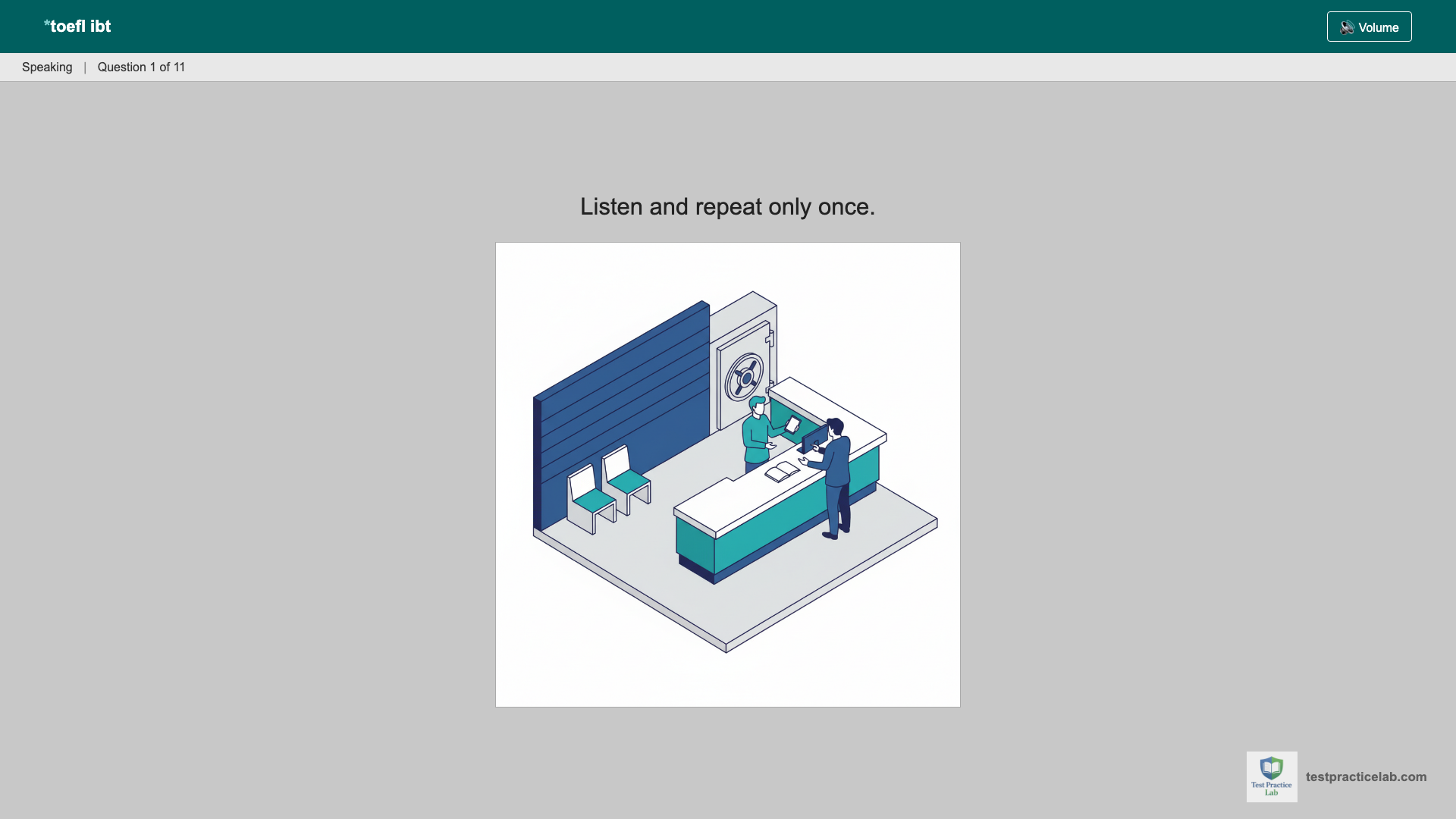
You are a customer service representative guiding a new client through the bank account opening process.
Show Answer
Welcome to our local branch office.
Show Answer
Please provide your government issued ID.
Show Answer
You will need to fill out these forms to start the official registration.
Show Answer
A small initial deposit is required to activate your new checking account.
Show Answer
Please create a secure personal password for your online banking access.
Show Answer
Once your paperwork is processed, you will receive your debit card by mail within seven business days.
Show Answer
Before you leave, please verify that all your contact information is accurate on this final summary sheet.
Take an Interview
Listen to each question and give a spoken response. You have 45 seconds for each answer, and there is no preparation time.
You have agreed to participate in an interview about your views on the effectiveness of the criminal justice system and the role of rehabilitation in society.

Thank you for joining me today. Please think back to a time when you read a news story, watched a documentary, or had a conversation about a person being released from prison. What was the situation, and how did that information change your perspective on whether rehabilitation is effective?
Start withI recall a time when…
Perfect answerScore 100
I recall a time when I watched this really compelling documentary about a guy named Marcus who had served ten years in prison. Honestly, before watching it, I kind of just assumed that prison was mostly about punishment, right? But the film showed his struggle to reintegrate into society, specifically how he was denied job after job because of his record. It made me realize that our current system is inherently flawed because it doesn’t really prepare people for life outside. Seeing him eventually succeed through a vocational training program completely shifted my view; it proved that rehabilitation isn’t just an idealistic concept. It’s actually a systemic necessity. Because of that, I’m now convinced that if we provide the right support, we can actually help people turn their lives around instead of just letting them fail.
Good answerScore 80
I recall a time when I watched a documentary about a man who was released from prison after serving ten years. At first, I thought that prison was just for punishment, so I didn’t really think about what happens after people get out. But the documentary showed how hard it was for him to find a job or even a place to live because people didn’t trust him. It made me realize that rehabilitation is actually super important because if they don’t get help, they might just end up in trouble again. So, it changed my mind because I see now that we need to support them if we want them to change.
People hold very different views on how to treat offenders; some prioritize strict punishment to deter crime, while others focus on educational programs and therapy to prevent reoffending. How do you usually approach this topic when discussing it with friends or family, and why do you think you have developed that perspective?
Start withIn my own discussions, I…
Perfect answerScore 100
In my own discussions, I tend to advocate for rehabilitation over purely punitive measures. It’s a bit of a nuanced take, but I feel that focusing solely on incarceration often overlooks the systemic issues that lead people to commit crimes in the first place. I actually developed this perspective after reading a compelling article about the Norwegian prison system, where they prioritize vocational training and mental health support. It’s counterintuitive to some, but the data shows that recidivism rates drop significantly when inmates are treated with dignity. I mean, if we just lock people away without providing tools for them to reintegrate, they’re almost destined to fail once they’re released. So, for me, prioritizing education isn’t just about empathy; it’s a pragmatic approach to creating a safer society for everyone involved.
Good answerScore 80
In my own discussions, I usually lean toward the idea that rehabilitation is better than just punishment. When I talk about this with my friends, I say that if we just send people to jail without any help, they’ll probably commit more crimes when they get out. So, it makes more sense to give them education or job training while they’re inside. I think I feel this way because I read a lot about how prisons are really crowded and don’t actually change anything. It just feels like a waste of money to keep them locked up without fixing the problem, you know? I really believe that helping them change is the best way to keep our communities safe.
Now I’d like your opinion. Some people argue that prisons should prioritize job training and mental health support over punitive confinement. Do you agree that rehabilitation should be the primary goal of the prison system, or is punishment more important? Why?
Start withPersonally, I feel that…
Perfect answerScore 100
Personally, I feel that rehabilitation should absolutely be the primary goal of the prison system. I mean, if we just focus on punishment, we’re essentially ignoring the systemic issues that lead people to commit crimes in the first place. For instance, I remember reading about a program in Norway where they focus entirely on vocational training and psychological support. As a result, they have one of the lowest recidivism rates in the world, which is pretty compelling evidence that this approach actually works. If we only prioritize confinement, we’re just setting individuals up to fail once they’re released. By investing in mental health and job skills, we’re not only helping the individual but also making our communities safer in the long run. So yeah, I’d say rehabilitation is definitely the more effective path forward.
Good answerScore 80
Personally, I feel that rehabilitation should definitely be the main goal of our prison system. I mean, if we just focus on punishment, people come out of prison without any real skills to help them find a job. So, they end up struggling and often go back to committing crimes because they feel like they have no other choice. It’s a bad cycle, right? But if we offer things like job training and mental health support, it gives them a better chance to turn their lives around. I think it’s just more practical to help them become productive members of society again instead of just locking them away and forgetting about them.
One last question. Do you think governments should invest more tax money into community-based rehabilitation programs rather than building more traditional prison facilities? For example, should we fund vocational schools for inmates instead of increasing security staff? Why or why not?
Start withI believe that it is…
Perfect answerScore 100
I believe that it is far more effective for governments to prioritize rehabilitation over simply expanding prisons. Honestly, the current system seems inherently flawed because it focuses on isolation rather than reintegration. If we invest in vocational training, we’re actually giving people a tangible path to employment. For instance, I read about a program in Norway where inmates learn high-tech manufacturing skills, and their recidivism rates are significantly lower than in traditional facilities. It’s a systemic shift; by teaching someone a trade, you’re not just punishing them, you’re preventing them from returning to crime. Not only that, but it’s more cost-effective in the long run than paying for constant security. So, I’m convinced that funding community-based programs is the only way to genuinely break the cycle of incarceration.
Good answerScore 80
I believe that it is better for the government to spend money on rehabilitation programs instead of building more prisons. You know, prisons are really expensive to run, and they don’t always help people change their behavior. If we fund vocational schools for inmates, they can actually learn useful skills while they are inside. Then, when they get out, they can find a job and support themselves instead of going back to crime. It just seems like a smarter way to use our tax money. I mean, we really need to focus on fixing the problems that cause people to commit crimes in the first place, and training is a great way to do that.
Every answer graded, for less than one tutoring lesson.
You heard the model answers. Record all 11 in a full TOEFL test and each one gets a band from 1 to 6 and a line by line note, like this sample.
I think it is important because hobbies makesmake people more creative inat work, and they come back more freshfresher.
That was one answer. Your full test has 11. Every one gets this.